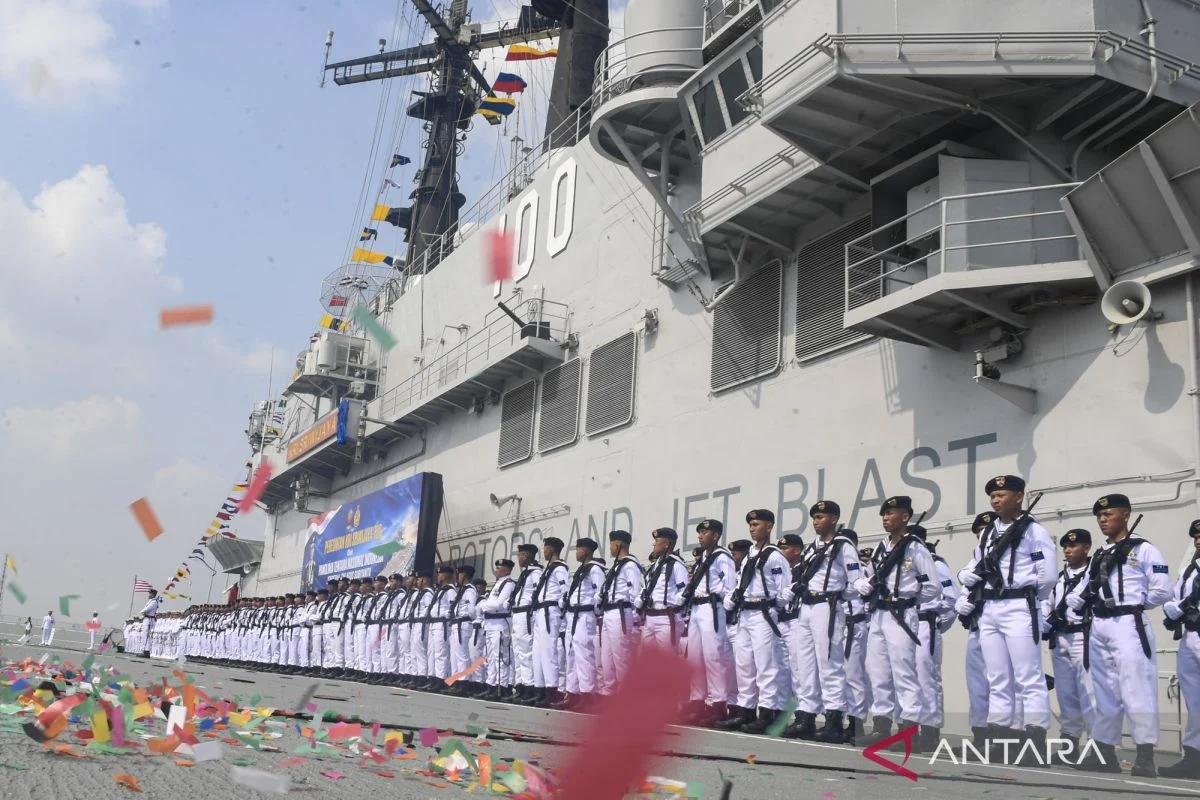
The arrival of the former Italian Navy aircraft carrier ITS Giuseppe Garibaldi at Pier 107 of Tanjung Priok Port in North Jakarta marks a historic milestone for the Indonesian National Armed Forces, particularly the Indonesian Navy (TNI AL). Docking on Friday, September 18, 2026, this significant naval acquisition represents a monumental shift in Indonesia’s maritime defense strategy, as the vessel is slated to become the first-ever aircraft carrier to operate under the Red and White flag. Formerly bearing the hull number C551 in the Italian fleet, the vessel will be officially commissioned and renamed KRI Sriwijaya during a high-profile handover ceremony scheduled for September 24, 2026, at the same port facility.
Chronology and Transition of the Italian Flagship
The acquisition of the ITS Giuseppe Garibaldi has been months in the making, reflecting deepening defense diplomacy between Jakarta and Rome. Following successful bilateral negotiations and preliminary inspections by Indonesian naval engineers, the vessel embarked on its strategic voyage from Italy to Southeast Asia earlier this year. Its arrival at Tanjung Priok Port immediately drew immense public and strategic attention, sparking nationwide discussions regarding Indonesia’s evolving naval capabilities.
The ceremonial transition will culminate on September 24, 2026, when the Italian flag is formally lowered and the Indonesian Red and White flag is hoisted aboard, officially designating the ship as KRI Sriwijaya. Following this, the Indonesian Navy plans to implement a series of intensive physical upgrades, structural modifications, and machinery overhauls. These refits are carefully designed to optimize the ship’s operational readiness, ensuring that its systems align seamlessly with the strategic doctrines and environmental demands of the Indonesian archipelago.
Decoding the Strategic Definition of an Aircraft Carrier
The arrival of KRI Sriwijaya has reignited public discourse concerning the fundamental nature, strategic utility, and tactical purpose of an aircraft carrier. In naval terms, an aircraft carrier transcends the classification of a standard surface combatant. While conventional warships—such as frigates, destroyers, and corvettes—rely primarily on surface-to-surface missiles, naval artillery, and torpedoes as their principal offensive and defensive measures, an aircraft carrier is fundamentally a mobile, floating airbase.
Defined structurally by its expansive flight deck, sophisticated aviation support systems, internal hangars, fuel storage facilities, and dedicated maintenance bays, an aircraft carrier projects air power far beyond traditional land-based boundaries. According to global naval doctrines, including those outlined by the United States Navy, these vessels serve as versatile instruments of national power. They are engineered to execute a wide spectrum of missions, ranging from high-intensity maritime strike operations and fleet air defense to routine maritime security patrols, power projection, and comprehensive humanitarian assistance and disaster relief (HADR).
Crucially, naval experts emphasize that sheer size alone does not qualify a vessel as a carrier. While KRI Sriwijaya possesses an impressive physical footprint, its true classification stems from its integrated aviation architecture. The ship is engineered to launch, recover, house, refuel, and service a multitude of rotary-wing and vertical/short takeoff and landing (V/STOL) aircraft simultaneously. This capability effectively transforms the vessel into a sovereign mobile airfield capable of operating in the open ocean, unconstrained by the geopolitical limitations or geographical distances inherent to fixed land-based runways.
Strategic Intent: Prioritizing Military Operations Other Than War (OMSP)
Despite its historical combat lineage with the Italian Navy—where it famously operated AV-8B Harrier II V/STOL jet fighters and diverse naval helicopters—the Indonesian Navy has articulated a distinct operational roadmap for KRI Sriwijaya. Chief of Staff of the Indonesian Navy (Kasal) Admiral TNI Muhammad Ali has clarified that the vessel will not immediately replicate the offensive, power-projection carrier strike group models utilized by Western superpowers. Instead, the primary focus for KRI Sriwijaya upon entering Indonesian service will center on Military Operations Other Than War (OMSP, Operasi Militer Selain Perang).
Given Indonesia’s unique geographic topology as the world’s largest archipelagic state—comprising over 17,000 islands spanning a vast maritime domain—rapid mobility and logistics present perennial challenges during national emergencies. The Ministry of State Secretariat and naval leadership have highlighted that KRI Sriwijaya will play an instrumental role in national disaster mitigation and humanitarian response.
In the event of natural disasters such as earthquakes, tsunamis, or volcanic eruptions that severely compromise regional infrastructure and sever vital land and sea access routes, KRI Sriwijaya will act as a heavily equipped floating logistics hub. By deploying heavy-lift helicopters and advanced unmanned aerial vehicles (UAVs) or drones directly from its flight deck, the Indonesian Navy can rapidly project relief supplies, establish field medical triage units, deploy emergency rescue personnel, and execute large-scale civilian evacuations to and from remote, otherwise inaccessible disaster zones.
Official Statements and Diplomatic Context
The acquisition of the Giuseppe Garibaldi has also been underpinned by extensive high-level diplomatic engagements. Reports from state news agency ANTARA confirm that state officials, including the Minister of State Secretariat, have coordinated closely with representatives of the Italian government and the Italian Navy regarding the handover process. President Prabowo Subianto’s administration is scheduled to receive a high-level Italian naval delegation to formalize the defense partnership, underscoring the strong diplomatic ties underpinning the bilateral transfer.
Admiral Muhammad Ali has addressed public curiosity regarding why Italy agreed to transfer such a prestigious asset to Indonesia, pointing to mutual strategic interests, defense industrial cooperation, and the robust diplomatic rapport cultivated between Rome and Jakarta. Furthermore, Indonesian naval leadership has expressed a keen interest in exploring future aviation integrations for the ship, specifically evaluating V/STOL aircraft and advanced rotary-wing platforms that can maximize the operational efficiency of the newly minted KRI Sriwijaya’s flight deck.
Broader Implications for Indonesia’s Defense Posture
The integration of KRI Sriwijaya into the TNI AL fleet carries profound implications for Indonesia’s broader defense and geopolitical posture in the Indo-Pacific region. As regional maritime dynamics grow increasingly complex, the possession of an aviation-capable capital ship significantly enhances Indonesia’s strategic deterrence, domain awareness, and maritime patrol capabilities across its three Archipelagic Sea Lanes (ALKI).
While critics and defense analysts debate the long-term sustainment costs and operational logistics associated with operating an aircraft carrier—traditionally considered among the most resource-intensive assets in modern naval warfare—the overarching consensus points to a paradigm shift in Indonesia’s blue-water naval aspirations. By prioritizing a dual-use operational profile that balances strategic deterrence with robust humanitarian response capabilities, Indonesia is positioning KRI Sriwijaya not merely as an instrument of combat, but as a versatile multi-mission flagship.
As the historic commissioning date of September 24, 2026, approaches, the eyes of the global defense community remain fixed on Tanjung Priok Port. The raising of the Red and White flag over the newly christened KRI Sriwijaya will signal a bold new chapter for the Indonesian Navy—one where maritime sovereignty, humanitarian readiness, and technological evolution converge on the decks of the nation’s first-ever aircraft carrier.