The boundaries of robotics and biomechanical engineering continue to expand as a team of innovative researchers at the prestigious Swiss Federal Institute of Technology (ETH Zurich) unveils a groundbreaking robotic appendage. Designed with unprecedented mobility, the newly developed mechanical hand possesses the uncanny ability to walk on its fingertips across various complex terrains. This technological marvel immediately draws striking visual and functional comparisons to Thing, the iconic, disembodied yet fiercely loyal hand from the classic pop-culture franchise The Addams Family, which has recently enjoyed a resurgence in global popularity through modern streaming adaptations.
While the aesthetic resemblance to a fictional horror-comedy trope offers a pop-culture touchstone for observers, the underlying engineering represents a serious leap forward in robotics. The primary objective of this research is to solve a long-standing logistical problem in field robotics: how to access tightly restricted, hazardous, or confined spaces that are entirely inaccessible to traditional wheeled or legged robots, and certainly too dangerous for human intervention.
Chronology and Development of the Fingertip-Walking Hand
The genesis of this project lies in the pursuit of adaptable modular robotics. Traditional robotic systems often require entirely bespoke, ground-up hardware designs for specific locomotion tasks. However, the ETH Zurich research team chose a different path, focusing instead on software innovation and hardware repurposing.
The foundational work on the project began several years ago as part of the institution’s broader initiative into soft robotics and dexterous manipulation. The core objective was to take an existing, commercially available robotic hand—designed primarily for grasping and industrial manipulation—and adapt its control algorithms to achieve dynamic locomotion without altering its physical structure.
The initial phase involved theoretical modeling and computer simulations to test whether disparate finger lengths, which mimic human anatomical variations, could be synchronized to achieve stable forward propulsion. By late 2023, the team successfully transitioned from simulation to physical prototyping. The research paper documenting these findings was subsequently published as a pre-print on arXiv, garnering immediate attention from both the academic community and international media outlets.
Technical Specifications and Operational Mechanics
Developing a mechanical hand capable of locomotion presented significant engineering hurdles. Unlike standard walking robots that benefit from symmetrical limbs and centralized centers of gravity, a robotic hand features opposable thumbs, varying finger lengths, and inherent asymmetry.
Amirhossein Kazemipour, a doctoral researcher and the lead author of the study, highlighted the inherent mechanical complexities during a technical demonstration. The walking motion often appears initially canggung, or awkward, precisely because the robotic digits are modeled after human hands, featuring unequal lengths and specialized articulation points.
"In addition, the hand must also maintain dynamic equilibrium while continuously interacting with various surface objects," Kazemipour explained.
To overcome these balance and coordination challenges, the engineering team developed a sophisticated internal software architecture. Unlike many modern robots that rely heavily on external optical sensors, computer vision, and cameras for spatial awareness, the ETH Zurich prototype operates via proprioceptive feedback and internal algorithmic coordination.
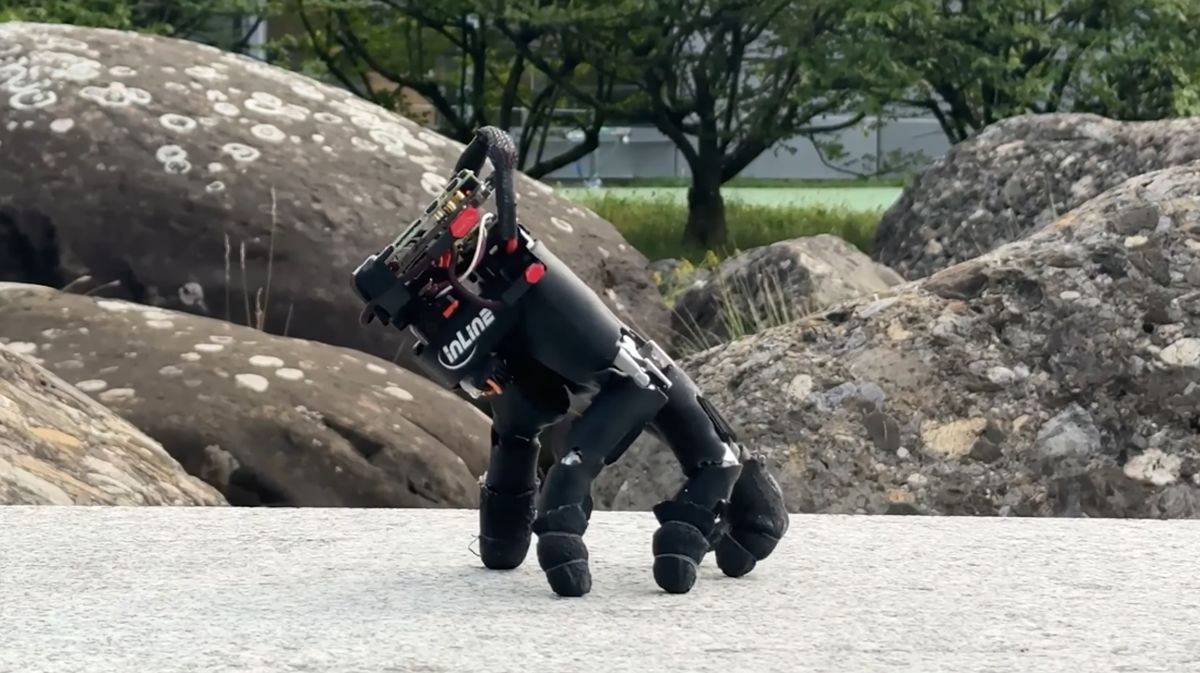
During rigorous laboratory testing, the robotic hand was subjected to a battery of movement trials. Operators commanded the device remotely using a standard video game controller (gamepad). The internal software seamlessly translated these high-level commands into precise finger-stepping sequences, effectively managing balance and weight distribution in real-time.
In formal performance evaluations, the robot successfully navigated across 14 distinct surface types. These included challenging textures such as uneven gravel, slick metallic sheeting, natural grass, and traditional hardwood flooring. Over the course of 21 experimental trials, the robotic hand maintained an impressive average velocity of 9.3 centimeters per second. While this speed is modest compared to wheeled drones or quadrupedal search-and-rescue dogs, it represents a remarkable feat of stabilization for a device operating entirely on fingertips.
Expert Insights and Long-Term Vision
The broader implications of this research extend far beyond laboratory demonstrations. Robert Katzschmann, a leading robotics expert and professor at ETH Zurich, envisions a future where autonomous systems are no longer bound by the rigid physical limitations of their primary chassis.
"In the future, a larger autonomous robot could dispatch one of its hands into a micro-space or confined cavity that the main chassis cannot physically enter, execute a task, and then retract the appendage once the operation is complete," Katzschmann stated, as reported by science and technology publications.
This modular approach addresses a critical bottleneck in industrial maintenance, search-and-rescue operations, and disaster response. For instance, in the aftermath of structural collapses, earthquakes, or industrial pipe failures, standard inspection robots frequently encounter narrow crevices or rubble-blocked entryways that halt their progress entirely. A mobile, autonomous robotic hand could detach from a parent drone or rover, crawl through the obstruction, retrieve a sample, inspect a valve, or clear a blockage, and subsequently reconnect.
To realize this ambitious vision, the research team at ETH Zurich has already outlined the next phases of development. The primary engineering goal moving forward is to engineer a reliable, automated docking and undocking mechanism. This system would allow the robotic hand to physically detach itself from a primary robotic host, operate completely untethered on battery power while performing remote locomotion tasks, and autonomously dock back onto the main unit to recharge and transfer collected data.
Broader Implications and Industrial Applications
The successful demonstration of a fingertip-walking robotic hand underscores a paradigm shift in how engineers approach mechanical dexterity. Historically, designers built specialized tools for specialized tasks—wheels for flat ground, treads for rough terrain, and grippers for manipulation. By combining locomotion and manipulation into a single, highly adaptable anatomical structure, the Swiss researchers are effectively blurring the line between how robots move and how they interact with their environment.
Economically and industrially, the implications are substantial. Manufacturing plants, nuclear facilities, and aerospace exploration programs frequently require maintenance in confined spaces where human entry carries extreme safety risks. Traditional robotic solutions for these environments are often prohibitively expensive and lack the versatility required to navigate unpredictable obstacles. By adapting commercially available robotic hands through advanced software control rather than building costly new hardware from scratch, this technology offers a scalable and cost-effective pathway toward widespread industrial adoption.
As the research moves past the arXiv pre-print stage and toward formal peer-reviewed publication and commercial prototyping, the scientific community eagerly awaits further field tests. Whether deployed in the deep reaches of space exploration or the hazardous confines of terrestrial infrastructure repair, the humble fingertip-walking hand developed in Switzerland promises to redefine the reach of modern robotics.