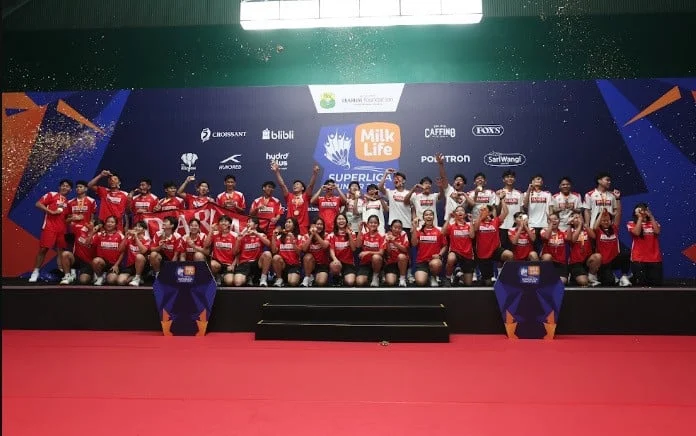
The curtains fell on the MilkLife Superliga Junior 2026 at the GOR Djarum in Jati, Kudus, with a display of unprecedented dominance by the host club, PB Djarum. In a historic performance that will likely be studied by badminton analysts for years to come, PB Djarum secured the title of overall champion by clinching five championship trophies across various age categories. The tournament, which concluded on Sunday, November 8, 2026, saw the club triumph in the U-15 girls, U-17 boys, U-17 girls, U-19 boys, and U-19 girls divisions. This singular achievement marks a watershed moment in the history of the Superliga Junior, as no other club has managed to sweep five distinct categories since the tournament’s inception in 2016.
A Historic Milestone in Junior Badminton
Since its debut a decade ago, the MilkLife Superliga Junior has evolved into a premier proving ground for young talent, bridging the gap between grassroots development and professional competition. The 2026 edition, held in the heart of Indonesia’s badminton hub, Kudus, provided a stage for clubs not just from Indonesia, but from around the globe to test their mettle. PB Djarum’s ability to secure victories across five categories signals a high level of operational efficiency and talent pipelines. The tournament’s structure, which emphasizes team-based formats—distinct from the traditional individual-based tournaments—allows for a deeper evaluation of a club’s collective depth and coaching philosophy.
The victory in the U-19 category was particularly symbolic, as the club successfully "married" the Liem Swie King Cup and the Susy Susanti Cup—two prestigious trophies named after Indonesian badminton legends. This dual victory serves as a testament to the balanced development of both male and female athletes within the organization.
The Path to Victory: A Chronological Analysis
The final day of competition was the culmination of a rigorous week of matches. In the U-19 boys’ final, PB Djarum faced the formidable PB Jaya Raya Jakarta, a perennial powerhouse in the national circuit. The clash was a tactical chess match that required grit and mental fortitude.
Radithya Bayu Wardana set the tone early for PB Djarum. His dominant performance against Maharishiel Timotius Gain in the first match resulted in a two-game victory, 15-9, 17-15. This momentum was sustained by the doubles pair Anju Siahaan and Muhammad Rizki Mubarrok, who extended the lead. Although PB Jaya Raya’s Nazwan Abdillah clawed back a victory for his team by defeating Yudha Rendra Wijaya in a tense three-game encounter (9-15, 15-3, 15-9), the comeback was short-lived. The deciding blow came from the pairing of Faizal Pangestu and Raihan Daffa Edsel Pramono, who edged out Akmal Nurrahman and Revand Harianto in a grueling 16-14, 11-15, 15-10 finale.
For the U-19 girls, the path to the Susy Susanti Cup was marked by clinical efficiency. Facing the international challenge of C.Y. Foundation Badminton from Chinese Taipei, the PB Djarum squad demonstrated their superior preparation. Hani Miftasari initiated the sweep, followed by a masterful performance from the doubles duo Atresia Naufa Candani and Aurelia Syakira Putri. Christabel Calista Purwanto cemented the 3-0 victory, ensuring the trophy remained in Kudus. Calista later remarked that the team’s familiarity with the Taipei side, having faced them earlier in the group stages, allowed for better tactical adjustments and less uncertainty during the pressure-filled final.
Strategic Insights from Team Management
Fung Permadi, the Team Manager of PB Djarum, attributed the success to a combination of disciplined training and the high intensity of the competition. In his post-match address, Permadi emphasized that while the club celebrates these five titles, the internal culture of PB Djarum mandates a cycle of continuous improvement.

"I observed that the players reached their peak performance at exactly the right time," Permadi stated. "However, a championship is not an endpoint but a reference point. We are currently conducting an internal audit of each match to identify areas of weakness that were masked by our wins. My hope for future iterations of this tournament is that we see an influx of even stronger international teams. For our athletes to reach the world stage, they must be tested by diverse playstyles from across the globe."
The players themselves echoed these sentiments. Radithya Bayu Wardana highlighted that the secret to the U-19 team’s six-year consecutive reign over the Liem Swie King Cup is not just technical skill, but psychological cohesion. "We train together, live together, and face setbacks together. When one of us fails on court, the rest of the team compensates. That support structure is what prevents a single lost game from spiraling into a lost series," Wardana explained.
Broader Implications for the Sport
The dominance of PB Djarum raises questions regarding the competitive landscape of Indonesian badminton. While the club’s success is a source of national pride, observers in the badminton community are calling for a broader distribution of talent. The challenge for the Indonesian Badminton Association (PBSI) and tournament organizers is to ensure that the competitive gap between elite clubs and the rest of the field does not widen to the point of stagnation.
Statistically, the 2026 tournament saw an uptick in tactical variety, with more focus on defensive transitions and mid-court speed compared to previous years. The international presence, including the C.Y. Foundation Badminton team, provided much-needed exposure for local athletes to styles that deviate from the traditional Indonesian "attack-first" approach.
Furthermore, the MilkLife Superliga Junior serves as a vital economic and cultural engine for Kudus. The influx of teams, support staff, and fans has turned the city into a temporary focal point for global junior sports. The economic impact, though yet to be quantified, is significant, with local infrastructure being stressed and tested by the high volume of participants.
Looking Toward the Future
As the dust settles, the implications of this tournament extend beyond the trophies. The scouting reports generated during the 2026 Superliga will likely influence the national team selection process for the next two years. Several young players who stood out in the U-15 and U-17 categories are now expected to be fast-tracked into national training camps.
The success of the 2026 MilkLife Superliga Junior confirms that the sport remains in a healthy state, characterized by high engagement and robust talent production. However, as Fung Permadi noted, the sustainability of this success depends on the willingness of the Indonesian badminton ecosystem to invite, embrace, and eventually overcome international competition. The 2026 edition was a triumph for PB Djarum, but it was also a milestone for the sport, setting a new benchmark for what junior badminton can look like on the global stage. As the players return to their daily training cycles, the focus shifts to the 2027 season, where challengers will undoubtedly be plotting their own path to dismantle the current hierarchy. For now, the banners in Kudus remain with PB Djarum, serving as a reminder of a week of dominance that will be remembered for its historical significance and the sheer quality of play displayed by the next generation of badminton icons.