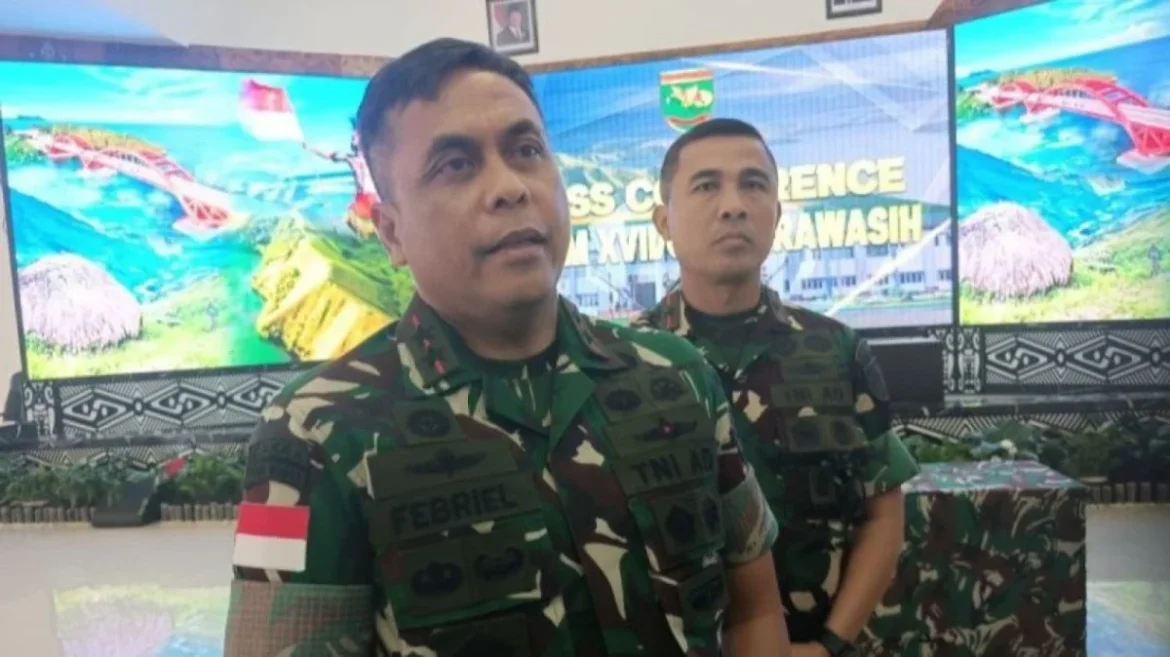
The formal establishment and inauguration of the new Military Area Command (Kodam) in Central Papua, strategically headquartered in Nabire, is officially scheduled to take place concurrently with the celebration of the 81st anniversary of the Indonesian National Armed Forces (TNI) on October 5, 2026. This monumental defense restructuring initiative was confirmed by the Pangdam XVII/Cenderawasih, Major General TNI Febriel Buyung Sikumbang, during a press briefing in Jayapura. The creation of this new regional command structure marks a significant milestone in the ongoing administrative and security reorganization of Indonesia’s easternmost regions, designed to optimize regional defense, enhance internal security coordination, and accelerate developmental support for local communities.
Strategic Scope and Territorial Jurisdiction of Kodam Papua Tengah
Under the newly formulated command structure, the incoming Kodam Papua Tengah will assume direct operational authority and administrative control over several key military sub-districts and tactical units operating within the administrative boundaries of the Central Papua Province. Major General Febriel elaborated that the new regional command will oversee the Korem 173/Praja Vira Braja (PVB), alongside a comprehensive network of District Military Commands (Kodim) strategically positioned across various regencies within the province.
The specific territorial units falling under the purview of Kodam Papua Tengah include the Kodim 1705/Nabire, Kodim 1703/Deiyai, Kodim 1718/Intan Jaya, Kodim 1714/Puncak Jaya, Kodim 1717/Puncak, and Kodim 1710/Mimika. This realignment aims to streamline the chain of command, reducing response times for localized security incidents and ensuring that military resources are distributed more equitably across rugged and challenging geographical terrain. By anchoring the headquarters in Nabire—a rapidly developing regional hub—the TNI seeks to project a stabilizing presence that supports both civilian governance and regional economic growth.
Force Restructuring and the Creation of Territorial Development Units
Alongside the inauguration of Kodam Papua Tengah, the Indonesian Army (TNI AD) is undertaking a broader force generation and restructuring initiative. This includes the establishment of two new Development Territorial Battalions (Batalyon Teritorial Pembangunan or Yon TP) and one Development Territorial Infantry Brigade (Brigif TP). These newly formed units will remain under the operational umbrella of the existing Kodam XVII/Cenderawasih to backfill the units that are being transitioned into the newly minted Central Papua command structure.

The restructuring plan ensures that the density of military personnel and operational readiness across the wider Papua region remains uncompromised during the transition. Military planners have emphasized that the inclusion of specialized territorial development units reflects a modern doctrinal shift within the TNI—one that balances traditional combat readiness with civil-military operations, infrastructure support, and community resilience-building.
Practical Impacts and Community Integration of Territorial Battalions
The effectiveness of the newly introduced structural models is already beginning to manifest at the grassroots level. According to Major General Febriel, the presence of the Development Territorial Battalions has yielded tangible benefits for local civilian populations residing near military installations. Personnel assigned to these units have increasingly been deployed to assist local civil defense and disaster management agencies in handling various emergencies, including structural fires, natural disasters, and land and forest fire (karhutla) mitigation efforts.
"The local communities have begun to tangibly experience the positive presence of the Territorial Development Battalions, which stand ready to assist the populace in their surrounding areas," stated Febriel. This civil-centric operational approach is designed to foster deeper trust and cooperation between indigenous populations and military personnel, aligning defense objectives with socio-economic development goals in remote and underserved regions.
National Military Expansion Framework and Strategic Implications
The creation of Kodam Papua Tengah does not occur in a vacuum; it is part of a sweeping, nationwide strategic initiative spearheaded by the Army Chief of Staff (KSAD), General TNI Maruli Simanjuntak. Earlier announcements by the army leadership confirmed plans for the establishment of five new regional commands across the archipelago, strategically distributed to address localized security paradigms, demographic shifts, and administrative expansions in provinces such as East Nusa Tenggara (NTT), the Special Region of Yogyakarta, and Papua.
Military analysts and defense observers have noted that the expansion of the Kodam network is a direct response to the decentralization of civilian administration in Indonesia, particularly the creation of new autonomous provinces in Papua (Papua Selatan, Papua Tengah, Papua Pegunungan, and Papua Barat Daya). By mirroring the civilian administrative divisions with synchronized military command structures, the central government and the TNI aim to improve inter-agency coordination, streamline bureaucratic processes related to national defense, and ensure a more agile response to potential security threats, ranging from localized armed separatist movements to transnational crime and natural disasters.

Chronology of Planning and Future Preparations
The realization of Kodam Papua Tengah is the culmination of extensive logistical, infrastructural, and administrative preparations that have been underway for months. Planning committees involving high-ranking officials from the Ministry of Defense, TNI Headquarters, and the Indonesian Army Staff (Mabesad) have conducted numerous site surveys in Nabire and surrounding districts to evaluate land acquisition, facility construction, housing for personnel, and communication networks.
As the target inauguration date of October 5, 2026—coinciding with the 81st anniversary of the TNI—rapidly approaches, final preparations are being accelerated. These efforts include the physical handover of military assets, the reassignment of personnel rosters, and the establishment of administrative protocols to ensure a seamless transition of authority from Kodam XVII/Cenderawasih to the new headquarters in Nabire.
Conclusion and Outlook
The official launch of Kodam Papua Tengah represents a pivotal chapter in Indonesia’s ongoing defense modernization and territorial management strategy. By embedding command structures closer to the administrative centers of the newly formed provinces, the TNI is positioning itself to better address the unique socio-political and geographical dynamics of Papua. As preparations enter their final stages ahead of the October deadline, all eyes remain on Nabire to witness the formal birth of a command structure intended to reinforce regional stability, foster community development, and safeguard national sovereignty in eastern Indonesia.