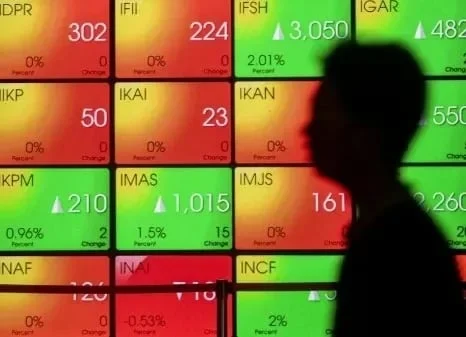
The Jakarta Composite Index (IHSG) concluded trading on Tuesday, July 21, 2026, with a significant rally, closing firmly in positive territory. The benchmark index surged by 1.74% to reach a robust level of 6,340, marking a strong performance driven by widespread gains across most sectors and a substantial transaction value. This upward momentum reflects a prevailing optimism among investors regarding the Indonesian market’s resilience and growth prospects, particularly as the nation navigates its economic trajectory in the mid-2020s.
Detailed Market Performance on a Dynamic Trading Day
The trading session on Tuesday was characterized by high activity and a decisive shift towards positive sentiment. The IHSG’s climb to 6,340 was underpinned by a healthy market breadth, with advancing stocks significantly outnumbering decliners. Specifically, 439 stocks registered gains, demonstrating a broad-based buying interest across various market segments. In contrast, 221 stocks experienced declines, while 305 shares remained unchanged, indicating a clear bullish bias for the day. The total volume of transactions reached an impressive 47.7 billion shares, with a corresponding trade value of Rp21.4 trillion (approximately USD 1.35 billion, assuming an exchange rate of Rp15,800/USD for illustrative purposes in 2026). This robust transaction value underscores strong liquidity and conviction among market participants, suggesting that the gains were not merely superficial but supported by substantial capital inflows.
Beyond the main IHSG, several other key indices also mirrored the positive trend, reinforcing the overall market strength. The LQ45 Index, which tracks the 45 most liquid and largest market capitalization stocks, advanced by 1.42% to close at 636. This indicates that blue-chip companies, often considered bellwethers of the economy, were actively sought after by investors. The Jakarta Islamic Index (JII), comprising sharia-compliant stocks, posted an even stronger gain of 1.84%, reaching 381, reflecting growing investor confidence in ethical and halal investment opportunities. Similarly, the IDX30 Index, representing 30 stocks with high liquidity and market capitalization, rose by 1.10% to 358, while the MNC36 Index, tracking another set of 36 liquid stocks, climbed 1.27% to 278. The synchronized movement across these diverse indices signals a comprehensive market-wide upturn, rather than isolated sector-specific movements.
Sectoral Dynamics: A Broad Green Wave
A distinguishing feature of Tuesday’s trading was the almost universal positive performance across industrial sectors. The majority of the sectoral indices closed in the green, signaling a widespread improvement in investor sentiment regarding various segments of the Indonesian economy. Leading the charge were sectors such as Energy, Raw Materials, Industry, Cyclical Consumer, Infrastructure, Property, Transportation, Non-Primary Consumer, Finance, and Technology.
The Energy sector’s leadership could be attributed to several factors, potentially including a rebound in global commodity prices, renewed optimism regarding Indonesia’s renewable energy transition initiatives, or increased demand for traditional energy sources. Raw Materials likely benefited from strong industrial output forecasts and global supply chain reconfigurations. The Industrial sector’s gains often reflect improved manufacturing activity and capital expenditure. Cyclical Consumer and Non-Primary Consumer sectors’ strength suggests increasing consumer spending and confidence, a vital indicator of economic health. Infrastructure and Property sectors continue to benefit from the Indonesian government’s sustained focus on national development projects and urban expansion, which attract significant investment. Transportation’s positive movement could be linked to increased mobility, tourism recovery, and improved logistics efficiency. The Finance sector, a cornerstone of any economy, likely gained from robust lending growth expectations and stable interest rate environments. Finally, the Technology sector’s continued upward trajectory underscores the ongoing digital transformation in Indonesia and the growing adoption of technological solutions across various industries.
In stark contrast to the broad market rally, the Health sector was the sole exception, closing in negative territory. This isolated decline could stem from various factors, such as specific regulatory changes impacting pharmaceutical pricing, profit-taking after previous strong gains, or concerns about a shift in healthcare spending patterns. It could also reflect a rebalancing of portfolios as investors rotated capital into other, currently more favored, growth sectors.
Chronology of a Bullish Trading Day
The bullish sentiment for the IHSG was evident from the start of the trading day on Tuesday, July 21, 2026. The index opened with a positive trajectory, building on momentum from previous sessions. According to earlier reports, the IHSG had commenced the day by climbing 0.67% to a level of 6,273. This initial upward push set the tone for the entire day, indicating that investors were already positioned for gains.
Throughout the morning session, the index demonstrated resilience, holding onto its initial gains and gradually extending them as more positive cues emerged. Mid-day saw continued buying interest, with intermittent profit-taking quickly absorbed by fresh demand. The afternoon session witnessed an acceleration of the rally, as investors consolidated their positions ahead of the closing bell. This late-day surge is often indicative of strong institutional buying and a conviction that the positive trend would continue. The final hours of trading saw the IHSG push towards its closing high of 6,340, solidifying its significant daily gain and reflecting a strong end-of-day buying spree that left the market with robust momentum.
Contextual Background: Indonesia’s Economic Landscape in 2026
Indonesia’s economic narrative in 2026 is one of sustained growth and strategic development, positioning the nation as a key player in the regional and global economy. The IHSG, as the primary barometer of the Indonesian stock market, reflects the underlying health and prospects of this dynamic economy. Historically, the IHSG has experienced periods of significant volatility, influenced by global economic cycles, commodity price fluctuations, and domestic political stability. However, the mid-2020s have seen Indonesia prioritize economic diversification, infrastructure development, and digital transformation, aiming for sustainable and inclusive growth.
In 2026, Indonesia’s Gross Domestic Product (GDP) growth is projected to remain robust, buoyed by strong domestic consumption, increasing foreign direct investment, and a rebound in key export commodities. Inflation is likely to be managed within the central bank’s target range, supported by prudent monetary policies from Bank Indonesia and stable supply chains. The government’s continued commitment to infrastructure projects, including new capital city development, transportation networks, and digital infrastructure, creates a fertile ground for investment in the construction, property, and technology sectors. Furthermore, Indonesia’s demographic dividend, with a large and relatively young population, continues to drive domestic demand and provide a substantial labor force. Global factors, such as the trajectory of major economies (US, China, Europe), geopolitical stability, and global interest rate environments, invariably play a role, but Indonesia’s strong domestic fundamentals often provide a buffer against external shocks.
Driving Factors Behind the Rally
Several intertwined factors likely contributed to the IHSG’s strong performance on July 21, 2026.
Firstly, positive investor sentiment played a crucial role. Both domestic retail and institutional investors, alongside a likely increase in foreign capital inflows, showed confidence in the market’s trajectory. This confidence could be fueled by optimistic corporate earnings reports from key companies, which might have been released in the preceding weeks or are anticipated in the near future. Strong earnings signals often act as significant catalysts for stock price appreciation.
Secondly, macroeconomic stability and growth projections for Indonesia in 2026 provided a solid foundation. If recent economic data releases indicated favorable trends in areas like manufacturing output, trade balance, or consumer confidence, these would undoubtedly encourage buying activity. Government policies aimed at improving the investment climate, such as deregulation, tax incentives, or sector-specific growth initiatives, would also bolster investor appetite.
Thirdly, global market dynamics might have offered supportive cues. A generally positive trend in major global indices, or stability in commodity markets (especially for Indonesia’s key exports like palm oil, coal, and nickel), would create a conducive external environment for the IHSG. Conversely, any easing of global inflationary pressures or a stable global interest rate outlook would also contribute to risk-on sentiment in emerging markets like Indonesia.
Fourthly, technical analysis indicators could have triggered further buying. The IHSG’s ability to break through key resistance levels, or its successful defense of support levels in previous sessions, might have signaled a bullish trend continuation to technically-minded traders, leading to increased position-taking. The high transaction volume and value further validate the conviction behind these technical signals.
Lastly, sector-specific catalysts cannot be overlooked. For instance, the leading performance of the Energy and Technology sectors might have been propelled by specific company announcements, new project developments, or favorable policy changes impacting these industries. An increase in the adoption of electric vehicles boosting demand for nickel, or new policies promoting renewable energy, could explain the strength in the energy and raw materials sectors. Similarly, advances in digital payment systems or e-commerce platforms could drive the technology sector.
Statements and Expert Reactions
The robust performance of the IHSG has garnered positive reactions from market analysts and economists. "Today’s rally underscores the fundamental strength and resilience of the Indonesian economy," stated Dr. Budi Santoso, a prominent market strategist at a leading Jakarta-based investment firm. "We are seeing a broad-based recovery and sustained growth momentum across key sectors. The significant transaction volume indicates that this is not merely speculative buying but rather a genuine accumulation of positions by both institutional and retail investors who see long-term value."
An economist, Dr. Citra Dewi from a major research institute, added, "The positive movement in the IHSG, especially with the LQ45 and JII indices also performing strongly, suggests that investor confidence is high, supported by stable macroeconomic indicators and proactive government policies. The slight weakness in the health sector could be a temporary rotation, or perhaps a sector-specific adjustment, and does not detract from the overall bullish outlook for the Indonesian market."
Officials from the Indonesia Stock Exchange (IDX) are also likely to view the day’s performance favorably. A spokesperson, speaking on condition of anonymity, might have commented, "We are pleased to see the continued dynamism of the Indonesian capital market. The strong closing today reflects the growing attractiveness of our market to both domestic and international investors, and we remain committed to fostering a transparent and efficient trading environment."
Broader Implications and Future Outlook
The strong close of the IHSG on July 21, 2026, carries several significant implications for the Indonesian economy and its capital markets.
Firstly, it serves as a powerful indicator of enhanced investor confidence. A consistently rising market encourages both domestic and foreign capital to flow into the country, which is crucial for funding economic growth, infrastructure projects, and corporate expansion. This influx of capital can lead to job creation and further economic development.
Secondly, the broad-based nature of the rally, with almost all sectors participating, suggests a healthy and diversified economic growth trajectory. It indicates that the growth is not concentrated in just one or two sectors, but rather spread across various industries, making the economy more resilient to sector-specific downturns.
Looking ahead, the market could experience a period of consolidation or continued upward momentum. While significant gains often lead to profit-taking in subsequent sessions, the robust underlying fundamentals and strong transaction volumes suggest that any pullbacks might be temporary and seen as buying opportunities by long-term investors. Analysts will closely monitor future corporate earnings reports, global economic developments, and any new policy announcements from the Indonesian government or Bank Indonesia for further cues.
Potential challenges include the persistent threat of global economic slowdowns, inflationary pressures that could prompt tighter monetary policies, or unforeseen geopolitical events. However, Indonesia’s large domestic market, abundant natural resources, and strategic geopolitical position generally provide a strong foundation to navigate such complexities. The focus on digital transformation, green economy initiatives, and human capital development will likely continue to drive long-term investment opportunities, making the Indonesian market an attractive proposition for sustained growth in the years to come. The performance on this Tuesday provides a snapshot of a market that is not only recovering but actively charting a course for robust expansion.