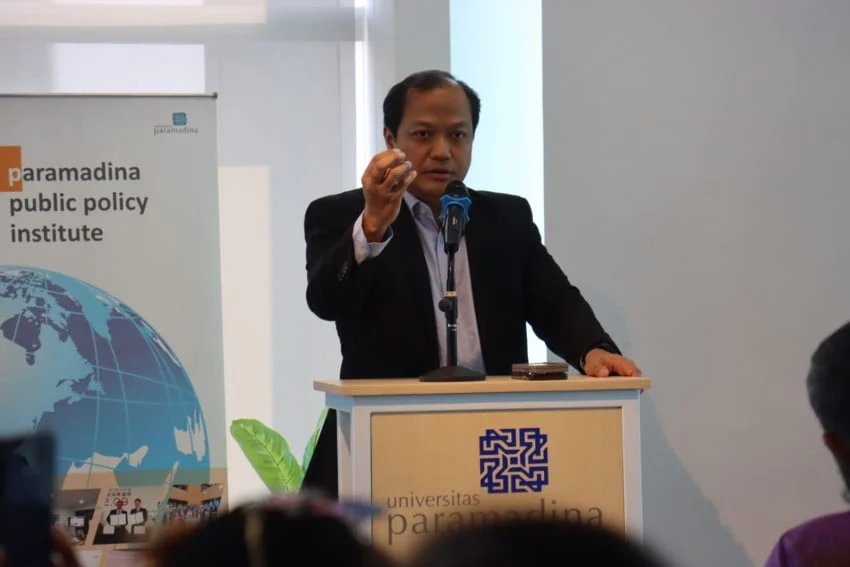
The political horizon of the United States is already beginning to shift as early indicators for the 2028 Presidential Election suggest a fundamental transformation within the Democratic Party, prompting international observers to urge nations like Indonesia to begin recalibrating their diplomatic strategies. Although the election remains two years away, the internal dynamics of the Democratic primary are revealing a departure from traditional "establishment" dominance toward a more polarized contest between progressive and moderate factions. Ahmad Khoirul Umam, a prominent international relations expert and Director of the Paramadina Graduate School of Diplomacy (PGSD) at Paramadina University, has highlighted that these shifts are not merely about personality politics but represent a significant battle for the ideological soul of the party that will eventually dictate American foreign policy in the late 2020s and beyond.
According to the latest data from the Granite State Poll conducted by the University of New Hampshire (UNH) Survey Center, the early frontrunners for the Democratic nomination in 2028 are experiencing diverging fortunes. The most notable development is the surge of Alexandria Ocasio-Cortez (AOC), whose support among potential primary voters has jumped from 14% to 22%. This rise places her at the vanguard of the progressive wing, signaling that the grassroots base of the party is increasingly hungry for systemic change. Simultaneously, Pete Buttigieg, the current Secretary of Transportation, has maintained a stable and formidable base of support, hovering between 19% and 21%. This stability suggests that the moderate wing of the party remains a potent force, favoring incrementalism and pragmatic governance over radical structural shifts.
The Erosion of the Political Establishment
Perhaps the most significant revelation from recent polling is the waning influence of the "establishment" wing, represented by figures such as Vice President Kamala Harris and California Governor Gavin Newsom. Historically, the sitting Vice President or the governor of the nation’s most populous state would be considered the natural heir to the party leadership. However, the UNH survey indicates a marked decline in their support. This trend suggests that the traditional power structures within the Democratic Party are losing their grip on the electorate, as voters look toward figures who represent more distinct ideological poles rather than the centrist "status quo."
Umam identifies three primary "axes of power" currently vying for control of the Democratic narrative. The first is the Progressive Democrats, led by Alexandria Ocasio-Cortez and veteran Senator Bernie Sanders. This faction prioritizes aggressive climate action, wealth redistribution, and a fundamental rethinking of American capitalism. The second is the Moderate Democrats, epitomized by Pete Buttigieg and Pennsylvania Governor Josh Shapiro, who focus on broad-based economic appeal, infrastructure, and maintaining a steady hand on the levers of government. The third is the Establishment Democrats, including Harris and Newsom, who represent the continuity of the Biden-era policies but are currently struggling to ignite enthusiasm among the younger and more ideological demographics.
Implications for Indonesian Foreign Policy
The internal restructuring of American politics has profound implications for Indonesia, a nation that has long maintained a "free and active" (bebas-aktif) foreign policy. Umam warns that Indonesia cannot afford to be a passive observer of these developments. The outcome of the 2028 election will determine the United States’ stance on critical issues such as the Indo-Pacific security architecture, global trade regulations, and environmental standards—all of which directly impact Indonesia’s national interests.
Indonesia’s strategic positioning between the United States and China requires a nuanced understanding of which faction holds power in Washington. A progressive-led administration under a figure like Ocasio-Cortez might place a heavier emphasis on human rights, labor standards, and environmental protections as prerequisites for trade and diplomatic cooperation. Conversely, a moderate administration led by Buttigieg or Shapiro might prioritize regional stability and economic partnerships that counter Chinese influence through more traditional diplomatic and military frameworks.
The urgency for Indonesia to engage with these emerging political realities was echoed by other figures in the Indonesian political landscape. Anis Matta, a senior political figure, recently commented on the necessity of a proactive foreign policy, stating that Indonesia should not only reach out to global powers when it faces immediate problems. Instead, he argued for a consistent and long-term engagement strategy that anticipates shifts in global leadership before they occur. This sentiment aligns with Umam’s analysis that the "face" of U.S. policy after 2028 is being shaped today in the primary polls of New Hampshire and the ideological debates of the Democratic National Committee.
A Chronology of the 2028 Democratic Evolution
The road to the 2028 election is paved with several key milestones that have led to the current state of fragmentation. Following the 2024 election cycle, the Democratic Party entered a period of intense soul-searching. While the Biden administration focused on post-pandemic recovery and infrastructure, the base of the party began to diverge on issues such as the conflict in the Middle East, student debt, and the pace of the energy transition.
By mid-2025, the "shadow primary" had begun in earnest. Potential candidates started making frequent visits to early primary states like New Hampshire and South Carolina, not to campaign for 2024, but to build the infrastructure for 2028. It was during this period that the "Buttigieg-Shapiro" moderate alliance began to solidify, presenting a vision of "competent liberalism" that sought to win over suburban voters and the industrial Midwest.
In early 2026, the rise of the progressives became undeniable. Alexandria Ocasio-Cortez, moving beyond her role as a firebrand legislator, began to build a national fundraising and organizational apparatus. Her ability to translate social media influence into polling numbers—as seen in the 8% jump in the Granite State Poll—marked a turning point where the progressive wing moved from being a "vocal minority" to a legitimate contender for the party’s nomination.
Comparative Data: Analyzing the Candidates’ Profiles
To understand the stakes of the 2028 contest, it is essential to look at the profiles and policy leanings of the three main factions:
-
The Progressive Axis (AOC/Sanders):
- Economic Policy: Support for a "Green New Deal," universal healthcare (Medicare for All), and significant tax increases on high earners and corporations.
- Foreign Policy: A move toward "restraint" in military interventions, a focus on global climate justice, and a more critical view of traditional alliances if they conflict with human rights values.
- Indonesian Impact: High pressure on Indonesia regarding deforestation, nickel mining standards, and labor rights.
-
The Moderate Axis (Buttigieg/Shapiro):
- Economic Policy: Focused on "middle-out" economics, private-public partnerships for infrastructure, and maintaining American competitiveness in the tech sector.
- Foreign Policy: Strong support for multilateralism, strengthening the "Quad" (U.S., Japan, Australia, India), and a pragmatic approach to the South China Sea.
- Indonesian Impact: A likely continuation of the Indo-Pacific Economic Framework (IPEF), focusing on supply chain resilience and security cooperation.
-
The Establishment Axis (Harris/Newsom):
- Economic Policy: Continuity of Biden-era industrial policy and social safety net expansions.
- Foreign Policy: Traditional liberal internationalism, emphasizing the defense of democratic norms and existing security treaties.
- Indonesian Impact: Predictable diplomatic relations but potentially less focus on the specific regional nuances required to navigate the ASEAN-U.S. relationship.
Economic and Geopolitical Context
The United States remains one of Indonesia’s largest trading partners and a vital source of foreign direct investment (FDI). In 2023 and 2024, bilateral trade between the two nations reached record levels, driven largely by American interest in Indonesia’s critical minerals and the digital economy. However, the "America First" tendencies that have permeated both sides of the U.S. political aisle mean that trade deals are no longer guaranteed.
If the Progressive wing gains power, Indonesia may find itself under increased scrutiny regarding its environmental, social, and governance (ESG) scores. The U.S. could implement carbon border adjustment mechanisms or stricter import requirements that could hamper Indonesia’s goal of becoming a global hub for electric vehicle (EV) battery production. On the other hand, a Moderate administration might be more willing to grant Indonesia "Limited Free Trade Agreement" status for certain minerals to ensure the U.S. supply chain remains independent of China.
Furthermore, the security dynamics in the Indo-Pacific are at a crossroads. Indonesia’s leadership in ASEAN is crucial for maintaining regional stability. A U.S. administration that is too focused on internal ideological battles may neglect the diplomatic heavy lifting required to engage with Southeast Asia, leaving a vacuum that other regional powers may seek to fill.
The Strategic Path Forward for Jakarta
Ahmad Khoirul Umam’s analysis serves as a wake-up call for the Indonesian Ministry of Foreign Affairs and the incoming Indonesian administration. The shift in U.S. domestic politics is not a distant phenomenon; it is a leading indicator of future global trends. Indonesia must diversify its diplomatic outreach by engaging not just with the current U.S. administration, but with the intellectual and political hubs of all three Democratic factions, as well as their Republican counterparts.
The "bebas-aktif" doctrine must evolve into a "proactive-anticipatory" stance. This involves:
- Broadening Engagement: Establishing dialogues with emerging leaders like Josh Shapiro or Alexandria Ocasio-Cortez to ensure they understand Indonesia’s strategic importance.
- Economic Resilience: Accelerating domestic reforms to meet higher international standards, thereby making Indonesia a "no-brainer" partner for any U.S. administration, regardless of its ideological leaning.
- Regional Leadership: Strengthening ASEAN’s collective bargaining power so that the bloc remains central to U.S. foreign policy planning.
As the 2028 U.S. Presidential Election approaches, the world will be watching a superpower in the midst of a profound identity crisis. For Indonesia, the challenge will be to navigate the waves of American political change without losing its own sovereign course. The data from the Granite State Poll is just the beginning of a long and unpredictable journey toward 2028, and for Jakarta, the time to prepare is now.