The security situation in Indonesia’s easternmost provinces remains a matter of intense strategic focus as joint military forces successfully intercepted and apprehended a high-ranking insurgent leader. In a decisive counter-terrorism and internal security operation, personnel from the 462nd Commando Battalion of the Indonesian Air Force (Yon 462 Pasgat) alongside the Mandala Operational Command Task Force (Satgas Mandala) of Koops TNI Habema—operating under the direct command of the Joint Regional Defense Command III (Kogabwilhan III)—successfully captured Abdon Kisamdu. Kisamdu serves as the Deputy Battalion Commander (Wadanyon) of the West Papua National Liberation Army-Free Papua Organization (TPNPB-OPM) under the 35th Bintang Timur Regional Defense Command (Kodap).
The high-stakes arrest took place on Saturday, September 19, 2026, precisely at 14:59 WIT (Eastern Indonesia Time), at the Nop Goliat Dekai Airport in Yahukimo Regency, Papua Pegunungan Province. The operation marks a significant blow to the logistics and command structure of armed separatist factions operating in the rugged highlands of Papua, particularly given the suspect’s active role in procuring illicit firearms to escalate armed campaigns in the region.
Chronology of the Nop Goliat Dekai Airport Operation
According to official briefings released by military authorities, the operation was executed with precision and high-level intelligence coordination. Abdon Kisamdu had been flagged by law enforcement agencies for an extended period, appearing prominently on the Wanted List (DPO) issued by the Indonesian National Police (Mabes Polri) due to his alleged involvement in numerous security breaches and violent incidents.
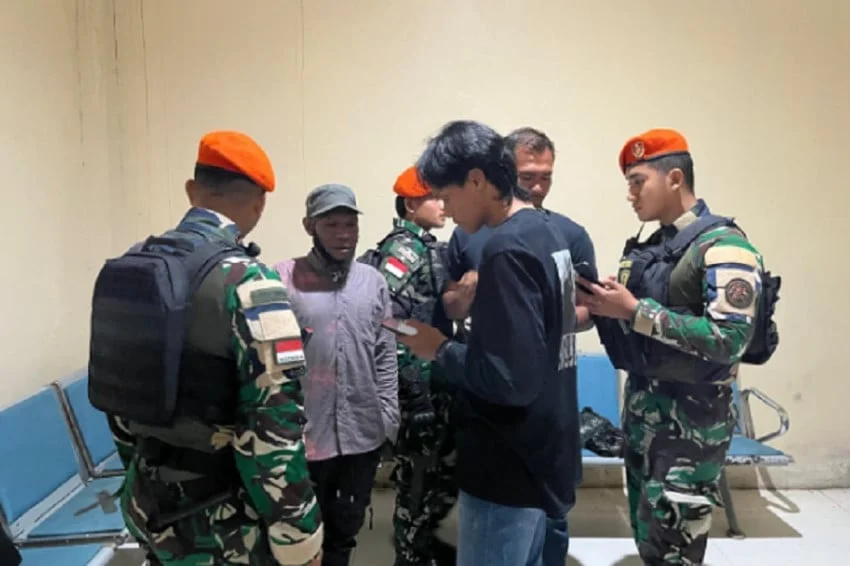
Intelligence units tracking Kisamdu’s movements determined that he was traveling via commercial aviation. Acting on real-time intelligence feeds, units from Yon 462 Pasgat and Satgas Mandala mobilized to Nop Goliat Dekai Airport well in advance of the flight’s arrival. Security personnel systematically secured all primary access points, exits, and perimeters of the airport terminal to prevent any potential escape or armed standoff in a civilian zone.
The target was identified aboard Trigana Air commercial passenger flight PK-YSC, a Boeing 737-500 aircraft operating the regional route into Yahukimo. As the aircraft touched down and taxied to the terminal, military personnel maintained a discreet yet robust containment posture. Moments after Kisamdu disembarked from the aircraft and entered the terminal area, joint task force operatives moved in swiftly. The arrest was executed without casualties or significant disruption to other civilian passengers.
Following the apprehension, Kisamdu was immediately escorted to a secure isolation room within the Nop Goliat Dekai Airport facility for initial questioning and security processing. A preliminary search yielded digital communications and mobile devices that corroborated intelligence reports regarding his illicit mission. During initial interrogations, Kisamdu openly admitted that his primary objective in traveling to Dekai was to orchestrate a major acquisition of military-grade firearms and ammunition from illegal suppliers operating in the Kali Seng area of Yahukimo.
Background Context: The Threat of TPNPB-OPM Kodap 35 Bintang Timur
The apprehension of Abdon Kisamdu highlights the persistent security challenges faced by the Indonesian state in the Papua Pegunungan (Mountainous Papua) region. The TPNPB-OPM Kodap 35 Bintang Timur has long been identified by security analysts and defense officials as a primary catalyst for instability in the mountainous terrain of the Bintang Regency and surrounding areas.
Kodap 35 has been linked to a series of coordinated attacks against both security forces and civilian infrastructure. These include ambushes, extortion, the destruction of public facilities, and targeted violence designed to undermine state authority and terrorize local populations. The procurement of illicit firearms—often smuggled across porous international borders or acquired through domestic black-market networks involving corrupt elements—remains the lifeblood of these insurgent groups.
Military intelligence experts emphasize that the interception of Kisamdu likely averted a catastrophic escalation of violence. Had the transaction at Kali Seng been successfully concluded, the influx of advanced weaponry would have significantly enhanced the tactical capabilities of Kodap 35, posing an immediate threat to the lives of indigenous civilians, transmigrants, and deployed military and police personnel alike.
Official Statements and Military Assessments
Panglima Komando Gabungan Wilayah Pertahanan (Pangkogabwilhan) III, Lieutenant General TNI Lucky Avianto, provided detailed insights into the significance of the operation during a subsequent media briefing. General Avianto underscored the meticulous planning that preceded the arrest and reiterated the military’s commitment to upholding the rule of law while neutralizing threats to national security.
"Abdon Kisamdu has been a primary target on the National Police’s DPO list for his extensive involvement in criminal and separatist activities," stated Lieutenant General TNI Lucky Avianto. "Our personnel executed the containment and apprehension protocols flawlessly at Nop Goliat Dekai Airport. The suspect was intercepted stepping off the Trigana Air flight and was secured immediately. Upon preliminary inspection of his electronic devices and subsequent questioning, he readily admitted that his sole purpose for traveling to Dekai was to conduct a wholesale transaction for firearms intended for his armed faction."
The Pangkogabwilhan III commander further elaborated on the broader operational landscape, drawing alarming parallels between the leadership networks of various OPM factions. He noted that the leadership structure of Kodap 35 Bintang Timur shares operational philosophies and strategic alliances with other notorious regional commanders, most notably Egianus Kogoya, the self-proclaimed commander of the TPNPB-OPM Third Ndugama War Regional Command.
Egianus Kogoya remains one of the most wanted insurgent leaders in Papua, having masterminded numerous high-profile acts of terror. Among these is the brutal execution of Aris Sanda, a civilian travel car driver, along the Trans Wamena-Nduga highway, as well as the abduction of foreign pilots and numerous attacks on construction workers building vital infrastructure designed to connect isolated Papuan communities. The ideological and operational alignment between figures like Kogoya and the leadership of Kodap 35 underscores the interconnected nature of the armed separatist threat across the highland provinces.
Digital Evidence and Intelligence Exploitation
A critical component of the success at Nop Goliat Dekai Airport was the immediate seizure and exploitation of digital evidence. Law enforcement and military intelligence specialists recovered multiple mobile devices from Kisamdu’s possession during the immediate aftermath of his detention.
Forensic extraction of data from these gadgets revealed a clear paper trail of illicit communications. Text messages, encrypted chat logs, and call records confirmed ongoing negotiations between Kisamdu and local brokers regarding the supply of firearms. The evidence pointed directly to the Kali Seng sector of Yahukimo as the designated meeting ground for the handover of weapons and funds.
Military analysts point out that digital forensics have become an increasingly vital asset in counter-insurgency operations in Papua. By exploiting captured communications networks, intelligence agencies can map out illicit supply chains, identify financial backers, and locate hidden arms caches, thereby dismantling entire logistical networks rather than merely capturing individual combatants.
Broader Implications for Regional Security and Development
The capture of a high-value target such as Abdon Kisamdu carries profound implications for the security architecture of Papua Pegunungan. For years, the region has struggled to balance aggressive infrastructure development—championed by the central government to reduce economic isolation—with the persistent security threats posed by armed separatist groups who view such development as an extension of state control.
Transport infrastructure, particularly regional aviation hubs like Nop Goliat Dekai Airport and arterial roadways like the Trans-Papua Highway, often serves as both a lifeline for economic development and a focal point for security vulnerabilities. Insurgent groups frequently attempt to exploit commercial transport networks to move personnel, funds, and contraband across vast and difficult geographical expanses. The successful interdiction at Dekai Airport demonstrates that security forces have enhanced their intelligence-gathering capabilities and inter-agency coordination, effectively leveraging commercial aviation tracking to intercept high-value suspects before they can blend into local populations or dense jungle terrain.
Furthermore, the operation serves as a strategic deterrent to other insurgent commanders contemplating the expansion of their arsenals. By cutting off key procurement channels and neutralizing logistics coordinators, the TNI-Police joint apparatus aims to degrade the operational tempo of the TPNPB-OPM, ultimately forcing a transition from armed conflict to peaceful dialogue or neutralizing their capacity to wage asymmetric warfare.
Humanitarian Impact and the Protection of Civilians
The ongoing security operations conducted by Koops TNI Habema under the banner of Kogabwilhan III are framed not only as counter-insurgency mandates but fundamentally as humanitarian missions aimed at protecting civilian populations. In recent months, communities in the highlands of Papua have suffered disproportionately from the violence perpetrated by armed factions.
Incidents such as the targeted killings of civilian construction workers, medical personnel, and transport drivers have severely impacted the socio-economic fabric of the region, creating localized humanitarian crises and hampering the delivery of essential public services. The pursuit and neutralization of figures like Abdon Kisamdu are viewed by defense officials as a necessary prerequisite to establishing lasting peace and security, which are essential for sustainable regional development and the protection of basic human rights for all residents of Papua.
Next Steps in Legal and Judicial Proceedings
Following his initial apprehension and interrogation at the airport facility, Abdon Kisamdu was placed under heavy guard and transferred to a secure detention facility for comprehensive legal processing. Given his status as a long-standing fugitive on the Mabes Polri DPO list, he will face formal charges related to illegal arms trafficking, criminal conspiracy, terrorism, and involvement in armed separatist violence.
The joint task force, in coordination with the Papua Regional Police (Polda Papua) and national counter-terrorism agencies, is expected to expand its investigations based on the intelligence extracted from Kisamdu’s devices. Authorities will likely conduct follow-up raids and surveillance operations in the Kali Seng area of Yahukimo to track down the local brokers and suppliers identified in the seized communications, aiming to dismantle the broader illicit weapons network feeding instability in the highlands.
As security forces maintain a heightened state of alert across Papua Pegunungan, the successful operation at Nop Goliat Dekai Airport stands as a testament to the efficacy of coordinated intelligence-led law enforcement and military deterrence in neutralizing high-level security threats in Indonesia’s eastern frontier.