A wave of intense civil unrest swept across major urban centers in Germany over the weekend, culminating in widespread property destruction, violent clashes with law enforcement, and alarming reports of weapon looting in the financial capital of Frankfurt. What began as coordinated demonstrations organized by youth-led advocacy groups quickly escalated into night-time riots, forcing police to deploy water cannons, tear gas, and specialized riot units. The disturbances reflect mounting socioeconomic anxieties across Europe, heavily mirroring recent youth-led protests in neighboring France, and have triggered an immediate and stern response from federal authorities demanding severe legal consequences for those involved.
The unrest marks a significant escalation in domestic tensions within Germany, driven by public frustration over escalating inflation, deteriorating public infrastructure, educational funding deficits, and contentious debates surrounding national security and compulsory military service. While daytime demonstrations drew tens of thousands of participants in a largely orderly fashion, the transition from peaceful civic dissent to urban warfare has raised profound questions regarding public safety management, the radicalization of youth protest movements, and the economic toll of post-pandemic recovery policies in Europe’s largest economy.
Chronology of Events: From Daylight Protests to Nighttime Chaos
The sequence of events unfolded rapidly across multiple German metropolitan areas on Saturday. The demonstrations were initially conceived weeks in advance by the youth-driven campaign collective known as "Gen Z regelt," translated colloquially as "Gen Z takes over." The primary stated objectives of the movement were to draw political attention to chronic underfunding in the public school system, skyrocketing costs of living driven by energy and housing inflation, looming public spending cuts, and government proposals regarding military service obligations.
By Saturday afternoon, large crowds had gathered in cities including Berlin, Cologne, Hamburg, and Frankfurt. Estimates provided by municipal authorities in Frankfurt, Munich, and Berlin placed the total number of demonstrators at approximately 18,000, though organizers had optimistically projected figures double that amount on their digital platforms. For several hours, the gatherings maintained a standard protest format, characterized by speeches, placards, and chants directed at federal austerity measures.
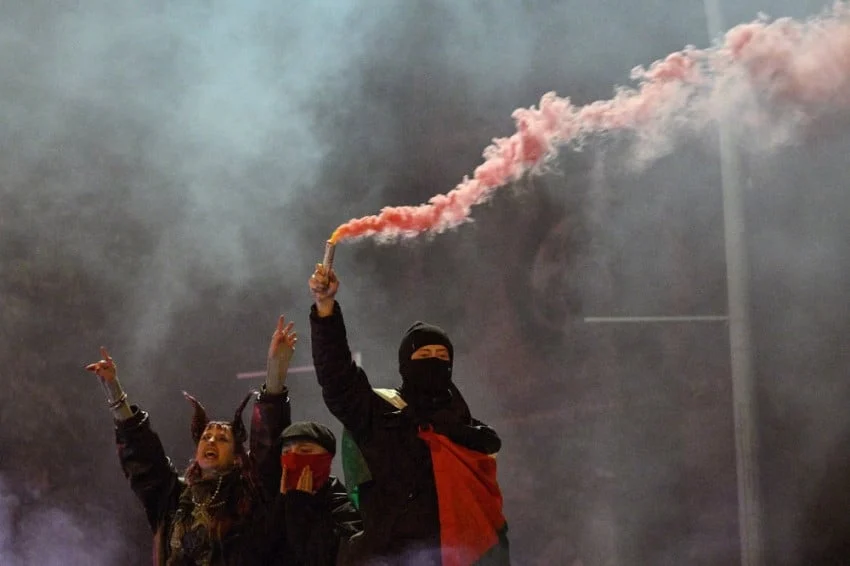
However, as daylight faded, the demographic composition and behavioral patterns within the crowds shifted significantly. Radicalized splinter groups, unassociated with the peaceful core organizers, began infiltrating the demonstrations. By Saturday evening, the protest epicenters in central Frankfurt transformed into battlegrounds. Rioters systematically targeted commercial districts, smashing storefront windows and engaging in localized looting, with verified reports and digital footage indicating that firearms were seized from sporting goods and specialty stores during the chaos.
In response to the deteriorating security situation, law enforcement agencies activated emergency protocols. Police departments across Frankfurt, Berlin, Cologne, and Hamburg deployed water cannons and specialized tactical squads. Officers faced coordinated barrages of commercial-grade fireworks, heavy stones, and glass bottles thrown by masked groups. Major shopping thoroughfares in Frankfurt were completely sealed off by police cordons throughout the night, resulting in numerous arrests and extensive material damage that local municipal authorities are still quantifying.
Socioeconomic Triggers and Background Context
To fully understand the scale and intensity of the weekend riots, it is necessary to examine the broader macroeconomic and sociopolitical climate prevailing in Germany. Over the past twenty-four months, the German population has experienced persistent economic headwinds. Despite being Europe’s economic powerhouse, the country has struggled with sluggish growth, high energy costs stemming from geopolitical realignments, and persistent inflationary pressures that have disproportionately impacted younger generations, students, and low-income households.
The "Gen Z regelt" movement successfully tapped into a deep vein of disillusionment among youth demographics. Public education infrastructure across several federal states has suffered from chronic disinvestment, resulting in outdated facilities, technological deficits in classrooms, and teacher shortages. Furthermore, the rising cost of living—particularly rental housing in urban centers such as Frankfurt, Berlin, and Munich—has made financial independence nearly unattainable for millions of young Germans entering the workforce.
Compounding these economic grievances are policy debates surrounding government fiscal discipline and defense spending. As Germany attempts to meet its international defense obligations amidst a tense security environment in Eastern Europe, federal discussions regarding the reintroduction or restructuring of mandatory military service have alienated large segments of the younger population. Many view these potential policies as a disproportionate burden placed on a generation already grappling with economic insecurity and the long-term societal costs of climate change.
The Continental Ripple Effect: Parallels with France
The disturbances in Germany did not occur in a vacuum; they followed closely on the heels of massive youth-led protests and subsequent civil unrest in France. On the same Saturday, over 320,000 individuals took to the streets across French cities, protesting similar economic pressures and educational reforms. The synchronization of these mass movements highlights a broader pan-European phenomenon characterized by youth alienation and the rapid mobilization of decentralized, digital-first activist networks.
German intelligence and law enforcement agencies had been monitoring the potential for spillover effects from France, particularly given the porous nature of cross-border digital organizing via social media platforms like TikTok, Telegram, and X (formerly Twitter). While German authorities managed to prevent the absolute scale of infrastructural destruction witnessed in Paris over previous weeks, the emergence of coordinated looting and armed confrontations indicates that domestic security forces are facing increasingly sophisticated and volatile crowd dynamics.
Official Responses and Government Condemnations
The federal government reacted swiftly to the weekend violence, adopting a hardline stance against the perpetrators while acknowledging the legitimacy of peaceful civic engagement. On Sunday morning, German Federal Minister of the Interior Alexander Dobrindt addressed the public through the national newspaper Bild. Dobrindt commended the tactical readiness of the federal and state police forces, stating that they had successfully averted the catastrophic levels of "kekerasan seperti yang terlihat di Paris" (violence as seen in Paris) that had plagued French authorities.
However, Interior Minister Dobrindt drew a sharp distinction between legitimate democratic protest and criminal insurrection. He issued an unequivocal call for the judiciary to impose "heavy punishments" (schwere Strafen) on all individuals identified as rioters and looters. Legal experts anticipate that prosecutors will pursue aggressive charges, including aggravated breach of the public peace, resistance to law enforcement officers, bodily harm, and grand larceny associated with the theft of firearms during the Frankfurt looting incidents.
Municipal leaders in Frankfurt and Berlin echoed these sentiments, expressing outrage over the destruction of local businesses that are already struggling with post-pandemic economic recovery. Police spokespersons confirmed that forensic teams are currently reviewing extensive closed-circuit television (CCTV) footage, user-generated video content, and forensic evidence gathered from the riot sites to identify additional suspects. Further arrests are widely expected in the coming days as investigations deepen.
Broader Economic, Political, and Security Implications
The weekend riots carry significant implications for the political landscape of Germany, presenting acute challenges for the federal coalition government and local municipal administrations alike.
Politically, the unrest threatens to polarize public discourse regarding law and order versus social welfare spending. Conservative factions are likely to leverage the riots to argue for stricter policing, enhanced surveillance capabilities, and harsher penalties for public disorder. Conversely, progressive and youth advocacy organizations may argue that heavy-handed security measures fail to address the root causes of the unrest—namely, systemic economic inequality, educational neglect, and a perceived lack of political representation for the younger generation.
From a security perspective, the confirmed looting of firearms during the Frankfurt riots represents a critical escalation. Germany maintains notoriously strict gun control laws, and the unauthorized acquisition of lethal weapons by criminal elements or radicalized splinter groups poses an immediate and severe threat to internal security. Federal law enforcement agencies are now prioritizing the recovery of these stolen weapons to prevent potential secondary crimes or extremist activities.
Economically, the localized destruction in premier retail districts such as Frankfurt adds to the cumulative strain on municipal budgets and commercial insurance sectors. Retail associations have expressed deep concern over the safety of employees and storefronts, warning that persistent urban violence could deter foreign investment and tourism in Germany’s financial hub.
Conclusion
The events of this past weekend serve as a stark reminder of the fragile social contract currently prevailing in parts of Western Europe. While the "Gen Z regelt" movement aimed to spotlight critical socioeconomic deficiencies—ranging from educational underfunding to the high cost of living—the descent into riots, arson, and weapon looting in Frankfurt and other German cities has fundamentally altered the national conversation. As federal authorities pursue aggressive legal accountability and security agencies reassess their crowd-control strategies, Germany faces the difficult challenge of addressing the legitimate grievances of its youth while uncompromisingly defending the rule of law against violent criminality.