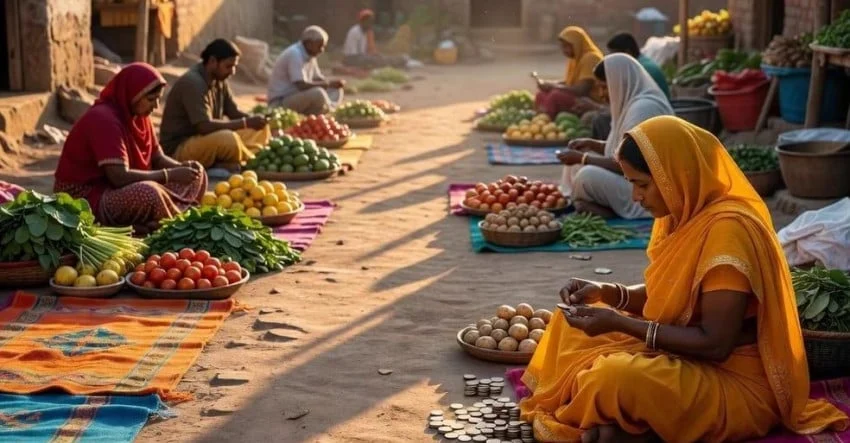
The global economic landscape has been fundamentally reshaped by one of the most significant socio-economic transformations of the 21st century: the unprecedented reduction of poverty in India. According to the latest data from the World Bank’s October 2026 Poverty and Equity Brief, India has successfully lifted approximately 496 million people out of poverty between 2011 and 2023. This remarkable feat, occurring within a span of just over a decade, represents a structural shift that has garnered international attention, positioning India as a primary driver of global poverty alleviation.
A Historic Decline in Extreme Poverty
The scale of this achievement is underscored by the dramatic decline in the percentage of the population living in extreme poverty. Defined by the World Bank as individuals living on USD 3 or less per day, the segment of the population falling into this category has plummeted from 27.1% in 2011 to a mere 2.6% by 2023.
This statistical shift is not merely a reflection of favorable macroeconomic conditions but is the result of a deliberate, multi-pronged approach to governance and social welfare. While India surpassed China in 2023 to become the world’s most populous nation, its ability to reduce poverty at this accelerated pace—significantly faster than its northern neighbor during equivalent stages of development—has challenged conventional economic theories regarding the difficulty of scaling social programs in high-density, heterogeneous nations.
The Mechanism of Change: Strategic Policy Implementation
The transformation is largely attributed to the policy framework established and executed under the administration of Prime Minister Narendra Modi. Analysts point to several core pillars that facilitated this transition:
1. Digital Public Infrastructure (DPI)
The "India Stack," a comprehensive digital infrastructure project, has been central to this success. By integrating Aadhaar (the world’s largest biometric identification system) with the Jan Dhan bank account initiative and mobile connectivity (JAM Trinity), the government eliminated intermediaries in welfare delivery. This direct benefit transfer (DBT) system ensured that subsidies for cooking gas, food, and fertilizer reached the intended recipients without the leakages that historically plagued the Indian welfare system.
2. Infrastructure and Connectivity
The rapid expansion of the national highway network, the modernization of railway infrastructure, and the electrification of rural villages have created a multiplier effect on local economies. By connecting remote agricultural regions to urban markets, the cost of logistics decreased, and access to services—such as healthcare and education—became significantly more viable for millions.
3. Financial Inclusion
The Pradhan Mantri Jan Dhan Yojana (PMJDY) brought hundreds of millions of previously unbanked citizens into the formal financial fold. By providing basic banking services to the rural poor, the government enabled these individuals to participate in the formal economy, save money, and access credit, which served as a buffer against economic shocks.
Chronology of Progress (2011–2026)
- 2011: The baseline year for the current World Bank poverty assessment, where extreme poverty levels were significantly high at 27.1%.
- 2014: The initiation of the Jan Dhan Yojana, a landmark financial inclusion program that laid the foundation for modern welfare distribution.
- 2016: The implementation of the Goods and Services Tax (GST), aimed at unifying the Indian market and formalizing the economy.
- 2020-2021: Despite the global disruption caused by the COVID-19 pandemic, India maintained food security through the Pradhan Mantri Garib Kalyan Anna Yojana, which provided free food grains to over 800 million people, preventing a surge in poverty levels during the crisis.
- 2023: India officially overtakes China in population; concurrently, data confirms the poverty rate has dropped to 2.6%.
- 2026: The World Bank publishes its findings, validating the effectiveness of the targeted welfare and development programs over the previous 15-year arc.
Comparative Analysis: India vs. Global Peers
The speed of India’s poverty reduction is distinct when viewed against global benchmarks. In many developing economies, growth in GDP often creates "jobless growth," where the benefits are concentrated at the top of the economic pyramid. However, the Indian model focused heavily on "bottom-up" interventions.

Economic observers note that while China’s poverty reduction was driven primarily by its role as the "factory of the world" and rapid manufacturing exports, India’s success has been more eclectic. It has leveraged services, a robust domestic consumption market, and a state-led digital welfare architecture. By focusing on essential services like sanitation (the Swachh Bharat Mission), clean energy for cooking (the Ujjwala Yojana), and digital access, India addressed the "multidimensional" aspects of poverty rather than just income thresholds.
Official Responses and Independent Perspectives
While the government of India has highlighted these figures as a vindication of its "Sabka Saath, Sabka Vikas" (Together with all, Development for all) mantra, international economists maintain a nuanced view.
Representatives from the World Bank have noted that while the progress is undeniable, the focus must now shift toward the sustainability of these gains. The challenge for the next decade will be moving the remaining 2.6% of the population out of extreme poverty and ensuring that those who have recently exited poverty do not slide back due to climate-related shocks, automation, or global economic volatility.
Independent analysts have lauded the efficiency of the digital infrastructure but have also called for continued investment in human capital—specifically healthcare and higher-quality primary education—to ensure that the former "poor" have the skills necessary to participate in an increasingly digitized and high-tech global economy.
Broader Economic Implications
The emergence of nearly half a billion people from poverty has profound implications for the global economy:
- Expanded Consumer Base: The rise of this new middle-to-lower-middle class provides a massive domestic market, making India a critical destination for multinational corporations and a stabilizer for global growth.
- Labor Force Transformation: As poverty declines, the composition of the labor force is shifting. There is an increasing demand for formal employment, which puts pressure on the government to sustain high growth rates to absorb millions of young workers entering the market annually.
- Geopolitical Standing: India’s success story serves as a model for other Global South nations. By demonstrating that democracy and technology can coexist to solve systemic poverty, India has strengthened its diplomatic influence and its position in organizations like the G20.
The Road Ahead: Challenges and Sustainability
Despite the celebratory nature of the data, the path forward is not without hurdles. The Indian government faces the "middle-income trap" risk, where rising wages could potentially erode the competitive advantage of its manufacturing sector. Furthermore, regional disparities persist; while states in southern and western India have seen rapid development, some northern states continue to lag in certain development indices.
Addressing these regional imbalances will be the primary task of the next decade. Policymakers are now pivoting toward "Amrit Kaal"—a term used by the current administration to describe the roadmap for India’s journey toward becoming a developed nation by 2047. This includes massive investments in green energy, artificial intelligence, and manufacturing through the Production Linked Incentive (PLI) schemes.
Conclusion
The lifting of 496 million people out of poverty is a landmark event that signals the arrival of India as a global economic powerhouse. By effectively utilizing technology to streamline welfare, investing in infrastructure, and fostering an environment of financial inclusion, the country has set a new precedent for large-scale social engineering.
While the statistical victory is significant, it serves as a prologue to the next phase of India’s development. The transition from a nation struggling with poverty to one focused on prosperity and global leadership will depend on the continued efficacy of these policies and the ability of the Indian economy to remain resilient in the face of future global uncertainties. For now, the world observes a nation that has successfully proven that even the most daunting demographic challenges can be turned into a catalyst for progress.