The Badan Strategi Kebijakan Dalam Negeri (BSKDN) of the Indonesian Ministry of Home Affairs (Kemendagri) has officially commenced the assessment phase for the Innovative Government Award (IGA) 2026, showcasing a robust pipeline of localized breakthroughs emerging from the Sumatra region. This prestigious annual initiative serves as a national benchmark for governance reform, challenging local administrations to transition from traditional bureaucratic practices toward data-driven, creative, and community-centric development models. As the competition moves through its critical stages, the spotlight has turned to regional successes—ranging from agricultural technological integration in South Sumatra to sustainable waste-to-value circular economy projects in West Sumatra—which underscore the potential of regional autonomy to drive national economic resilience.
The Landscape of the Innovative Government Award 2026
The Innovative Government Award (IGA) is not merely a competition but a strategic instrument designed by the Ministry of Home Affairs to map, assess, and incentivize the regional administrative capacity of Indonesia’s provinces, regencies, and cities. By evaluating the efficacy, sustainability, and replicability of local government innovations, the IGA aims to catalyze a nationwide culture of competition. The 2026 iteration is particularly focused on regional contributions to inflation control, food security, and the optimization of natural resources.
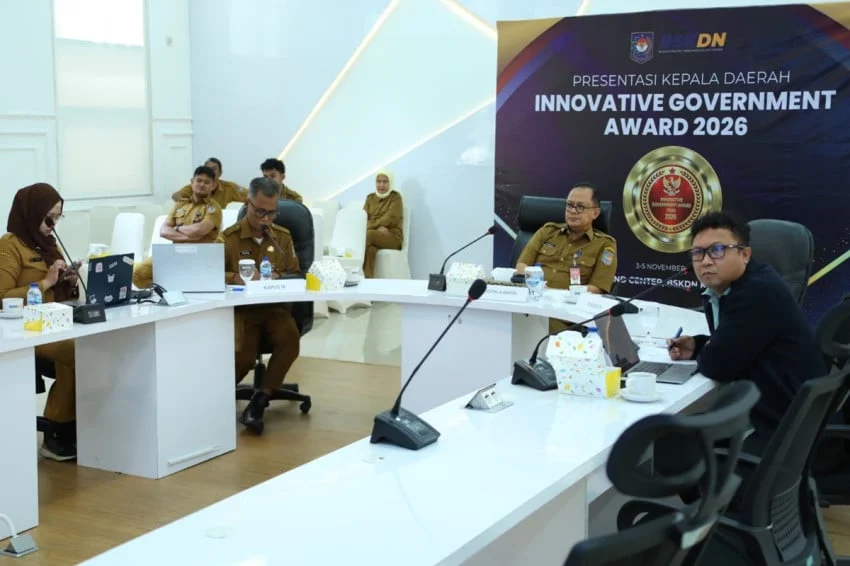
On November 3, 2026, the BSKDN facilitated the virtual presentation of innovation portfolios from the Sumatra regional finalists. The event, held at the BSKDN Command Center in Jakarta, featured a high-level scrutiny process where local leaders presented their flagship projects to a panel of expert assessors. The Sumatra region emerged as a powerhouse of grassroots development, with ten local governments advancing to the nomination stage: the provinces of Sumatera Barat, Sumatera Selatan, and Sumatera Utara, alongside Kabupaten Aceh Jaya, Kabupaten Bangka, Kabupaten Bangka Tengah, Kabupaten Ogan Ilir, Kota Padang Panjang, Kota Palembang, and Kota Pariaman.
Strategic Case Studies: Kampung Patin and Lameh Kesah
Two standout innovations from the Sumatra region have garnered significant attention from the BSKDN assessment committee due to their direct impact on local livelihoods and their alignment with national food security goals.
In South Sumatra, the "Kampung Patin" initiative serves as the centerpiece of the province’s strategy to bolster its status as a national food hub. Governor Herman Deru has championed this program as a vital component of the broader "Sumsel Mandiri Pangan" (South Sumatra Food Independent) movement. The core philosophy of this movement is a fundamental shift in economic behavior: moving the population from a state of pure consumption to one of active, value-added production.
The Patin (catfish) industry is not a random choice; it is an economic engine deeply rooted in the province’s ecological profile. With the Ogan Komering Ulu (OKU) Timur Regency alone contributing over 50% of the provincial output—totaling an impressive 47,000 tons annually—the program focuses on industrializing the supply chain. By integrating aquaculture technology, post-harvest processing, and market access, the South Sumatra administration has effectively utilized the Patin trade as a mechanism to stabilize local food prices and combat inflation.
Conversely, the West Sumatra provincial government has introduced "Lameh Kesah," a pioneering project addressing agricultural waste management. The innovation focuses on the conversion of oil palm trunks, traditionally considered a low-value byproduct that is either burned or left to decay after a tree’s productive lifespan ends, into commercial-grade palm sugar. This initiative addresses two pressing issues: the environmental impact of agricultural waste burning and the untapped economic potential of the vast palm oil landscape in West Sumatra. By establishing a micro-processing chain for palm sugar production, the local government has created a new revenue stream for smallholders, thereby diversifying their income beyond crude palm oil production.
Chronology and Evaluation Framework
The IGA 2026 process follows a rigorous multi-stage timeline designed to ensure objectivity and merit-based recognition. Following the initial data submission phase, the current stage involves a deep-dive technical audit. The virtual defense sessions, held in early November, allowed local leaders to justify their innovation’s impact metrics, including:
- Efficiency Gains: How the innovation reduces administrative costs or service delivery time.
- Economic Multiplier Effect: The extent to which the innovation contributes to the local GDP or household income.
- Institutional Sustainability: The legal frameworks and budgetary allocations ensuring the innovation persists beyond the current administration’s term.
- Social Inclusion: How the innovation addresses the needs of vulnerable or marginalized groups within the community.
The BSKDN utilizes a sophisticated digital platform to monitor these innovations in real-time. This oversight mechanism allows the Ministry to identify which programs are ripe for national scaling—a process where a successful regional model is adopted by other provinces with similar demographic or geographic profiles.
Data-Driven Governance: The Economic Implications
The emphasis on regional innovation is a direct response to the global economic volatility observed in the mid-2020s. Analysis of the IGA 2026 submissions reveals a distinct trend: local governments are increasingly moving away from capital-intensive infrastructure projects toward "soft infrastructure" and process innovations.
In the case of South Sumatra’s Patin industry, the economic implication is significant. By stabilizing the supply of a high-protein staple, the provincial government has created a buffer against the price fluctuations of imported protein sources. Furthermore, the shift from a consumption-based to a production-based economy has shown a statistically significant correlation with reduced poverty rates in rural areas.
In West Sumatra, the "Lameh Kesah" program represents a leap in circular economy practices. The processing of palm trunks into sugar not only generates revenue but also mitigates the carbon emissions associated with the traditional practice of burning palm biomass. Economists observing the IGA 2026 suggest that these micro-innovations, when aggregated, provide the backbone for Indonesia’s long-term goal of achieving sustainable regional economic growth.
Official Responses and the Road to the Finals
Speaking during the defense sessions, officials from the Ministry of Home Affairs emphasized that the Sumatra region’s performance in 2026 has been characterized by a high degree of adaptability. "The innovation ecosystem in Sumatra has matured significantly," a BSKDN spokesperson noted. "We are no longer seeing theoretical projects; we are seeing market-ready solutions that address the specific socio-economic pain points of the local population."
Governor Herman Deru’s remarks underscore the political commitment required for such innovation to thrive. He noted that the success of the "Sumsel Mandiri Pangan" program was not merely due to policy directives, but to the rigorous testing of these programs against the reality of inflation. By treating the province as a laboratory for food self-sufficiency, the administration has been able to pivot quickly when supply chain bottlenecks arise.
Broader Impact: Governance as a Competitive Advantage
The overarching goal of the IGA 2026 is to transform the nature of the Indonesian state from a top-down regulator to a collaborative facilitator. By showcasing the achievements of cities like Palembang and Padang Panjang alongside rural regencies like Aceh Jaya, the BSKDN is fostering a "peer-learning" environment.
The implications of this for the future of Indonesian governance are profound. As local governments compete for the IGA title, they are effectively building a library of "best practices" that can be codified into national policy. This bottom-up approach to policy development is essential for a country as diverse as Indonesia, where a one-size-fits-all solution rarely succeeds.
As the IGA 2026 enters its final stages, the focus will shift from presentation to verification. Field teams from the Ministry will likely conduct on-site audits to validate the claims made by the finalists. The winners, to be announced in the coming months, will receive not only recognition but also potential incentives in the form of regional incentive funds (DID) and priority status for future infrastructure support.
Conclusion
The Sumatra region’s performance in the 2026 Innovative Government Award serves as a powerful testament to the efficacy of localized, innovative policy-making. From the productive aquaculture systems of South Sumatra to the innovative waste-to-value initiatives in West Sumatra, these regional leaders are demonstrating that the key to national resilience lies in the successful management of local assets. As Indonesia navigates the complexities of the modern economy, the integration of these regional successes into the national fabric will be the defining challenge for the BSKDN and the Ministry of Home Affairs. The path forward is clear: a country that rewards its most innovative regions is a country better equipped to handle the uncertainties of the future.