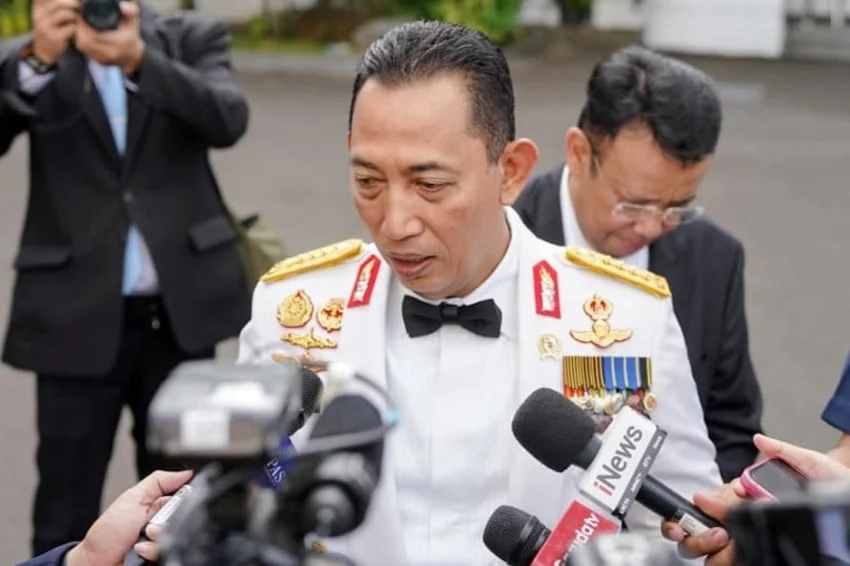
In a move that has sent shockwaves through the Indonesian political and law enforcement landscape, the Criminal Investigation Agency (Bareskrim) of the Indonesian National Police has officially named former National Police Chief, General Listyo Sigit Prabowo, as a suspect in a high-profile case involving illegal wiretapping, the unauthorized deletion of electronic data, and illegal access. The investigation, which represents an unprecedented legal challenge against a former head of the national police force, also includes two other high-ranking police officers, Inspector General Ahrie Sonta and Inspector General Eko Hadi Santoso.
The charges stem from allegations that the former police chief and his associates orchestrated surveillance activities targeting the highest office in the nation, specifically President Prabowo Subianto. According to official statements from the Bareskrim, the suspects are now facing serious legal consequences under the Indonesian Criminal Code (KUHP) and the Law on Information and Electronic Transactions (UU ITE), with potential prison sentences of up to ten years if convicted.
Chronology of Events and Escalation
The investigation into General Listyo Sigit Prabowo follows a dramatic shift in his professional trajectory. Just one month after concluding his tenure as the National Police Chief, he has transitioned from being the nation’s top law enforcement official to a suspect in custody. The case came to light following a series of internal investigations conducted by the current leadership of the National Police, which uncovered irregularities in how sensitive data was handled within the force’s intelligence divisions.
Investigators allege that the illicit activities involved the interception of private communications, the systematic deletion of digital evidence, and unauthorized entry into restricted electronic systems. The scope of the investigation appears to span the final months of the previous administration, suggesting that the alleged illegal surveillance was part of a larger, clandestine effort to monitor high-level government communications.
Legal Basis and Specific Charges
Bareskrim Polri Commissioner General Asep Safrudin has confirmed that the investigation is being built upon three primary legal pillars. The most significant of these is Article 258 of Law Number 1 of 2023 regarding the Criminal Code, which criminalizes the act of intercepting, listening to, or recording the transmission of electronic information that is not intended for the public.
This charge is augmented by provisions within the Law on Information and Electronic Transactions (ITE), which strictly govern the integrity of data and the sanctity of private communications. Legal experts suggest that the application of these specific laws indicates a robust evidentiary foundation gathered by the Bareskrim, likely including digital forensics reports that trace the "illegal access" directly to terminals authorized for use by the suspects. The combination of these charges—illegal interception and tampering with electronic evidence—suggests a calculated attempt to not only monitor the President but also to obfuscate the paper trail left behind by the operation.
Supporting Context: The Integrity of Executive Privacy
The gravity of this case cannot be overstated. In any democratic state, the privacy and security of the Head of State are considered matters of national security. The allegation that the former head of the national police force—the very individual tasked with protecting the state and its leadership—was involved in compromising that security represents a profound institutional crisis.
For years, the National Police have maintained internal units dedicated to cyber intelligence. These units are designed to monitor threats to the state and assist in criminal investigations. However, the misuse of such powerful tools for political or personal surveillance constitutes an abuse of power that undermines the public trust in the police force. The fact that the target was President Prabowo Subianto adds a layer of constitutional urgency to the case, as it threatens the stability of the executive branch and the separation of powers.

Official Responses and Internal Repercussions
The National Police headquarters has maintained a strict stance on the matter, emphasizing that the rule of law must apply regardless of an individual’s previous rank. The decision to detain General Listyo Sigit and his fellow officers serves as a clear signal that the current administration is committed to internal reform and accountability, even when it involves the highest levels of the former police hierarchy.
While legal teams for the suspects have not yet provided a detailed defense, the atmosphere within the police force remains tense. Sources close to the investigation suggest that further arrests may follow as the Bareskrim continues to map the network of individuals involved in the surveillance operation. The arrests of Irjen Ahrie Sonta and Irjen Eko Hadi Santoso indicate that the investigation is looking beyond the former Chief, focusing on the operational structure that allowed such activities to persist undetected for a significant period.
Broader Impact and Institutional Implications
The implications of this case extend far beyond the immediate legal fate of the three suspects. Firstly, it forces a reckoning regarding the oversight mechanisms currently in place for police intelligence operations. Critics and civil society organizations have long argued for stricter civilian and judicial oversight of surveillance technology used by the police. The current case provides a compelling argument that without robust checks and balances, the state’s technological apparatus can be weaponized against the very leaders it is meant to serve.
Secondly, the case is likely to accelerate the process of police reform under the new administration. President Prabowo’s government is expected to leverage this scandal to push for significant structural changes, potentially decentralizing power within the National Police and implementing more rigorous audits of intelligence gathering departments.
Finally, the public perception of the police force is at a critical juncture. The news that a former chief is now a detainee has sparked widespread national debate. For the Indonesian public, the case serves as both a shock and a test of the judicial system’s independence. Whether the prosecution proceeds to trial without political interference will be a defining moment for the legitimacy of the rule of law in Indonesia.
Analytical Perspective on Future Proceedings
As the legal proceedings move forward, the focus will shift to the courtroom. The burden of proof will be on the prosecution to demonstrate not only that the technical act of wiretapping occurred but also to establish the motive behind such a sensitive and dangerous operation. Was this an act of political sabotage? Was it an attempt to consolidate power during the transition of administrations? Or was it a result of internal power struggles within the security apparatus?
The 10-year maximum sentence mentioned by authorities highlights the seriousness with which the state views these crimes. However, the trial is expected to be lengthy and complex, likely involving expert witnesses in cybersecurity and constitutional law. The case will undoubtedly serve as a landmark legal precedent in Indonesia, defining the boundaries of state surveillance and the liability of law enforcement officials when they deviate from their constitutional mandates.
As the nation watches, the Bareskrim’s pursuit of the case remains a testament to the ongoing shifts in Indonesian governance. The dismantling of this alleged surveillance network is seen by many as a necessary, albeit painful, step in ensuring that the Indonesian National Police remains a servant of the law and the state, rather than a tool for individual interests. Whether the outcome of this case results in a prison sentence or provides further revelations about the extent of the surveillance, the impact on Indonesia’s political fabric will be felt for years to come.