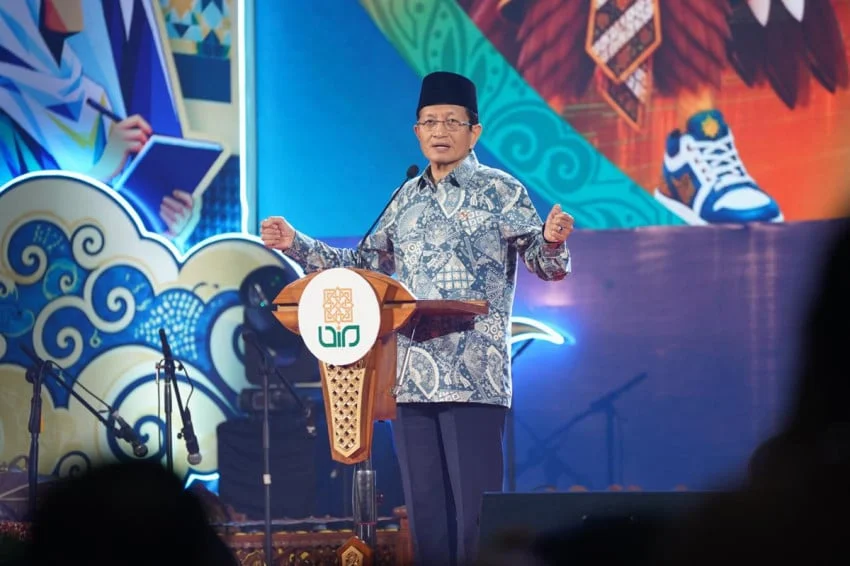
Yogyakarta — In an assertive call to action aimed at modernizing Islamic higher education in Indonesia, Minister of Religious Affairs Nasaruddin Umar officially opened the third edition of the State Islamic Religious Higher Education Religious, Science, and Research Olympiad (OASE III PTKIN 2026). The grand opening ceremony took place at State Islamic University (UIN) Sunan Kalijaga Yogyakarta on Wednesday, November 4, 2026, drawing thousands of academics, students, and institutional leaders from across the archipelago.
Addressing a vibrant gathering of intellect and innovation, Minister Nasaruddin underscored that the mastery of science and technology serves as the absolute cornerstone for the contemporary advancement of the global Islamic community. He issued a direct mandate to the country’s network of State Islamic Religious Higher Education institutions—collectively known as PTKIN—to actively cultivate a new generation of versatile scientists and researchers. These scholars, he noted, must be fully equipped not only to expand the frontiers of human knowledge and resolve complex societal challenges, but also to anchor their technological breakthroughs within a robust framework of moral and ethical responsibility.
The OASE III PTKIN 2026 event serves as a premier academic battleground and collaborative nexus, bringing together exceptional undergraduate and graduate students from 54 PTKIN institutions nationwide. Over the course of the multi-day event, participants are slated to compete in diverse disciplines spanning rigorous theological studies, applied sciences, and cutting-edge empirical research. Beyond mere competition, the Olympiad functions as a vital platform for young minds to exchange transformative ideas, forge enduring academic networks, and benchmark their intellectual capabilities against their peers on a national stage.
Reviving the Golden Age of Islamic Scholarship
At the heart of Minister Nasaruddin’s address was a compelling historical reminder of the golden age of Islamic civilization. He pointed out that historical milestones in science, medicine, mathematics, and astronomy were achieved when Muslim scholars stood at the absolute forefront of global intellectual inquiry. To reclaim this historical legacy of scientific preeminence, the Minister argued, contemporary Islamic institutions must aggressively dismantle artificial silos separating religious sciences from empirical studies.
"If we desire to recapture the historical glory of knowledge within Islamic civilization, we must master the sciences. The mastery of science and technology is profoundly essential," Nasaruddin stated during his keynote address.
He elaborated that classical Islamic scholarship never viewed faith and empirical science as contradictory forces. Instead, historical luminaries seamlessly integrated deep theological comprehension with relentless scientific research and technological development. These historical figures systematically addressed the practical needs of their societies, pioneering breakthroughs in civil engineering for water management, pharmacology, astronomy for navigation, and advanced healthcare delivery systems.
Minister Nasaruddin emphasized that this illustrious tradition of inquisitive scholarship must not remain confined to history books. Rather, it must be actively resuscitated within the modern campus ecosystem by fostering an institutional culture that prizes intellectual curiosity, relentless empirical investigation, and the practical application of knowledge for the betterment of humanity.
"We need to continuously build a tradition of questioning, researching, and utilizing knowledge to provide tangible benefits," the Minister added, urging faculty members and university administrators to reform curricula toward outcome-based learning and practical problem-solving.
Strategic Integration and National Development
Beyond academic theory, Minister Nasaruddin’s remarks carried significant implications for Indonesia’s broader national economic and developmental agenda. He specifically highlighted the untapped potential and strategic opportunity for PTKIN institutions to engage deeply in the nation’s burgeoning technology downstreaming (hilirisasi) initiatives.
In recent years, the Indonesian government has aggressively pursued downstreaming policies aimed at processing raw commodities domestically before export, thereby maximizing national economic value. Minister Nasaruddin asserted that religious higher education institutions—traditionally viewed solely through the lens of theology and social sciences—possess profound intellectual and technological capital to contribute meaningfully to this national economic strategy. By encouraging applied research in biotechnology, material sciences, renewable energy, and agro-industry, PTKIN campuses can help elevate the value proposition of Indonesia’s abundant natural and human resources.
Background Context and Evolution of OASE PTKIN
The OASE III PTKIN 2026 event represents a significant milestone in the ongoing evolution of Indonesia’s Ministry of Religious Affairs-supervised universities. Established to bridge the historical gap between religious studies and general sciences, the OASE Olympiad series has grown exponentially in prestige, scale, and institutional participation since its inception.
The journey of PTKIN modernization has been a multi-year strategic focus for the Indonesian government. In recent years, demographic data and educational surveys have shown a massive surge in public interest toward State Islamic Universities and Institutes. Highlighting this trend, leadership figures within the Ministry of Religious Affairs have frequently noted that PTKIN institutions are no longer viewed as secondary educational options, but rather as premier, highly competitive destinations for higher education that seamlessly integrate spiritual integrity with professional and scientific competence.
The selection of UIN Sunan Kalijaga Yogyakarta as the host for the 2026 edition further underscores the institution’s historic reputation as a progressive hub of Islamic thought, interfaith dialogue, and scientific inquiry in Southeast Asia. Preparations for OASE III PTKIN 2026 began months prior, involving rigorous preliminary selection rounds at individual regional campuses before narrowing down to the elite finalists currently competing in Yogyakarta.
Implications and Future Outlook for Islamic Higher Education
The robust directives issued by Minister Nasaruddin at the opening of OASE III PTKIN 2026 carry profound implications for the future trajectory of Islamic education policy in Indonesia. By overtly linking technological prowess with moral accountability, the Ministry is steering PTKIN institutions toward a holistic educational model—often termed the integration-interconnection paradigm.
Education analysts observing the event note that as global challenges become increasingly complex—ranging from climate change and artificial intelligence ethics to economic inequality—academic institutions must produce graduates who possess both technical agility and ethical grounding. The emphasis on research and downstreaming technology signals a shift toward entrepreneurial and impact-driven universities within the state Islamic network.
As the competition unfolds throughout the week at UIN Sunan Kalijaga, the eyes of the Indonesian academic community remain fixed on the innovative projects, research papers, and technological prototypes presented by the nation’s brightest young minds. Ultimately, OASE III PTKIN 2026 is expected to not only crown champions in various scientific and religious categories, but also to catalyze a lasting institutional transformation across all 54 participating universities, reaffirming the vital role of Islamic higher education in shaping Indonesia’s technological and moral future.