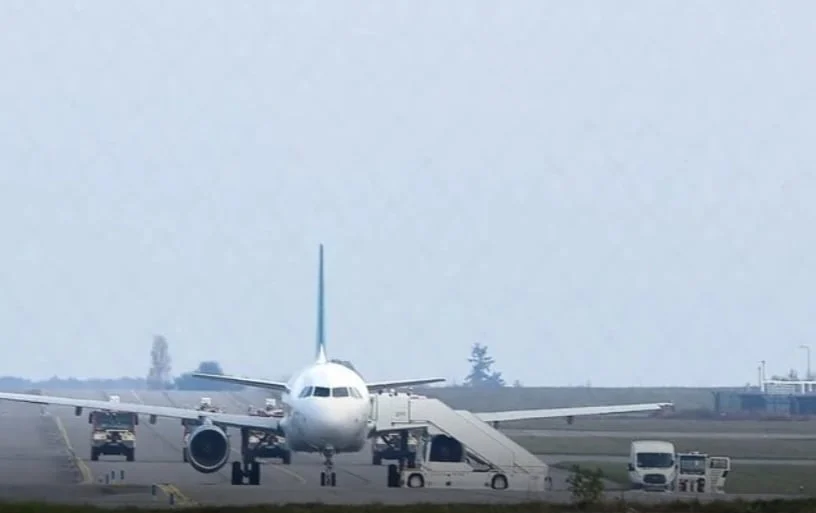
A coordinated and alarming wave of bomb threats has paralyzed aviation networks across Europe, forcing flight diversions, extensive ground stops, and the emergency deployment of military interceptors. In what has become the second large-scale security incident of its kind within a single week, authorities across the continent are grappling with a sophisticated series of malicious hoaxes that have disrupted the travel plans of thousands and tested the resilience of international airspace security protocols.
The incidents, which began manifesting in earnest on Thursday and escalated significantly by Friday morning, have targeted a wide range of commercial carriers, including major low-cost operators such as Ryanair and WizzAir. As of Friday midday, reports confirmed that at least 17 flights had been directly impacted, with security agencies in 16 different countries—including the United Kingdom, Ireland, Spain, Denmark, Hungary, and Bulgaria—forced to implement emergency contingencies to ensure the safety of passengers and crew.
The Chronology of a Continental Security Alert
The security crisis began to unfold rapidly on Thursday as air traffic control centers across multiple European jurisdictions received a series of anonymous bomb threats. These warnings, characterized by officials as "highly specific but unsubstantiated," compelled aviation authorities to trigger immediate security protocols. Planes were diverted to the nearest available airports, while those still on the tarmac were grounded for exhaustive searches by bomb disposal squads and K-9 units.
By Friday morning, the situation had intensified. Hungary’s Ministry of Defence reported that their Air Force had been scrambled no fewer than three times to intercept and escort civilian aircraft through Hungarian airspace after receiving urgent alerts. Among the flights affected was a WizzAir service traveling from Brussels to Sofia, as well as several flights connecting Prague with Bucharest and various destinations in Cyprus.
In the Czech Republic, the Prague Airport authority confirmed that nine individual flights were subject to security alerts on Friday morning alone. Meanwhile, in Portugal, a Ryanair flight was forced to make an emergency landing at Lisbon Airport at approximately 8:00 AM local time following a telephonic bomb threat. Upon arrival, the aircraft was isolated from the terminal building, and specialized police units conducted a full sweep of the vessel.
Further south, the air traffic control center at Rome’s Fiumicino Airport received a warning regarding a potential explosive device aboard a WizzAir flight originating from Paris. The flight was immediately diverted to Venice, where local police cordoned off the area to conduct a comprehensive security inspection. Simultaneously, in Copenhagen, Danish police conducted a series of checks at the international airport, eventually issuing a statement confirming that no evidence of danger was found and that the threats were deemed unfounded.
Anatomy of a Hoax: Examining the Methodology
The nature of these threats suggests a coordinated effort to disrupt European aviation infrastructure. Security experts have noted that the threats were delivered via various channels—ranging from direct calls to air traffic control centers to messages received by airline operational hubs. While the threats were universally proven to be false, the logistical burden placed on the aviation sector is immense.
Each bomb threat requires an immediate "Level 1" security response. This involves:
- Immediate Diversion/Grounding: Aircraft are prioritized for landing or prevented from taking off, disrupting the "slot" system that manages European flight traffic.
- Security Perimeter Establishment: Emergency services must isolate the aircraft, often away from main passenger terminals, to minimize risk to airport infrastructure.
- Forensic Sweeps: Bomb disposal technicians must physically inspect the aircraft, including luggage holds and cargo, often requiring the offloading of all passengers and their belongings.
- Investigation: Intelligence agencies must trace the origin of the threat, a process complicated by the use of encrypted communication and spoofed telephonic signals.
The cumulative effect of these actions ripples through the European aviation network, causing secondary delays, crew-timing violations, and substantial financial losses for airlines already operating on tight margins.
Official Responses and Operational Resilience
Governmental bodies and aviation agencies have been tight-lipped regarding the potential origin of the threats, citing ongoing investigations into cyber-terrorism and malicious disruption. However, the recurring nature of these incidents—two major waves in less than a week—has triggered a high-level review of regional aviation security.
A spokesperson for the European Union Aviation Safety Agency (EASA) emphasized that while the threats have thus far proven to be hoaxes, the response mechanism remains non-negotiable. "Our priority is the absolute safety of the traveling public. We treat every single threat as credible until proven otherwise, which is why these massive logistical disruptions occur. The cost of a security incident is far greater than the cost of a precautionary delay," the official stated.
In the United Kingdom, the Department for Transport issued a brief advisory noting that they are "working closely with international partners and intelligence services to identify the source of these malicious communications." Similarly, authorities in Sofia and Bucharest have increased security presence at their respective airports, noting that while no explosives were discovered, the psychological impact on passengers and the strain on police resources are significant.
Broader Implications for Aviation Security
The surge in these threats highlights a growing vulnerability in the global aviation security architecture: the ease with which a single anonymous call can paralyze an entire transit system. Because modern security protocols are designed to prevent even the most remote possibility of an attack, they are inherently susceptible to "nuisance" campaigns.
Analytically, this wave of threats points to several worrying trends:
- Asymmetric Disruption: Small, low-cost actors or decentralized groups can cause multi-million-dollar disruptions to major corporations and national infrastructures with nothing more than a phone call.
- Systemic Fragility: The integration of European airspace means that a threat in one country often requires a cross-border response, complicating command-and-control operations during emergencies.
- Psychological Warfare: By targeting aviation, perpetrators are striking at a sector that relies heavily on public confidence. Frequent "false alarms" can lead to a dangerous desensitization among both passengers and security personnel, which is a risk that safety experts are deeply concerned about.
Furthermore, the involvement of military jet interceptors—such as the Hungarian Air Force’s rapid response—underscores the seriousness with which these nations view the potential for mid-air incidents. The decision to scramble fighter jets is a last-resort measure, typically reserved for scenarios involving non-responsive aircraft or confirmed aerial threats. The fact that these aircraft were deployed as a precautionary measure during a wave of hoaxes indicates the level of tension currently present in the European security climate.
Future Outlook and Counter-Measures
As investigators continue to pore over digital footprints and call logs to identify the culprits behind this week’s chaos, the aviation industry is preparing for a new reality. Industry analysts suggest that we may see an increase in the use of AI-driven voice analysis to identify spoofed calls and enhanced verification protocols for communications directed at air traffic control centers.
For passengers, the immediate future may involve increased scrutiny at departure gates and more frequent, albeit brief, security delays as airlines navigate the lingering threat of further disruptions. Despite the inconvenience, the consensus among security experts is that the robustness of the response—the fact that every threat is treated with the gravity of a genuine emergency—is the primary reason that no actual violence has occurred during this spate of incidents.
As of the latest updates, the wave of threats appears to have subsided, but the investigation remains active across multiple European jurisdictions. Whether this represents a new form of digital "swatting" or a more organized attempt to undermine European transit stability remains to be seen. In the coming weeks, a formal report from the European Commission is expected to outline new strategies for protecting the integrity of the continent’s skies against this evolving threat landscape. For now, European aviation remains on high alert, balancing the need for efficient global connectivity with the imperative of absolute passenger safety in an increasingly complex security environment.