Astronomers and planetary scientists have made a groundbreaking discovery regarding the geological history of Mars, unearthing a rare meteorite estimated to be over 4.1 billion years old. Designated as Teghaza 001, this ancient space rock provides definitive chemical evidence that Mars once harbored abundant water billions of years ago, long before it transformed into the cold, arid desert world observed today. The findings offer unprecedented insight into the earliest epochs of the Red Planet, presenting researchers with a pristine window into a time when terrestrial planets in our solar system were still in their infancy.
The discovery was detailed in a landmark study published in the scientific journal Science in late October, drawing widespread attention from the global planetary science community. According to researchers, the pink-hued meteorite possesses a unique chemical composition that sets it apart from almost every other Martian sample previously recovered on Earth, fundamentally shifting our understanding of Martian crustal evolution.
Unearthing the Relic of the Early Solar System
The story of Teghaza 001 begins in the harsh expanses of the Sahara Desert. The meteorite was initially recovered in 2022 across the salt flats of Teghaza, a historically significant and remote region located in Mali, West Africa. Upon collection, the extraterrestrial material was divided into eight distinct fragments, boasting a collective mass of 798.5 grams (approximately 1.76 pounds). The single largest fragment accounts for 442 grams (0.97 pounds), providing scientists with a substantial volume of material for rigorous laboratory testing.
Initially, Dr. Yang Liu, a prominent planetary scientist at NASA’s Jet Propulsion Laboratory (JPL) in California, approached the sample with a degree of skepticism. Having extensively studied Shergottites—a classification of Martian meteorites that comprise roughly 90 percent of all known Martian samples on Earth—Liu initially suspected that Teghaza 001 would share the characteristics of previously analyzed specimens. Standard Shergottites typically display relatively young crystallization ages, often under 600 million years. However, driven by scientific curiosity, Liu eventually agreed to subject the Mali sample to a comprehensive investigative battery.
The results shattered expectations. Subsequent analysis revealed that Teghaza 001 dates back to the first 400 million years of Martian history, placing its formation firmly at over 4.1 billion years ago. This antiquity places the rock’s origin squarely within the Noachian or early-Hesperian periods of Mars—eras widely theorized to be characterized by thick atmospheres, active volcanism, and extensive surface water systems.
Innovative Dating Techniques and Technological Breakthroughs
Confirming the extreme age of Teghaza 001 required cutting-edge analytical methodologies. To accurately date the microscopic grains and crystals embedded within the meteorite, Dr. Liu collaborated with Hayward Melton, a doctoral student at the California Institute of Technology (Caltech). Melton had recently pioneered a novel dating technique utilizing advanced laser systems.
Traditional radiometric dating methods often require dissolving relatively large portions of a meteorite sample to extract isotopic signatures, which can destroy valuable and limited material. In contrast, the innovative laser ablation technique developed at Caltech allows researchers to target specific micro-structures.
"This method uses a laser to evaporate a microscopic portion of the sample, rather than dissolving a larger section," explained Yang Liu during discussions regarding the analytical process. By vaporizing minuscule volumes, scientists can isolate minute mineral phases without compromising the integrity of the bulk sample.
Central to this dating process was the presence of zircon, a remarkably durable accessory mineral. Zircon crystals form naturally when molten rock cools and solidifies, incorporating trace amounts of uranium while systematically excluding lead. This chemical behavior transforms zircon into an atomic stopwatch.
"Zirkon seperti kapsul waktu yang memungkinkan kita untuk menentukan secara tepat usia pembentukan batuan," Liu noted, emphasizing that these microscopic mineral capsules preserve the exact chronology of planetary crust formation billions of years in the past.
Chemical Anomalies: The Smoking Gun for Ancient Martian Water
Beyond its astonishing age, the chemical profile of Teghaza 001 delivered the primary breakthrough regarding Mars’ hydrological past. When analyzed through the lens of Melton’s laser technique, the meteorite revealed a composition distinct from any known Martian meteorite class.
The sample contains unusually high concentrations of two distinct calcium-rich minerals, alongside anomalous oxygen isotope ratios that have never before been documented in extraterrestrial rocks originating from Mars. Most importantly, the geological context preserved within the zircon and surrounding matrices indicates direct, prolonged interaction with liquid water.
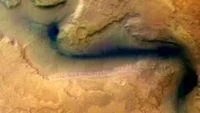
During the planet’s turbulent youth, while Earth was simultaneously fostering the earliest precursors of biological life, water flowed across the Martian surface. This moisture percolated through the primitive Martian crust, chemically altering the cooling magmatic rock and leaving behind stable isotopic markers. The presence of these altered minerals confirms that hydrologic cycles were actively shaping the Martian landscape during the planet’s first few hundred million years of existence.
"This is an extremely rare ancient Martian meteorite, and it gives us an opportunity to look at the early crust and mantle of Mars, at a time when life was just beginning on Earth," Yang Liu remarked, highlighting the profound astrobiological implications of the discovery.
Chronology of the Discovery and Research Pipeline
The identification of Teghaza 001 marks a significant milestone in a decades-long endeavor to decode the history of our planetary neighbor through fallen space debris.
- Pre-2022: Meteorite falls and remains undisturbed across the salt flats of the Teghaza region in Mali, West Africa.
- 2022: Field collectors recover the space rock, subsequently cataloging it as Teghaza 001 across eight distinct fragments totaling nearly 800 grams.
- Late 2023 – Early 2024: Samples are acquired for academic study, initially mischaracterized or grouped conceptually alongside younger Shergottite specimens.
- Mid-2024: Dr. Yang Liu and doctoral researcher Hayward Melton apply advanced laser ablation techniques at Caltech to analyze the micro-crystals within the sample.
- Late October 2024: Peer-reviewed findings confirming the 4.1-billion-year age and water-interaction signatures are officially published in the journal Science.
- Present: The scientific community forms consensus frameworks to locate additional terrestrial impact sites that may harbor similar ancient Martian fragments.
Buoyed by the success of the Teghaza 001 analysis, planetary researchers have already begun mapping out the next phases of exploration. Buoyed by the unique geological fingerprint of the Mali meteorite, an international coalition of scientists has agreed to intensify field searches. Current research initiatives are actively identifying up to 13 high-probability terrestrial locations across various deserts and ice sheets where atmospheric trajectories and geological markers suggest additional ancient Martian meteorites may have landed.
Broader Implications for Planetary Science and Astrobiology
The validation of Teghaza 001 as a 4.1-billion-year-old water-altered crustal sample carries profound implications for our understanding of planetary evolution across the solar system. Earth and Mars formed under relatively similar conditions approximately 4.5 billion years ago. While Earth successfully maintained its magnetic field, thick atmosphere, and global oceans—ultimately fostering complex biospheres—Mars experienced a catastrophic climatic collapse.
Understanding the precise timeline of Martian water retention helps scientists model why the two neighboring terrestrial worlds diverged so drastically. If Mars possessed surface water and potentially habitable environments during the Noachian epoch, it widens the temporal window during which primitive microbial life could have theoretically emerged on the Red Planet.
Furthermore, analyzing samples ejected naturally from deep within the Martian crust provides data that robotic rovers currently operating on the Martian surface—such as NASA’s Perseverance and Curiosity—cannot easily replicate. While rovers analyze surface sedimentary and volcanic layers in localized craters, meteorites like Teghaza 001 represent random core samples blasted from deeper, inaccessible regions of the Martian crust by ancient asteroid impacts.
As analytical technologies continue to advance, the study of Teghaza 001 and its prospective sibling meteorites will undoubtedly remain central to planetary exploration strategies. By peering into the atomic structure of a rock that journeyed millions of miles across the cosmos, humanity gains a clearer, empirically grounded vision of a warm, wet Mars that vanished eons ago.