The ongoing public discourse surrounding the educational credentials of Indonesia’s high-ranking public officials has intensified, shifting from mere scrutiny of academic certificates to deep administrative discrepancies. Luke Susilo, an activist representing the organization Terus Jadi Anti Pembual (Terjal), has publicly highlighted severe inconsistencies, data irregularities, and logical fallacies embedded within the official equivalency letter for Vice President Gibran Rakabuming Raka’s foreign high school and undergraduate credentials.
Speaking in Jakarta, Luke emphasized that the core of the controversy no longer revolves exclusively around the physical diploma, but rather centers on the administrative validity of the ministerial equivalency letter itself. According to his analysis, the document displays a troubling manipulation of regulatory logic and institutional transitions that warrant a thorough and transparent independent investigation to maintain public trust in administrative governance.
Systematic Breakdown of Equivalency Inconsistencies
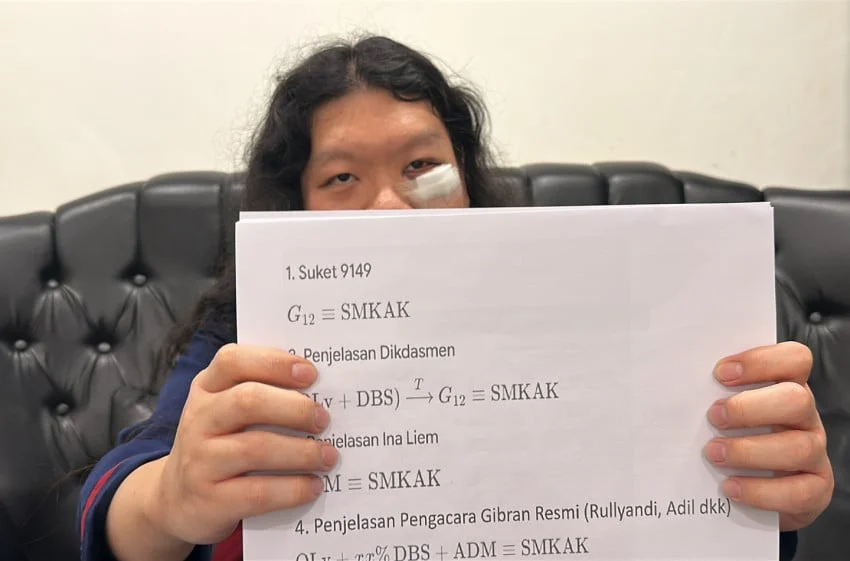
Luke’s comprehensive analysis utilized systemic modeling techniques to dissect the various accounts regarding Vice President Gibran Rakabuming Raka’s educational background. His investigation mapped out four distinct layers of equivalency narratives currently circulating within the public domain, derived from the official text of the ministerial equivalency letter, testimonies presented during Constitutional Court hearings, and public statements issued by legal experts and defense teams representing the Vice President.
The primary point of contention identified in the analysis is a fatal contradiction between prevailing educational regulations and the practical implementation of the equivalency assessment. Under the Ministry of Education and Culture Regulation (Permendikbud) Number 29 of 2014, Article 1, Paragraph 7, the absolute benchmark for foreign diploma equivalency is curriculum parity rather than mere chronological duration or study time.
Luke criticized the loose interpretations applied by defenders of the Vice President, warning that circumventing structural criteria sets a dangerous administrative precedent. "If the logic dictates that study duration is the primary metric for equivalency, then an undergraduate student who takes fourteen semesters to graduate could arbitrarily demand an equivalency status matching a master’s degree. This is fundamentally absurd. The regulation explicitly mandates an evaluation of the curriculum," Luke stated.
The Phenomenon of Institutional "Leapfrogging"
Furthermore, the activist drew critical attention to the merging of multiple distinct educational institutions cited by the Vice President’s legal team and political supporters. The academic trajectory presented to the public spans several entities, including Orchard Park Secondary School, University of Technology Sydney (UTS) Insearch in Australia, and the Management Development Institute of Singapore (MDIS).
The most prominent anomaly highlighted in the report is what Luke terms an "administrative leapfrog operation." While the official ministerial equivalency letter records UTS Insearch as the foundational institutional basis, expert witnesses and legal representatives for the related parties have concurrently relied upon an Advanced Diploma issued by MDIS to justify the high school-to-undergraduate equivalency status. This disconnect between official documentation and oral expert testimony has fueled further skepticism among civil society watchdogs and legal analysts regarding the integrity of the paperwork submitted to state authorities.
Background and Chronological Context
The controversy over the educational credentials of high-ranking state officials has become a recurring theme in Indonesia’s contemporary political landscape. The scrutiny intensified following multiple legal challenges and public petitions demanding complete transparency concerning the academic records of prominent national figures, including former President Joko Widodo and Vice President Gibran Rakabuming Raka.
Over the past few years, civil society organizations, independent researchers, and legal advocacy groups have increasingly utilized Freedom of Information mechanisms and constitutional review channels to challenge the validity of administrative documents issued by state ministries. The specific debate surrounding Vice President Gibran’s credentials gained significant momentum as public inquiries probed the exact pathways of his secondary and tertiary education abroad, particularly given the varying structures of international curriculum systems compared to the national education standard.
The tension surrounding these investigations reached a critical juncture recently when activist Luke Susilo reported experiencing physical intimidation and assault by unidentified individuals near the East Jakarta District Court following a court hearing related to public transparency lawsuits. Despite these security concerns, the Terjal activist collective has vowed to continue its fact-finding mission, demanding that the Ministry of Education, Culture, Research, and Technology provide a transparent, point-by-point clarification regarding the issuance protocols of the disputed equivalency letters.
Institutional Responses and Stakeholder Positions
To date, representatives from the Ministry of Education, Culture, Research, and Technology have maintained that all equivalency letters are issued in strict compliance with existing administrative procedures and guidelines. Government defenders argue that foreign credential evaluations are conducted by specialized directorates equipped to assess international academic qualifications through standardized equivalency matrices. They maintain that administrative variations often stem from complex transitional pathways common among students who pursue international education across multiple jurisdictions.
Conversely, legal experts outside the government sphere argue that state institutions have a heightened obligation to demonstrate absolute transparency when public skepticism reaches national levels. Constitutional law specialists suggest that releasing the complete administrative dossier—including application forms, institutional transcripts, and internal evaluation notes—would permanently resolve public doubts and safeguard the legitimacy of executive governance. However, the administration has largely relied on statutory defenses, asserting that ministerial discretion and standard operating procedures were properly followed during the evaluation phase.
Fact-Based Implications for Public Administration
The ongoing dispute over Vice President Gibran Rakabuming Raka’s equivalency documentation carries significant implications for Indonesia’s bureaucratic and educational sectors. Analysts point out that the controversy highlights systemic vulnerabilities within the country’s credential verification processes, particularly regarding the handling of non-standard international study programs.
First, the case underscores the urgent need for digitalization and standardization within the Directorate General of Higher Education, Research, and Technology. A more transparent, publicly accessible database of verified foreign equivalencies could prevent future ambiguities and reduce the likelihood of politically charged disputes over academic records.
Second, the controversy tests the institutional independence and responsiveness of administrative bodies. When civil society organizations question the logical coherence of ministerial documents, the refusal or delay of comprehensive official clarifications risks eroding public confidence in the rule of law and bureaucratic accountability.
Ultimately, whether the debate centers on technical curriculum matching or broader questions of administrative ethics, the persistence of groups like Terjal indicates that public demand for institutional transparency is higher than ever. As legal battles and public forums continue to unpack the complexities of foreign credential evaluations, the pressure remains on state authorities to uphold the highest standards of administrative integrity and open governance.