Jakarta’s rapidly expanding digital economy demands robust technological infrastructure, yet the environmental toll of data centers has increasingly drawn scrutiny from regulators, environmentalists, and industry stakeholders. Amidst a global push toward sustainable corporate practices, local metro edge data center provider Bitera has positioned itself at the forefront of environmental stewardship in Indonesia. Operating from the heart of Jakarta with a 30-megawatt capacity, the facility has integrated cutting-edge efficiency measures—most notably a closed-loop cooling system—to minimize resource consumption while maintaining a flawless operational record since its commercial launch in February 2024.
The strategic deployment of Bitera’s facility addresses a critical bottleneck in Indonesia’s digital transformation. As cloud adoption, financial technologies, and artificial intelligence inferencing accelerate across Southeast Asia’s largest economy, the reliance solely on centralized hyperscale data centers has introduced latency challenges. By bridging the gap between core infrastructure and end-users through a metro edge architecture, Bitera facilitates rapid data transfer and optimized cloud networking. However, unlike traditional facilities that incur massive water and energy footprints, Bitera’s operational framework demonstrates that high-performance digital infrastructure and stringent ecological standards can coexist.
Navigating the Architectural Paradigm: Metro Edge Versus Hyperscale
To understand the operational significance of Bitera, it is essential to examine the distinct functional categories within the modern data center ecosystem. Hyperscale data centers are massive facilities designed for large-scale computing, massive data storage, and heavy cloud processing. They are typically situated on the outskirts of metropolitan areas due to their vast land and power requirements. Conversely, metro edge data centers are strategically positioned within urban centers to reduce physical distance from end-users, thereby minimizing latency delays.
Bitera operates precisely within this edge category. Its 30-megawatt capacity is tailored for enterprise applications, complex financial systems, and real-time AI inferencing workloads that require immediate data processing capabilities. By offering co-location services—whereby organizations rent secure physical space to house their own servers and IT hardware rather than constructing independent facilities—Bitera centralizes resource management. The company assumes full responsibility for continuous power delivery, thermal regulation, physical and digital security, network uptime, and 24/7 hardware maintenance.
This centralized co-location model yields systemic efficiency gains. Instead of dozens of enterprises operating fragmented, moderately efficient server rooms across Jakarta, resources are pooled into a single, highly optimized facility equipped with enterprise-grade redundancy and advanced environmental controls.
Operational Excellence and Uninterrupted Reliability
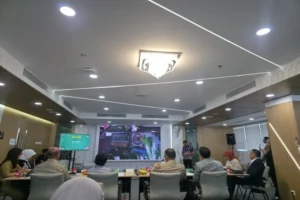
Since commencing operations in February 2024, Bitera has achieved a notable operational milestone: 100 percent power availability with zero downtime. During a media roundtable event held on November 9, Marketing Senior Associate Putri Allysha underscored this achievement, noting that the facility has maintained uninterrupted service from its grand opening to the present day.
This continuous uptime is underpinned by a resilient power architecture. The facility’s primary electricity supply is backed by a 100 percent Renewable Energy Certificate (REC) issued by state electricity company PT PLN (Persero), aligning directly with corporate Environmental, Social, and Governance (ESG) mandates and Indonesia’s broader national target toward Net Zero Emissions. Furthermore, to safeguard against potential grid instabilities or blackouts originating from the primary power source, Bitera incorporates a redundant power setup featuring two independent sets of heavy-duty backup generators. This dual-layered redundancy ensures seamless continuity for critical financial and enterprise workloads around the clock.
Innovative Thermal Management: The Closed-Loop Cooling Advantage
One of the most pressing environmental concerns associated with modern data centers is their immense consumption of water and electricity for cooling. Traditional facilities, particularly those housing high-density AI computing clusters, frequently rely on open-loop liquid cooling systems or cooling towers that require continuous water evaporation to dissipate heat. This process can consume hundreds of thousands of liters of water daily, placing a heavy burden on local municipal water supplies.
Bitera has bypassed this environmental pitfall by implementing an advanced magnetic air-cooled chiller system paired with a closed-loop thermal regulation framework. CEO Tedy Harjanto emphasized that the technology deployed at the Jakarta facility represents global best practices in energy and water efficiency, explicitly avoiding the high evaporation rates characteristic of conventional cooling towers.
According to company data, the entire Bitera building consumes approximately 500 cubic meters of water per month—a volume that Chief Operating Officer Gary Robinson notes is comparable to the water used to irrigate the landscape surrounding the building. Crucially, this 500-cubic-meter figure encompasses total facility-wide consumption rather than being exclusively dedicated to IT equipment cooling.
Detailing the mechanics of the system, Robinson explained that the closed-loop infrastructure captures ambient air within the building, which is then processed using high-efficiency refrigerants to chill water within a closed circuit. This chilled water is subsequently pumped into the data halls. Within each data hall, specialized computer room air handler units route the chilled water through cooling coils, circulating refreshing, regulated air throughout the server spaces without letting the water escape into the atmosphere through evaporation.
To maintain optimal hardware performance while preventing environmental degradation, the facility regulates its data hall temperatures at approximately 24 degrees Celsius. Robinson pointed out that maintaining excessively low temperatures is not only energy-intensive but also counterproductive, as it elevates indoor humidity levels and introduces mechanical risks to sensitive IT hardware.
Comprehensive Certifications, Security Standards, and Risk Mitigation
In the digital infrastructure sector, operational resilience must be matched by verifiable compliance with international standards. Bitera has systematically acquired a broad portfolio of certifications from the International Organization for Standardization (ISO), covering quality management (ISO 9001), environmental management (ISO 14001), information security management (ISO/IEC 27001), occupational health and safety (ISO 45001), and business continuity management (ISO 22301).
On the structural and infrastructural front, Bitera’s building design and construction have achieved Tier III certification standards under the Uptime Institute’s Tier Certification of Design Documents (TCDD) and Tier Certification of Constructed Facility (TCCF) frameworks. These certifications validate that the facility is concurrently maintainable, meaning any planned maintenance on power or cooling components will not disrupt client operations.
Security remains a foundational pillar of Bitera’s value proposition. The data center adheres to the Payment Card Industry Data Security Standard (PCI DSS), making it an optimal hosting environment for financial institutions and e-commerce platforms that process sensitive cardholder data. Additionally, the facility regularly undergoes rigorous Threat, Vulnerability, and Risk Assessments (TVRA).
Addressing the cybersecurity and physical security posture of the enterprise, Robinson confirmed that the facility has maintained a spotless record against major security breaches. While routine internet-scale nuisances such as automated bot traffic and minor spam occur, Bitera has experienced zero successful physical intrusions or serious cyber breaches since its inception. This robust defense mechanism validates the multi-layered security protocols implemented to protect enterprise assets.
Broader Implications for Indonesia’s Digital Economy
The operational model demonstrated by Bitera carries significant implications for the future trajectory of Indonesia’s digital landscape. As the Indonesian government accelerates its national digital transformation roadmap—fostering the growth of fintech unicorns, digital banking, and government cloud initiatives—the demand for domestic data storage will scale exponentially.
However, rapid digitalization cannot occur in a vacuum; it must align with national carbon-reduction commitments and sustainable urban planning. By proving that a metro edge data center can operate with minimal water consumption, rely entirely on certified renewable energy, and maintain flawless uptime, Bitera sets a new benchmark for infrastructure developers across the archipelago.
The integration of closed-loop cooling and high-efficiency power sourcing demonstrates that technological advancement and ecological responsibility are not mutually exclusive. As enterprises increasingly prioritize ESG compliance in their vendor selection processes, facilities that combine ultra-low latency, rigorous security certifications, and sustainable engineering will inevitably become the backbone of Southeast Asia’s sustainable digital economy.