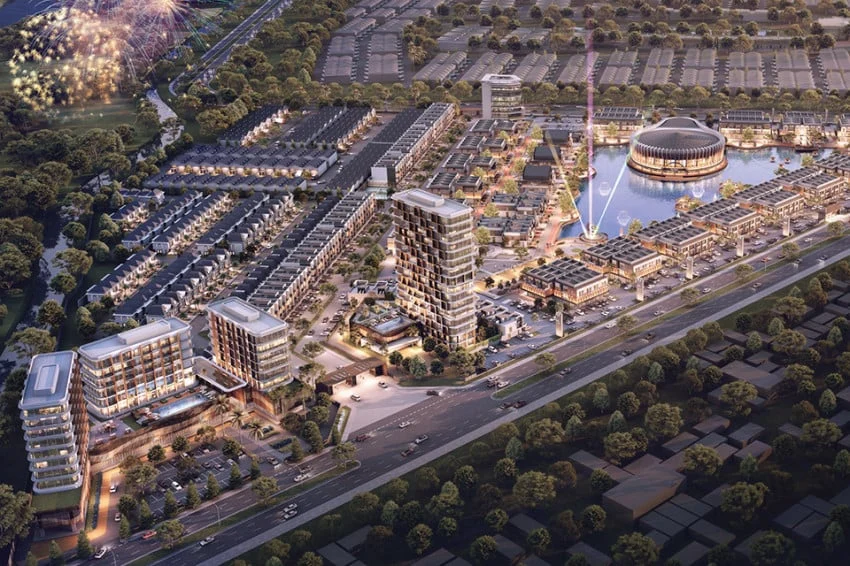
The rapid economic expansion of Batam, one of Indonesia’s most strategic industrial and commercial hubs, has placed significant pressure on the city’s urban infrastructure. As businesses and populations migrate toward this island city, the demand for commercial space has evolved beyond mere utility. Modern urbanites and business owners are no longer satisfied with traditional shophouse developments characterized by heat-retaining concrete expanses, narrow walkways, and poor water management. Addressing these systemic challenges, Tana Group has unveiled AURUM Batam, a 20-hectare mixed-use development in the Bengkong district that shifts the paradigm from transactional architecture to experiential, human-centric design.
The Evolution of Commercial Space in Batam
For decades, commercial development in secondary cities across Indonesia followed a rigid, efficiency-first model. In Batam, this often resulted in fragmented urban landscapes where retail hubs functioned as "in-and-out" points—places designed exclusively for the quick exchange of goods and services. However, as Batam positions itself as a premier destination for both international investment and domestic tourism, the limitations of these older models have become glaringly apparent.
Common issues plaguing traditional commercial clusters include the "urban heat island" effect, where vast amounts of asphalt and concrete trap heat, making pedestrian travel uncomfortable. Furthermore, the lack of integrated drainage systems often leads to flash flooding during the intense monsoon seasons characteristic of the Riau Islands. Recognizing these pitfalls, the master planning of AURUM Batam represents a strategic departure, prioritizing environmental resilience and social interaction as the foundational pillars of the project.
Strategic Planning: The 50/50 Green Ratio
At the heart of the AURUM Batam master plan is an ambitious land-use policy: dedicating 50% of the total 20-hectare site to public green spaces and communal infrastructure, while reserving the remaining 50% for commercial activities. This ratio is rarely seen in private commercial developments, which typically prioritize maximizing the Gross Floor Area (GFA) for revenue generation.
Francesca Margati, Director of Tana Group, highlights that the philosophy behind the project is to foster a sense of "place" rather than just a commercial zone. "Traditionally, many commercial areas are built solely for transactions. People arrive, complete their business, and leave. We want AURUM Batam to be a destination where people feel comfortable spending their time. This is why we have designed the landscape from the very beginning to unify the entire area, creating a cohesive experience that bridges the gap between work, retail, and leisure," Margati stated.
AurumQua: The Blue-Green Infrastructure Core
The centerpiece of the development is "AurumQua," a two-hectare man-made lake that serves as more than just an aesthetic feature. It is a critical component of the development’s "blue-green" infrastructure. By integrating water bodies with extensive greenery, the developers aim to regulate the microclimate of the Bengkong area, naturally cooling the air and improving the overall quality of the urban environment.
To ensure the design met international standards, Tana Group collaborated with SIURA Studio, the Singapore-based landscape architecture firm renowned for its work on the award-winning Tebet Eco Park in Jakarta. SIURA’s approach involves moving away from the conventional, dangerous open-drainage systems that have long defined many Indonesian commercial districts. Instead, AURUM Batam utilizes advanced subterranean drainage engineering. By moving water management systems underground, the development effectively reclaims valuable surface area, providing wider, safer, and more pleasant walkways for pedestrians.
Fact-Based Analysis: Implications for Batam’s Economy
The economic implications of such a development are significant. According to regional economic data, Batam has consistently recorded growth rates exceeding the national average, driven largely by its Free Trade Zone status and proximity to Singapore. However, for the city to attract high-value talent and sustainable long-term investment, the quality of life within its urban centers must improve.
AURUM Batam acts as a catalyst for "placemaking," a design concept that creates high-quality public spaces to promote people’s health, happiness, and economic well-being. By providing a controlled, aesthetically pleasing environment, the development is expected to extend the "dwell time" of visitors. In the retail industry, increased dwell time is directly correlated with higher spending per capita. Furthermore, the focus on biodiversity and water management reduces long-term maintenance costs and mitigates the risks associated with climate change, such as seasonal flooding—a major concern for business continuity in tropical coastal cities.
Chronology and Project Milestones
The development of AURUM Batam follows a multi-phase implementation strategy:
- Master Planning Phase (Pre-2023): Initial site assessment of the 20-hectare Bengkong tract, focusing on topography, hydrologic conditions, and local economic needs.
- Design Partnership (Early 2023): Collaboration with SIURA Studio to finalize the blue-green infrastructure design, including the blueprints for the AurumQua lake and pedestrian circulation networks.
- Infrastructure Development (Late 2023–2024): Execution of subterranean drainage systems and site grading to ensure flood resilience.
- Current Phase (2025): Focus on the integration of commercial structures with the completed landscape, transitioning from foundational site work to the activation of retail and community spaces.
Regional Context and Industry Trends
The shift toward "24/7 Urban Hubs" is becoming a global trend in property development. As discussed in recent industry discourse, commercial hubs that integrate residential, retail, and recreational elements are far more resilient to economic fluctuations than mono-functional developments.
In the broader context of Indonesian property, the AURUM Batam project mirrors a transition seen in larger metropolitan areas like Jakarta and Bali, where developers are increasingly incorporating "lifestyle-first" elements. For investors, this represents a transition from high-risk, low-quality assets to "trophy" assets that appreciate in value due to their superior environment and functional versatility.
Sustainability and Environmental Stewardship
The reliance on blue-green infrastructure is a forward-thinking response to urban environmental challenges. By incorporating native flora and water filtration systems within the AurumQua area, the project supports local ecosystems, which are often decimated in traditional construction. The use of permeable paving, shade-providing canopy trees, and reflective architectural materials further combats the urban heat island effect.
From a regulatory standpoint, the development aligns with national efforts to promote "Green Cities" (Kota Hijau) in Indonesia. By effectively managing stormwater on-site, AURUM Batam lessens the burden on the city’s municipal drainage systems, setting a benchmark for future private developments in the region.
Stakeholder Perspectives and Future Outlook
While Tana Group leads the project, the success of AURUM Batam will ultimately depend on the synergy between the developer, the municipal government, and the business tenants. Industry analysts suggest that if successful, the AURUM model could serve as a template for other commercial zones in Batam.
The integration of professional landscape management—a common practice in Singapore but still emerging in Indonesia—suggests that the long-term viability of the project is a priority. By treating the landscape as a primary asset, Tana Group is protecting its investment from the rapid degradation often associated with poorly maintained commercial estates.
As Batam continues to evolve into a sophisticated, internationally-linked city, developments like AURUM Batam are no longer luxury options; they are becoming essential components of the urban fabric. By prioritizing human experience, ecological health, and commercial efficiency, the project offers a blueprint for the next generation of Indonesian commercial real estate. The shift toward sustainable, integrated urban design is a clear indicator that the market is maturing, demanding spaces that are not only profitable but also responsible and sustainable for the long-term benefit of the city and its residents.