The 1999 presidential and vice-presidential elections in Indonesia represent a seminal moment in the nation’s post-Soeharto democratic transition. Following the collapse of the New Order regime in 1998, the People’s Consultative Assembly (MPR) became the central stage for determining the nation’s leadership. The events of October 1999, specifically the selection of the vice president, remain a critical case study in Indonesian political maneuvering, illustrating the volatile interplay between electoral mandates, coalition building, and legislative pragmatism.
The Context of the 1999 Political Landscape
To understand the election of Megawati Soekarnoputri as Vice President, one must examine the backdrop of the 1999 legislative elections. The Indonesian Democratic Party of Struggle (PDI-P), led by Megawati, emerged as the clear winner of the June 1999 legislative vote, securing the largest share of the popular vote and the highest number of seats in the House of Representatives (DPR). Under normal democratic conventions, this victory would have positioned Megawati as the presumptive president.
However, the political architecture of the time, governed by the MPR, allowed for a parliamentary-style selection process. While PDI-P held the most seats, it did not hold an absolute majority, leaving the door open for other factions to form alliances. This vulnerability was exploited by the "Central Axis" (Poros Tengah), a loose coalition of Islamic-based parties orchestrated by Amien Rais, the influential figurehead of the National Mandate Party (PAN). The coalition sought to prevent what they perceived as a secular-nationalist hegemony, successfully rallying behind KH Abdurrahman Wahid, or Gus Dur, the charismatic leader of the National Awakening Party (PKB).
The Presidential Election: A Shift in Momentum
The presidential vote on October 20, 1999, served as a shock to the political establishment. Despite PDI-P’s electoral victory, the MPR session concluded with Gus Dur securing 373 votes, while Megawati trailed with 313 votes. The result triggered immediate unrest among PDI-P supporters, who felt that the democratic mandate of the people had been usurped by backroom legislative deals.
The outcome highlighted the profound influence of the MPR in the immediate post-Soeharto era. The assembly, which included appointed members from the military and regional delegates, acted as a gatekeeper of power. With Gus Dur installed as the fourth President of the Republic of Indonesia, the immediate political crisis shifted to the selection of a vice president, a post that became essential for maintaining national stability and appeasing the disenfranchised supporters of PDI-P.
The Vice-Presidential Contest: Megawati vs. Hamzah Haz
Following her defeat in the presidential bid, the pressure mounted on the political elite to incorporate Megawati into the executive branch to prevent further civil instability. On October 21, 1999, the MPR convened to select the vice president. The contest featured two primary contenders: Megawati Soekarnoputri and Hamzah Haz, the leader of the United Development Party (PPP).
Hamzah Haz represented a significant political force, backed by conservative elements of the Central Axis. However, the dynamics had shifted significantly overnight. President-elect Gus Dur, recognizing the necessity of national reconciliation and the potential for a PDI-P-led legislative gridlock, threw his weight behind Megawati. Reports from the time indicate that Gus Dur engaged in intensive lobbying, offering assurances to various factions that Megawati’s inclusion was the only viable path to a functioning government.

The vote was a demonstration of shifting alliances. While the Central Axis had been united against Megawati for the presidency, the necessity of maintaining a stable government led many to pivot. Megawati eventually defeated Hamzah Haz, securing a mandate that effectively served as a "cooling-off" mechanism for the nation.
Chronology of the October 1999 MPR Session
- June 7, 1999: Indonesia holds its first free legislative elections since 1955. PDI-P wins the plurality of votes.
- October 19, 1999: The MPR convenes for the General Session to elect the President and Vice President.
- October 20, 1999: Presidential election results are announced. Gus Dur (373 votes) defeats Megawati Soekarnoputri (313 votes).
- October 20-21, 1999 (Overnight): Intense political negotiations occur between PDI-P, PKB, and other factions to reach a consensus on the vice presidency.
- October 21, 1999: Vice-presidential election takes place. Megawati secures the position, defeating Hamzah Haz.
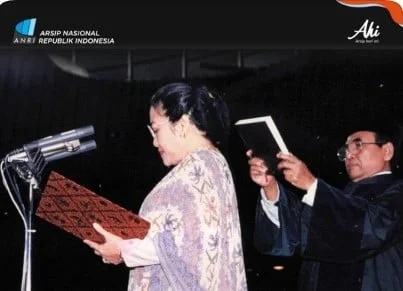
- October 21, 1999 (Afternoon): Megawati Soekarnoputri is officially sworn in as the 8th Vice President of the Republic of Indonesia.
Data Analysis and Political Implications
The events of 1999 highlight the inherent tensions of the parliamentary model in a nascent democracy. The gap between the popular vote and the legislative outcome led to a reconfiguration of the executive branch. The figures are telling: while PDI-P had 33.7% of the vote, the coalition-building process necessitated that Megawati accept the second-in-command position.
From a political science perspective, the appointment of Megawati as vice president served as a strategic "power-sharing" arrangement. It neutralized the potential for mass protests by PDI-P supporters and provided the Gus Dur administration with a degree of legislative support, albeit fragile. This arrangement would eventually prove unsustainable, leading to the impeachment of Gus Dur in 2001, at which point Megawati ascended to the presidency.
The Role of Hamzah Haz
It is important to note the position of Hamzah Haz during this period. As a representative of the PPP, his candidacy represented the influence of political Islam in the post-Soeharto era. Although he lost to Megawati in 1999, Hamzah Haz remained a central figure in Indonesian politics, later ascending to the vice presidency in 2001 under Megawati’s administration. His career serves as a bridge between the old-guard political structures and the emerging democratic era.
Broader Impact on Indonesian Governance
The 1999 election process spurred constitutional reforms. The realization that the MPR-led selection process was prone to intense volatility and could potentially contradict the popular will led to the landmark constitutional amendments between 1999 and 2002. These amendments transitioned Indonesia toward a direct presidential election system (Pilpres), which was first implemented in 2004.
By moving away from legislative selection, Indonesia aimed to ensure that the President and Vice President would derive their legitimacy directly from the voters, rather than through the shifting sands of parliamentary coalitions. The "Megawati vs. Hamzah Haz" episode stands as the final major example of the old model—a historical relic of a transition period characterized by negotiation, compromise, and the delicate balancing of competing political interests.
Conclusion
The selection of Megawati Soekarnoputri as Vice President in 1999 was not merely a matter of electoral results; it was an act of political preservation. In a country reeling from the trauma of the 1998 crisis, the MPR session acted as a pressure valve. While the process was criticized for ignoring the clear winner of the legislative polls, it succeeded in preventing the total fragmentation of the state.
Today, the 1999 election serves as a reminder of the fragility of early democracy. It highlights how political giants like Gus Dur, Megawati, and Hamzah Haz navigated a system that was still being written. As Indonesia continues to refine its democratic practices, the lessons of that October day remain relevant, emphasizing the importance of political stability, the necessity of compromise, and the ongoing evolution toward a more direct and transparent system of governance.