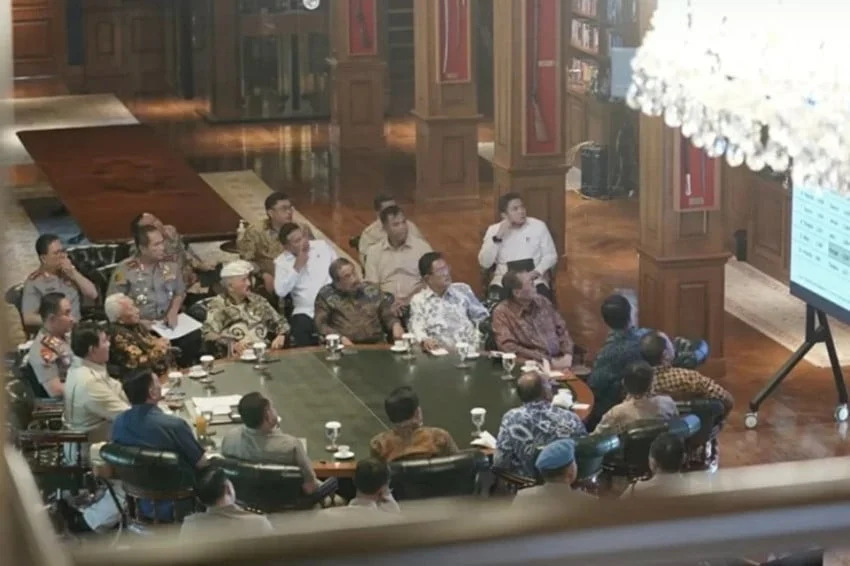
BOGOR — In a high-stakes meeting held at his private residence in Hambalang, Bogor, Indonesian President Prabowo Subianto addressed one of the most sensitive national security concerns to rock the country’s political and law enforcement landscape in recent memory. On Sunday, November 8, 2026, President Prabowo convened a strategic gathering with several former Chiefs of the Indonesian National Police (Kapolri). The discussions heavily centered around a burgeoning controversy involving allegations of illegal surveillance and wiretapping targeted at the highest office of the state, allegedly linked to high-ranking police officials, including former National Police Chief General Listyo Sigit Prabowo and several other high-ranking officers.
The closed-door meeting brought together veteran leaders of the law enforcement agency to deliberate on the unfolding crisis, which has sent shockwaves through Indonesia’s bureaucratic, military, and political establishments. Among the attendees was former Kapolri General Police (Ret.) Da’i Bachtiar, who provided crucial insights to the press following the conclusion of the session. Speaking on Monday, November 9, 2026, Da’i Bachtiar offered a rare and candid glimpse into the personal reaction of the Head of State upon discovering that he had allegedly been subjected to covert electronic monitoring.
According to Da’i Bachtiar, President Prabowo did not attempt to downplay the gravity of the situation, openly admitting that the revelation came as a profound shock. The interception saga, which has rapidly transformed from an internal institutional headache into a full-scale constitutional dilemma, has placed the Indonesian National Police (Polri) under intense public scrutiny and internal turmoil.
The Shock at Hambalang: Inside the Presidential Briefing
The tranquil hills of Hambalang, often the backdrop for pivotal political strategy sessions, served as the venue for a somber discussion on institutional integrity and national security. President Prabowo, a former military general intimately familiar with intelligence operations and state counter-espionage protocols, reportedly expressed genuine astonishment when presented with intelligence detailing the alleged wiretapping operation.
"Yes, he stated that ‘I myself was also quite surprised, truly shocked’ regarding the matter of the wiretapping," Da’i Bachtiar recounted to journalists on Monday, detailing the president’s demeanor during the high-level consultations.
The gathering was deliberately organized to seek counsel and perspective from former police chiefs who have navigated decades of institutional crises, political transitions, and internal disciplinary challenges. By bringing in respected elder statesmen of the force, the administration aimed to project a posture of measured governance and deliberate crisis management, ensuring that the integrity of the broader police institution would not be irreparably compromised by the actions of a few individuals.
Da’i Bachtiar did not shy away from characterizing the scandal for what it truly represents to the foundational credibility of law enforcement in Indonesia. Describing the scandal with stark candor, he acknowledged that the ongoing controversy involving several high-ranking police officers effectively constitutes a severe institutional crisis. "It happens that we all know about it. I call it a disaster within the police force," Da’i Bachtiar remarked, reflecting the deep dismay felt by many veteran officers who spent their careers building the reputation of the Bhayangkara Corps.
Background Context: Unraveling the Wiretapping Scandal
The origins of the current surveillance controversy trace back weeks prior to the Hambalang meeting, sparked by mounting internal tensions and classified leaks regarding clandestine intelligence-gathering activities. The scandal broke into the public domain following sweeping disclosures—notably amplified by legal experts and senior administration figures such as Coordinating Minister for Legal, Human Rights, Immigration, and Corrections Yusril Ihza Mahendra—who began pulling back the curtain on how the alleged spying apparatus was uncovered.

Preliminary investigations and internal security sweeps reportedly revealed that advanced electronic surveillance devices and software capable of intercepting encrypted telecommunications, tracking real-time movements, and recording high-level policy discussions had been deployed in proximity to sensitive state corridors. The discovery that such state-of-the-art wiretapping tools were allegedly operationalized without proper legal authorization, let alone the direct knowledge or consent of the executive branch, triggered immediate alarm bells within the state intelligence apparatus and the presidential palace.
The involvement of names connected to former Kapolri General Listyo Sigit Prabowo and various other senior officers has transformed the affair into an unprecedented institutional showdown. Under Indonesian law, unauthorized wiretapping conducted by domestic security agencies against the democratically elected head of state constitutes a grave breach of statutory law, touching upon matters of treason, abuse of power, and severe violations of the Law on Information and Electronic Transactions (ITE), alongside criminal code provisions regarding espionage and executive protection.
Chronology of Events and Escalating Tensions
The timeline of the crisis highlights a rapid escalation from whispered intelligence reports to open political confrontation:
- Late October 2026: Initial security anomalies are detected during routine counter-surveillance sweeps conducted by the Presidential Security Force (Paspampres) and state intelligence agencies around key executive workspaces.
- Early November 2026: Forensic analysis confirms the presence of unauthorized interception hardware and software links, with preliminary internal intelligence pointing toward networks allegedly associated with elements within the National Police.
- November 7, 2026: High-level briefings are delivered directly to President Prabowo Subianto, detailing the scope of the alleged surveillance and identifying key personnel suspected of orchestrating or facilitating the operation.
- November 8, 2026: President Prabowo convenes an emergency consultation at his residence in Hambalang, Bogor, inviting former Chiefs of Police, including Da’i Bachtiar, to assess the institutional fallout and chart a path forward.
- November 9, 2026: Public disclosures emerge as veteran figures like Da’i Bachtiar speak to the media, confirming the president’s shock and acknowledging the profound "disaster" facing the police force.
Broader Implications and Institutional Fallout
The revelation that the Indonesian National Police—or rogue factions within it—may have monitored the nation’s chief executive carries profound ramifications for civil-military relations, the separation of powers, and the ongoing reform of Indonesia’s security sector.
For an administration that has consistently emphasized the rule of law, institutional transparency, and systemic anti-corruption measures, the scandal presents both a monumental challenge and a decisive test of resolve. Observers note that how the Prabowo administration handles the investigation will establish a crucial precedent for executive oversight over intelligence and law enforcement agencies.
If proven true, the use of police intelligence assets to spy on the civilian leadership signals a dangerous overreach reminiscent of authoritarian eras, directly undermining the democratic accountability that reform-era Indonesia has fought for decades to establish. Consequently, legal analysts anticipate sweeping internal purges, structural overhauls of police intelligence divisions, and potentially severe criminal indictments against any active-duty officers found culpable.
Furthermore, the scandal risks deeply demoralizing the rank-and-file officers of the National Police who strive to maintain public trust through daily policing duties. Leadership figures like Da’i Bachtiar stepping forward to publicly condemn the incident underscore an urgent effort by the senior policing community to distance the broader institution from the alleged misconduct of specific individuals.
As investigations proceed under the watchful eye of both the executive branch and independent oversight bodies, the nation waits to see whether the full truth behind the Hambalang wiretapping affair will be brought to light. What is certain is that President Prabowo’s administration is treating the breach with the utmost gravity, signaling that institutional accountability will be enforced regardless of rank, badge, or past affiliation.