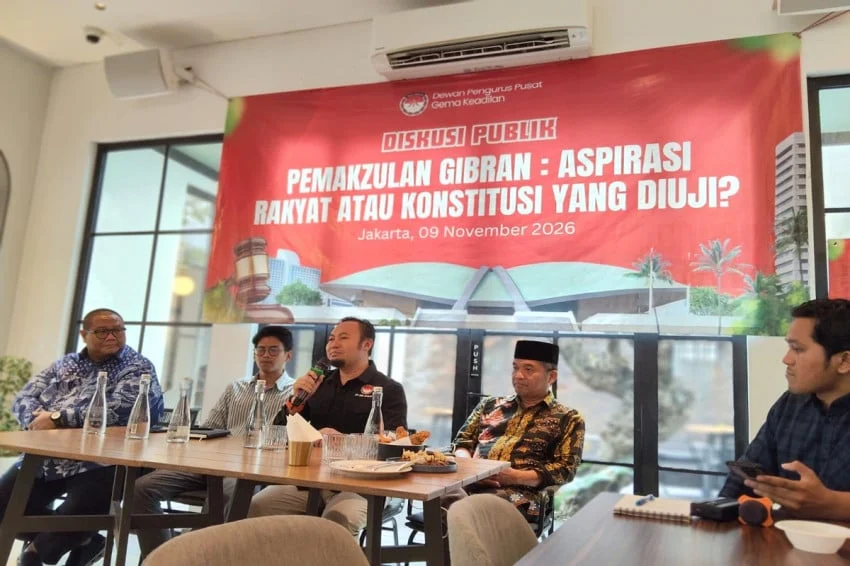
The political landscape in Indonesia has entered a tense new phase following mounting calls from various civil society organizations and political factions regarding the constitutional legitimacy of Vice President Gibran Rakabuming Raka. In a recent public discussion held in Cikini, Central Jakarta, the Central Executive Board of Gema Keadilan (DPP Gema Keadilan) officially urged the House of Representatives (DPR RI) to initiate the use of its Right to Express an Opinion, commonly known as Hak Menyatakan Pendapat (HMP). This legislative mechanism is being pushed as a constitutional pathway to address the escalating controversy surrounding what critics have termed the "Ijazah Gate" scandal and the broader debate over the vice president’s eligibility.
Rahmat Saleh, the General Chairman of DPP Gema Keadilan who also serves as a member of the DPR RI, made headlines during the forum by explicitly declaring his readiness to spearhead and sign the formal proposal for the HMP if it is officially brought to the parliament floor. The event, titled "Gibran’s Impeachment: Public Aspiration or the Constitution Put to the Test?", served as a focal point for legal experts, activists, and politicians to debate the intersection of recent judicial rulings and executive legitimacy. As political pressure mounts in the halls of Senayan, the unfolding situation highlights deep-seated debates over constitutional integrity, judicial consistency, and public trust in Indonesia’s democratic institutions.
The Legal and Constitutional Background of the Controversy
The core of the current political friction stems from a series of contested decisions and interpretations issued by the Constitutional Court (Mahkamah Konstitusi – MK) and the Supreme Court (Mahkamah Agung – MA). Over recent months, civic groups and legal scholars have scrutinized the administrative requirements and educational credentials submitted by public officials during the previous election cycle. Critics argue that ambiguities and alleged procedural flaws in how these requirements were validated have undermined the transparency expected of the nation’s highest offices.
During the public discussion, Rahmat Saleh emphasized that recent developments in rulings from both the MK and the MA have provided a substantive legal foundation for the legislature to exercise its constitutional oversight functions. According to Rahmat, the parliament cannot remain passive in the face of persistent public questioning regarding the integrity of executive credentials.
"If the HMP is rolled out in the DPR, I am ready to be among the members of parliament who sign the proposal," Rahmat stated during the Cikini forum. He further underscored that the issue transcends partisan politics, framing it instead as a fundamental test of the nation’s constitutional framework, the strict adherence to public office requirements, and the preservation of public confidence in democratic governance.
Chronology of Events Leading to the HMP Push
The momentum behind the push for the Right to Express an Opinion did not materialize overnight. It represents the culmination of months of escalating tensions, legal challenges, and public debates that began prior to the inauguration of the current administration and have steadily intensified.
Phase 1: Pre-Election Eligibility Challenges
Long before the ballots were cast, various legal coalitions and independent groups questioned the administrative eligibility criteria of candidates, particularly concerning educational background verifications and adjustments to candidacy age requirements made by the Constitutional Court. These initial challenges laid the groundwork for ongoing skepticism among specific segments of civil society.
Phase 2: Post-Inauguration Legal Scrutiny
Following the swearing-in of the president and vice president, legal challenges shifted from electoral disqualification attempts to institutional accountability mechanisms. Activists and legal aid organizations began compiling dossiers regarding administrative discrepancies, famously dubbed by public commentators as "Ijazah Gate." These groups argued that discrepancies in official documentation warranted formal legislative investigation.
Phase 3: Civil Society Mobilization and Public Forums
As public discourse grew louder, organizations such as Gema Keadilan stepped up by organizing public symposia, legal workshops, and panel discussions. These platforms brought together constitutional law experts, student leaders, and political figures to debate whether public dissatisfaction had reached a threshold that justifies constitutional intervention by the legislature.

Phase 4: Legislative Response and the Call for HMP
The most recent development involves active members of parliament responding to these civil society pressures. Statements from key legislators, including reports that several lawmakers are viewing the HMP proposal with cautious openness, have signaled that the debate has successfully transitioned from the streets and university campuses into the legislative chambers of Senayan.
Legal Perspectives and Institutional Implications
Under the Indonesian 1945 Constitution and the Law on the People’s Consultative Assembly, House of Representatives, and Regional Representative Council (UU MD3), the Right to Express an Opinion (HMP) is one of the ultimate supervisory tools available to the DPR. It is a formal instrument through which the legislature can state its official view on a policy, a national crisis, or an alleged violation of law by the executive branch, potentially leading to further constitutional consequences, including impeachment proceedings.
Legal analysts point out that invoking the HMP is an inherently high-threshold political process. It requires substantial political maneuvering, bipartisan consensus, and adherence to strict procedural steps within parliamentary committees. Anton Aryadi, the Head of the Legal Aid Institute (LBH) of Gema Keadilan, adopted an even firmer stance during the Cikini discussion, publicly suggesting that Gibran Rakabuming Raka consider voluntarily stepping down from the vice presidency to alleviate national political tension and preserve constitutional stability.
However, constitutional scholars remain divided on the practical viability of such measures. Proponents argue that exercising legislative oversight is essential to maintaining accountability and ensuring that no public official is above the scrutiny of administrative law. Conversely, cautious observers warn that invoking extreme mechanisms like the HMP over disputed credential claims could introduce severe political instability, polarize the legislature, and disrupt the governance of the state at a time when economic recovery and administrative continuity are paramount.
Reactions from Political Factions in the DPR
The proposition to utilize the HMP has elicited mixed reactions across the various political parties represented in the House of Representatives. While some opposition factions and reform-minded legislators have expressed conditional openness to reviewing the proposal, ruling coalition parties have largely defended the legitimacy of the administration, emphasizing that both the election results and the administrative validation processes were conducted in accordance with prevailing laws and validated by authorized state institutions.
Ahmad Doli, a prominent senior legislator, noted that while a number of parliamentarians have responded positively to discussions regarding the potential use of the HMP, transforming these discussions into a formal parliamentary quorum requires overcoming significant procedural hurdles. The threshold for initiating an HMP requires backing from a substantial number of representatives spanning multiple factions, ensuring that any motion brought to the plenary session commands serious political weight rather than isolated partisan posturing.
Broader Socio-Political Impact and Future Outlook
The ongoing debate over the "Ijazah Gate" controversy and the potential invocation of the HMP carries profound implications for Indonesia’s democratic trajectory. It tests the resilience of the nation’s checks and balances, the independence of its judicial bodies, and the responsiveness of its elected representatives to grassroots concerns.
As DPP Gema Keadilan and allied legal organizations continue to lobby lawmakers in Senayan, public attention remains firmly fixed on whether political parties will translate public discourse into formal legislative action. Regardless of whether the HMP motion successfully secures the necessary signatures to reach the floor of the DPR, the episode underscores a growing public demand for absolute transparency, rigorous adherence to constitutional requirements, and unwavering accountability from the highest echelons of executive power. The coming weeks in Jakarta will likely determine whether this legislative initiative gains momentum or subsides into another chapter of Indonesia’s vibrant, albeit turbulent, political debates.