The transformation of traditional farming practices into technology-driven enterprises has emerged as a cornerstone of national economic resilience in Indonesia. In a decisive move toward achieving long-term agricultural independence, the Ministry of Agriculture, in close collaboration with the Regional Government of Sukabumi Regency, is aggressively scaling up the adoption of modern farming methodologies. At the heart of this initiative is the implementation of the Pertanian Modern–Advanced Agriculture System (PM-AAS), a comprehensive technological framework designed to optimize yield, minimize operational losses, and secure sustainable food production across high-potential agricultural zones.
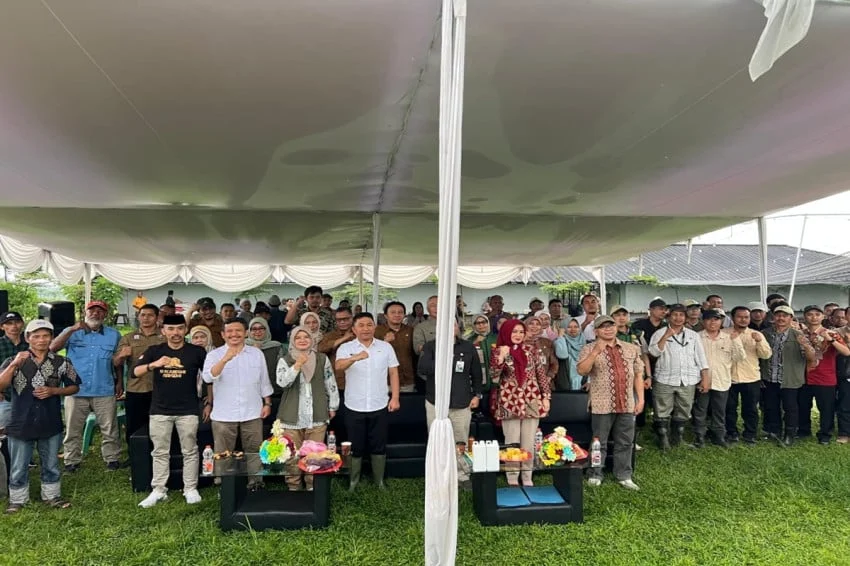
This strategic partnership materialized through the official launch of the Field School for Rice Cultivation Implementation under the PM-AAS framework. Hosted at the farming grounds of the Subur Rejeki Farmers Group in Sukaresmi Village, Cisaat Subdistrict, Sukabumi Regency, the initiative marks a pivotal milestone in the region’s trajectory toward systemic agricultural modernization. Rather than relying solely on top-down directives, the program prioritizes localized capacity building, bridging the gap between advanced scientific research and daily farming practices on the ground.
Expanding Technological Footprint Across Sukabumi Regency
The launch in Cisaat Subdistrict is not an isolated experiment, but rather a calculated expansion of an ongoing regional modernization strategy. Prior to the establishment of the Sukaresmi field school, the Ministry of Agriculture and the Sukabumi regional government successfully rolled out the PM-AAS optimization program across two distinct geographic regions: Palabuhanratu and Waluran subdistricts.
By diversifying the testing grounds across coastal, valley, and plateau agroecosystems, agricultural authorities aim to gather comprehensive empirical data on how the PM-AAS framework adapts to varying soil compositions, microclimates, and irrigation availabilities. The systematic rollout allows technical teams to fine-tune the technology, ensuring that local farming communities are not merely recipients of imported machinery, but active participants in tailoring modern practices to their specific regional environments.
Chronology of Success: The Path to the Sukaresmi Harvest
The momentum behind the PM-AAS rollout in Sukabumi is anchored by tangible, quantifiable successes on the ground. The timeline of this agricultural transformation gained significant traction on October 15, 2026, when a dedicated demonstration plot (demplot) spanning 2,800 square meters in Sukaresmi reached maturity.
Following months of closely monitored cultivation under the PM-AAS protocols, the harvest evaluation—conducted through standardized ubinan (crop cutting estimation) methods—yielded results that exceeded traditional regional averages. The highest ubinan measurement recorded during the event was equivalent to an astounding 11,2 tons of harvested dry unhusked rice (gabah kering panen) per hectare.
This high-yield milestone served as a powerful proof-of-concept for local farmers who had spent generations relying on conventional planting cycles and intuition-based fertilization. The October 15 harvest did not merely signal a successful crop cycle; it established a new benchmark for what is agriculturally and economically possible within the region when modern inputs are paired with precise agronomic management.
Core Pillars of the PM-AAS Framework
The high yields recorded in Sukaresmi are the direct result of a multi-faceted technological intervention. The PM-AAS framework is not limited to a single mechanical upgrade, but encompasses an entire ecosystem of agricultural engineering and biological management.
-
Precision Seed and Variety Management: The initiative emphasizes the use of superior, certified seed varieties capable of maximizing response to targeted nutrient applications while maintaining high resistance to regional blights and lodging.
-
Optimized Planting Techniques: Moving away from traditional random broadcasting, the program implements systematic planting geometries—such as the modified legowo system—which optimizes sunlight capture, air circulation, and nutrient absorption for every individual plant.
-
Scientific Fertilization Regimes: Soil testing and customized nutrient management ensure that nitrogen, phosphorus, potassium, and essential micronutrients are delivered precisely when the crop demands them during its vegetative and reproductive stages, eliminating waste and environmental runoff.
-
Integrated Pest Management (IPM): The framework trains farmers in the early detection and biological or targeted chemical control of Organisme Pengganggu Tumbuhan (OPT)—plant pest organisms—preventing minor infestations from escalating into catastrophic crop losses.
-
Agroecosystem Alignment: Continuous evaluation ensures that the machinery, water management systems, and chemical inputs deployed are structurally compatible with the local environment, preventing soil degradation and ensuring long-term ecological sustainability.
Official Perspectives and Strategic Alignment
The urgency of scaling up the PM-AAS framework is underscored by broader national policy dialogues surrounding resource security. In parallel with discussions in legislative bodies regarding the absolute necessity of resource self-reliance—such as parallel legislative drives emphasizing that energy and gas self-sufficiency are just as vital to national sovereignty as food self-sufficiency—local executives are aligning regional policies with national food security mandates.
During the inauguration and subsequent evaluations of the PM-AAS program, Sukabumi Vice Bupati H. Andreas emphasized that the modernization initiative is the most viable pathway to fulfilling the central government’s mandate for sustainable food self-sufficiency. He noted that technological adoption must be paired with institutional resilience at the grassroots level.
To support this integration, the Sukabumi Regency Government has officially championed a localized strategic framework known as the "Sangkuriang" strategy, an acronym translating to Swasembada Pangan Berkelanjutan dan Kemandirian Pangan (Sustainable Food Self-Sufficiency and Food Independence). This strategic umbrella coordinates regional extension services, infrastructure development, and financial literacy programs for farmer groups, ensuring that the productivity gains achieved through pilot projects like PM-AAS can be institutionalized across the entire agricultural sector of the regency.
Economic Implications and Farmer Capacity Building
The transition toward advanced agriculture carries profound socioeconomic implications for rural communities in Sukabumi. Historically, Indonesian smallholder farmers have faced shrinking profit margins driven by rising input costs—particularly chemical fertilizers and labor—coupled with stagnant or fluctuating farmgate prices.
By increasing output per hectare from traditional averages of 5 to 7 tons up to the 11.2 tons demonstrated by the PM-AAS framework, the economic equation for the farmer shifts dramatically. Higher productivity per unit of land directly translates to increased net household income, helping to reverse the demographic trend of rural youth abandoning agriculture for urban employment.
Furthermore, the Field School model addresses the human capital deficit that often hampers technological adoption. Agricultural extension officers, working hand-in-hand with researchers from the Ministry of Agriculture, conduct structured learning sessions that blend classroom theory with hands-on field execution. Farmers learn not just how to operate machinery or apply specific inputs, but why those practices matter, empowering them to make independent, data-driven decisions in future seasons.
Broader Impact on National Food Security Architecture
On a macroeconomic scale, localized successes in regions like Sukabumi are vital building blocks for Indonesia’s national food security architecture. As global supply chains face increasing volatility driven by climate anomalies, geopolitical tensions, and shifting weather patterns, reliance on international food imports exposes the domestic economy to severe inflationary pressures.
Programs like the PM-AAS initiative directly address the supply side of the equation by structurally raising the baseline productivity of Indonesia’s agrarian heartlands. If scalable models achieving over 11 tons per hectare can be successfully replicated across Java and expanded to outer islands, the nation moves substantially closer to permanent self-sufficiency in staple commodities.
Challenges and the Road Ahead
Despite the impressive initial results recorded on October 15, agricultural economists and ministry officials stress that sustained success will require continuous monitoring and adaptive management. Several challenges remain on the horizon:
- Infrastructure Bottlenecks: Ensuring consistent irrigation access and post-harvest drying facilities to handle increased yields without post-harvest loss.
- Financial Access: Expanding micro-credit facilities and agricultural insurance schemes so that smallholder farmers can afford the upfront costs of advanced seeds and mechanical inputs.
- Climate Resilience: Adapting the PM-AAS protocols to unpredictable weather patterns, including prolonged droughts induced by El Niño or excessive rainfall driven by La Niña phenomena.
The Ministry of Agriculture and the Sukabumi Regency Government have committed to maintaining an active oversight and evaluation loop. By regularly assessing the performance of demonstration plots, addressing farmer feedback, and refining the curriculum of the Field Schools, the stakeholders intend to build an enduring model of modern agrarian success.
Conclusion: A Blueprint for Modern Indonesian Agriculture
The synergy between the Ministry of Agriculture and the Sukabumi Regency Government in deploying the Pertanian Modern–Advanced Agriculture System represents a forward-looking approach to one of the nation’s most pressing challenges. Through rigorous capacity building, targeted technological deployment, and strategic frameworks like the Sangkuriang initiative, Sukabumi is proving that traditional farming can successfully evolve into a high-tech, highly productive enterprise.
As the findings from the Sukaresmi field school continue to be analyzed and disseminated, the initiative stands as a replicable blueprint for agricultural modernization nationwide—proving that with the right combination of science, policy, and grassroots participation, Indonesia’s vision of sustainable food self-sufficiency is well within reach.