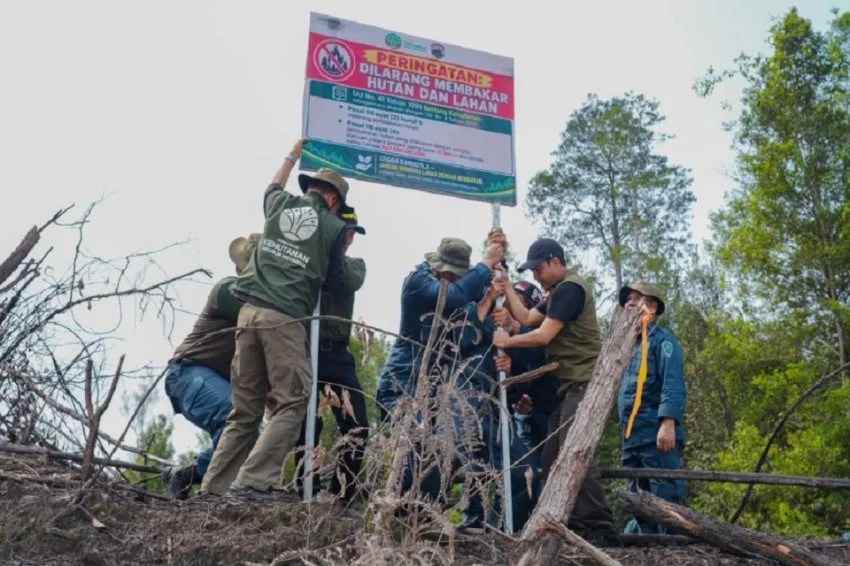
The Indonesian Ministry of Forestry has ramped up its efforts to safeguard vulnerable forest ecosystems by officially installing warning and prohibition signs across various post-wildfire zones in Central Kalimantan. This strategic intervention targets specific areas previously ravaged by forest and land fires, locally known as karhutla, where unauthorized activities pose a severe threat to ecological recovery. By clearly marking these lands, the government aims to establish a transparent legal boundary, preventing opportunistic encroachment, illegal logging, and unauthorized land utilization in zones that are currently undergoing mandatory environmental rehabilitation.
The deployment of these physical markers follows a series of stringent enforcement actions taken against holders of Forest Utilization Business Permits, commonly abbreviated as PBPH. These concession areas were previously slapped with severe administrative sanctions by the Ministry of Forestry due to ecological degradation resulting from fires within their boundaries. The punitive measures enforced by the ministry include the formal freezing of operational permits and the imposition of compulsory environmental restoration obligations. Under Indonesian forestry regulations, concessionaires found legally or administratively responsible for fires on their leased lands are mandated to restore the damaged ecosystems at their own expense, during which all commercial and unauthorized activities are strictly prohibited.
The aftermath of severe forest fires leaves vast tracts of land highly vulnerable to further exploitation. Burned and degraded landscapes often attract illegal land grabbers, unauthorized miners, and illicit loggers who take advantage of compromised ecological barriers and temporarily weakened institutional oversight. Recognizing this high-risk window, the Ministry of Forestry determined that legal enforcement alone—such as sporadic patrols or retroactive legal filings—is insufficient to deter unlawful actors on the ground. The installation of prominent, official warning signs serves as a proactive, visual deterrent, unmistakably signaling to local communities and external actors that the land is under strict state monitoring and legal protection.
Minister of Forestry Raja Juli Antoni recently emphasized that institutional limitations, such as a shortage of active forest rangers, known locally as Polhut, must never serve as an impediment to comprehensive forest protection. He asserted that contemporary environmental enforcement requires a paradigm shift toward smarter, more tactical oversight. This approach involves leveraging intelligence data to pinpoint high-risk zones, optimizing resource allocation, and deploying visible deterrents like prohibition signages to secure vast landscapes that might otherwise escape continuous physical surveillance.
The escalation of forestry enforcement in Central Kalimantan and neighboring provinces is part of a broader, aggressive campaign by the Indonesian government to hold corporate entities accountable for environmental degradation. Just weeks prior to the placement of these warning signs, the Ministry of Forestry officially designated two major corporate entities as suspects in ongoing criminal investigations regarding suspected deliberate or negligence-driven forest fires in West Kalimantan and Central Kalimantan. These legal maneuvers represent a significant tightening of environmental governance, signaling a departure from traditional leniency toward corporate negligence in land-clearing practices.
To fully understand the gravity of the current situation in Central Kalimantan, one must examine the broader historical and environmental context of forest and land fires in the region. Central Kalimantan encompasses millions of hectares of tropical rainforests and critical carbon-rich peatland ecosystems. For decades, the province has been the epicenter of annual dry-season fires, driven by a combination of extreme weather anomalies induced by phenomena like El Niño, prolonged droughts, and the widespread drainage of peatlands for agricultural and plantation expansion.
The ecological implications of these recurring fires are catastrophic. Beyond the immediate destruction of flora and fauna, burning peatlands release massive quantities of sequestered carbon dioxide into the atmosphere, contributing significantly to global climate change. Furthermore, the resulting transboundary haze routinely poses severe public health crises across Southeast Asia, disrupting aviation, closing schools, and causing respiratory ailments for millions of citizens. When a concession area suffers a major wildfire, the ecological balance is shattered, and the soil loses its structural integrity. If left unprotected, these burned landscapes become prime targets for illegal occupation, where opportunistic individuals attempt to convert public forest estate lands into informal agricultural plots or palm oil smallholdings through slash-and-burn methods.

The chronology of the current enforcement actions in Central Kalimantan unfolds against this backdrop of heightened regulatory scrutiny. The timeline began with the detection of massive thermal hotspots and subsequent satellite mapping of burned areas during the peak of the dry season. Environmental impact assessments quickly followed, identifying specific corporate concessions where negligence or failure to maintain adequate fire prevention infrastructure contributed to the spread of the flames.
Following the scientific and field verification of the fires, the Ministry of Forestry initiated administrative audits of the responsible PBPH holders. By late 2024 and extending into the administrative cycles of 2025 and 2026, the ministry issued formal decrees freezing the operational permits of non-compliant corporations. Alongside these suspensions, legally binding orders were issued requiring the concessionaires to execute comprehensive ecosystem recovery plans. Recognizing that these administrative processes take time and that suspended lands often fall into a regulatory vacuum during the interim period, the ministry authorized the immediate physical demarcation of these zones through warning signs, effectively establishing a state of emergency conservation on the affected plots.
The strategic decision to install prohibition signs carries profound operational and legal implications. Legally, the presence of these signs strips away any plausible deniability for trespassers or encroachers claiming ignorance of the land’s protected status. It transforms unauthorized entry and land utilization from potential civil disputes into clear-cut criminal offenses involving the violation of state-secured forestry zones and ongoing ecological restoration sites. Operationally, it acts as a force multiplier for the limited number of forest rangers stationed in Central Kalimantan. While rangers cannot physically stand guard over every hectare of burned peatland, the signs act as permanent sentinels, warning potential violators that the state is actively watching and that legal repercussions will follow.
Environmental law experts and civil society organizations have largely welcomed the ministry’s proactive stance, viewing the visible demarcation of sanctioned lands as a necessary step toward ending impunity in the forestry sector. For years, critics argued that suspended concessions often continued to operate in the shadows, with permit holders or local actors quietly exploiting the land while administrative appeals dragged on in courts. By asserting physical control and explicitly banning unauthorized activities on the ground, the Ministry of Forestry is demonstrating a firmer commitment to administrative enforcement and environmental restoration.
However, challenges remain. The sheer scale of Central Kalimantan’s geography means that monitoring and maintaining these signs will require sustained logistical support and active community engagement. Forest authorities acknowledge that signs alone cannot stop determined illegal actors unless backed by rigorous, routine patrols and swift judicial follow-through when violations are detected. Furthermore, the success of these restoration zones depends heavily on the cooperation of local communities living adjacent to the burned areas. Integrating local populations into community-based fire prevention and forest watch programs is viewed by conservationists as a vital complementary strategy to ensure that restored lands are not re-ignited or illegally cleared.
The broader implications of the Ministry of Forestry’s actions in Central Kalimantan extend far beyond regional boundaries. As Indonesia faces mounting international pressure to meet its ambitious climate commitments—particularly under the Forestry and Other Land Use (FOLU) Net Sink 2030 operational plan—demonstrating credible, on-the-ground enforcement against illegal land use and forest degradation is paramount. The global community closely monitors how Jakarta handles corporate accountability and ecosystem restoration in carbon-dense provinces like Central Kalimantan.
In conclusion, the installation of prohibition and warning signs across post-wildfire zones in Central Kalimantan represents a tangible escalation in Indonesia’s fight against environmental degradation and illegal land exploitation. By bridging the gap between high-level administrative sanctions and localized field enforcement, the Ministry of Forestry is signaling a new era of proactive environmental governance. As these vulnerable landscapes embark on the long, arduous journey of ecological recovery, the success of these initiatives will rely on the sustained political will of the government, rigorous legal prosecution of violators, and the active participation of all stakeholders in safeguarding Indonesia’s irreplaceable natural heritage.