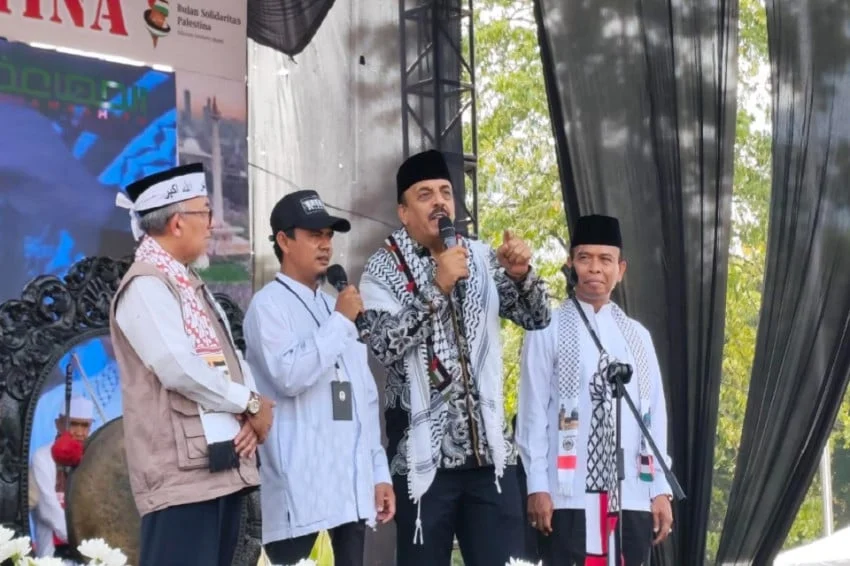
Jakarta – The diplomatic relationship between Indonesia and Palestine has once again taken center stage as Palestinian Ambassador to Indonesia, H.E. Abdulfattah A.K. Al-Sattari, publicly addressed the United Nations’ recent call for Indonesia to withdraw from the Board of Peace (BoP). Speaking in Jakarta on Sunday, November 1, 2026, the Ambassador emphasized that while participation in such international bodies remains a sovereign decision for Jakarta, the relevance and efficacy of the Board of Peace itself have significantly diminished in the current geopolitical climate.
Ambassador Al-Sattari’s remarks come at a time when Indonesia is actively demonstrating its unwavering solidarity with Palestine through various nationwide initiatives, most notably the commencement of the 2026 Palestinian Solidarity Month. His commentary highlights the delicate balance developing nations must maintain when navigating multilateral frameworks that are frequently paralyzed by competing superpower interests. Furthermore, the Ambassador lauded Indonesia’s historical and contemporary diplomatic agility, expressing absolute confidence in Jakarta’s strategic capacity to advocate for Palestinian self-determination without compromising its broader foreign policy objectives.
The Evolution and Current Status of the Board of Peace
To understand the context of Ambassador Al-Sattari’s assessment, it is necessary to examine the trajectory and structural limitations of the Board of Peace (BoP). Originally conceived as a multilateral mechanism to foster dialogue, stabilize post-conflict zones, and coordinate humanitarian relief, the BoP has increasingly struggled to maintain its core mandate. Over recent years, shifting global power dynamics and a concentration of diplomatic bandwidth among Western superpowers have diluted the organization’s operational focus.
According to Ambassador Al-Sattari, the BoP has become largely "hambar"—a term translating to bland, flavorless, or ineffective—in its current structural standing. The primary driver behind this institutional inertia is the shifting geopolitical focus of the United States, a principal architect and participant in many Western-led multilateral bodies. Washington’s foreign policy apparatus has been overwhelmingly consumed by multifaceted crises spanning multiple theaters, including escalating tensions involving Iran, protracted instability in Yemen, political fragmentation in Libya, and volatility in Lebanon.
This dispersion of strategic attention has created a vacuum where pressing, long-standing humanitarian and political crises—foremost among them the plight of the Palestinian people under Israeli occupation—are frequently relegated to the periphery. Consequently, participation in bodies like the BoP offers diminishing returns for nations genuinely committed to resolving the core grievances of the Middle East, prompting international actors to reevaluate the utility of their engagement.
Indonesia’s Diplomatic Astuteness and Sovereign Prerogative
Addressing the UN’s recommendation that Indonesia withdraw from the BoP, Ambassador Al-Sattari maintained a respectful and pragmatic stance, reiterating that such decisions are strictly within the sovereign purview of the Indonesian government. However, his overarching evaluation of Indonesian diplomacy was effusive in its praise. He characterized Jakarta’s foreign policy maneuvers as exceptionally astute, highlighting the nation’s ability to navigate complex international forums without losing sight of its constitutional mandate to oppose colonialism and support global independence.
"Indonesia is very, very smart in playing its politics, especially regarding the issue of supporting Palestine," Ambassador Al-Sattari stated during his address at the South Plaza of the National Monument (Monas) in Jakarta. He underscored that Indonesia possesses the institutional maturity, historical experience, and diplomatic weight to independently assess which international platforms genuinely advance the Palestinian cause and which serve merely as bureaucratic distractions.
This diplomatic maturity is rooted in Indonesia’s foundational foreign policy doctrine of "free and active" ( bebas aktif), which allows Jakarta to engage constructively with various international organizations while retaining the autonomy to dissociate from frameworks that fail to deliver tangible results. By refusing to be rigidly bound by external directives—such as the recent UN recommendation concerning the BoP—Indonesia demonstrates an independent foreign policy posture that prioritizes substantive outcomes over performative multilateralism.
The Broader Context: The 2026 Palestinian Solidarity Month
Ambassador Al-Sattari’s remarks were delivered against the backdrop of massive public mobilization in Indonesia, coinciding with the official launch of the 2026 Palestinian Solidarity Month. This annual observance serves as a powerful testament to the deep emotional and political ties binding the Indonesian public and government to the Palestinian struggle.
The 2026 calendar for the Solidarity Month features a robust array of public events designed to maintain domestic awareness and channel grassroots support into concrete humanitarian action. Among the eight marquee agendas scheduled for the month are the high-profile Solidarity Run and a massive Long March culminating at the historic Istiqlal Mosque in central Jakarta. These events draw hundreds of thousands of participants, ranging from civil society organizations and religious leaders to ordinary citizens, all uniting under the banner of humanitarian solidarity and justice.
The convergence of high-level diplomatic commentary from the Palestinian Ambassador and widespread public demonstrations underscores a unique dynamic in Indonesia: foreign policy toward Palestine is not merely an elite-level bureaucratic exercise, but a deeply internalized national commitment. Successive Indonesian administrations, regardless of political shifts, have maintained an unyielding stance opposing Israeli zionism and supporting a sovereign Palestinian state based on pre-1967 borders with East Jerusalem as its capital.
Fact-Based Analysis: Implications for Multilateral Diplomacy
The friction between United Nations recommendations and national sovereign decisions, as highlighted by the BoP controversy, points to a broader crisis of confidence in traditional multilateral institutions. For decades, international bodies have been criticized by the Global South for structural biases, selective enforcement of international law, and an inability to halt protracted conflicts, particularly the ongoing occupation and humanitarian catastrophe in Palestine.
When international organizations issue directives or recommendations that appear disconnected from the ground realities of geopolitical power struggles—such as asking a committed supporter like Indonesia to alter its institutional engagements—it often prompts targeted pushback or quiet reassessment by member states. Indonesia’s measured response reflects a pragmatic understanding that institutional titles within global bodies matter far less than consistent, principled advocacy in both bilateral and multilateral arenas.
Furthermore, Ambassador Al-Sattari’s acknowledgment of Western preoccupation with other regional conflicts illustrates the fragmentation of the global security architecture. As traditional Western powers spread their diplomatic and military resources thin across multiple global flashpoints, middle powers like Indonesia are stepping into a more assertive role. By maintaining strategic clarity and refusing to be bogged down by ineffective bureaucratic mechanisms, Jakarta positions itself as a credible, independent voice capable of fostering genuine dialogue and practical assistance for Palestine.
Future Outlook and Policy Directions
Looking ahead, the diplomatic fallout from the BoP debate is unlikely to strain relations between Jakarta and Ramallah. On the contrary, the transparent dialogue between Ambassador Al-Sattari and Indonesian officials reinforces a mutual trust forged through decades of solidarity. Indonesia’s refusal to blindly follow external bureaucratic pressures regarding its international affiliations signals a maturing foreign policy apparatus equipped to handle the complexities of a multipolar world.
As the events of the 2026 Palestinian Solidarity Month unfold across the archipelago, the Indonesian government faces both domestic expectation and international scrutiny to maintain its leadership role on the Palestinian issue. Whether through humanitarian aid delivery, diplomatic lobbying at the United Nations General Assembly, or grassroots mobilization, Jakarta’s strategy remains aligned with the aspirations of the Palestinian people.
Ultimately, Ambassador Al-Sattari’s endorsement of Indonesia’s diplomatic acumen serves as a validation of Jakarta’s careful navigation of international waters. As global governance structures face unprecedented stress tests, Indonesia’s ability to balance sovereign autonomy with principled international solidarity offers a compelling model for middle-power diplomacy in the twenty-first century.