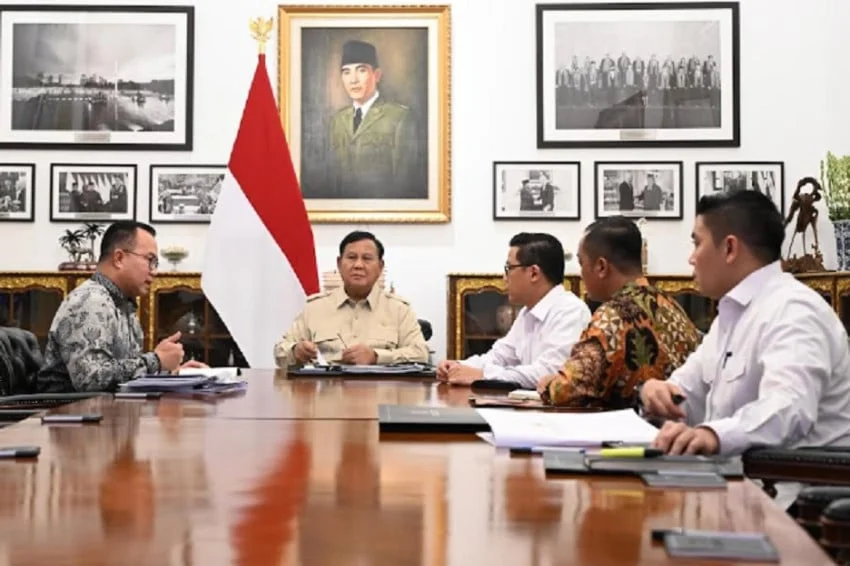
In a high-level meeting held at the Merdeka Palace in Jakarta on Tuesday, February 27, 2026, President Prabowo Subianto convened with the Head of the National Research and Innovation Agency (BRIN), Arif Satria. The engagement serves as a critical checkpoint in the administration’s efforts to integrate scientific rigor into national policy-making. As Indonesia navigates complex environmental, energy, and public health challenges, the discourse between the President and the nation’s chief scientist highlights a shift toward evidence-based governance, specifically targeting climate resilience and sustainable resource management.
The Strategic Mandate of the Meeting
The discussion between President Prabowo and Arif Satria centered on four primary pillars of national importance: the mitigation of forest and land fires (karhutla), the development of alternative energy sourced from palm oil waste, the acceleration of medical research regarding vaccines and herbal medicine, and the implementation of advanced technological solutions for waste management.
President Prabowo’s administration has consistently signaled that scientific intervention is not merely an academic pursuit but an operational necessity. By prioritizing these sectors, the government aims to reduce dependency on traditional fossil fuels, enhance the country’s bio-pharmaceutical sovereignty, and tackle the perennial environmental hazards that have historically hampered Indonesia’s economic and ecological stability.
Addressing the Karhutla Crisis: A Multidimensional Approach
The issue of forest and land fires remains a top priority for the administration. Indonesia’s tropical peatlands are highly susceptible to ignition during prolonged dry seasons, leading to significant economic losses and transboundary haze issues.
According to reports following the meeting, BRIN is spearheading a collaborative framework involving the Meteorology, Climatology, and Geophysics Agency (BMKG), the National Disaster Management Agency (BNPB), the Ministry of Forestry, and the Indonesian Air Force. This inter-agency synergy is designed to execute Operation Weather Modification (OMC), a sophisticated technique that utilizes dry ice and cloud seeding to induce precipitation over fire-prone regions.
However, the President underscored that reactive measures are insufficient. "Bapak President continues to monitor the fire situation and emphasizes that research results to solve these problems—whether in the short, medium, or long term—must be implemented systematically," Arif Satria stated.
The strategy now pivots toward predictive modeling. BRIN is currently developing advanced simulations to map the "fire propagation patterns." By understanding the physics of how flames spread through specific topographies and vegetation types, authorities hope to implement proactive firebreaks and early warning systems that can neutralize fire threats before they reach catastrophic scales.
Chronology of Collaborative Disaster Mitigation
The effort to institutionalize disaster research is a culmination of years of escalating environmental pressures.
- Early 2024: The Indonesian government began formalizing the integration of satellite imagery with AI-driven fire detection software.
- Late 2025: Increased pressure from regional environmental bodies and the domestic agricultural sector prompted the government to seek more permanent solutions to the annual haze.
- February 2026: The meeting at the Merdeka Palace formalizes the current mandate: moving from crisis management to predictive infrastructure.
This timeline reflects a maturing national strategy that recognizes the limitations of manual fire suppression, which is often hampered by the sheer scale and remoteness of the affected forest areas.
Bio-Energy and Waste Management: The Sustainability Frontier
Beyond environmental protection, the meeting addressed the energy transition. Indonesia, as the world’s largest producer of palm oil, possesses a significant opportunity to convert agricultural waste—specifically empty fruit bunches and palm oil mill effluent—into sustainable aviation fuel (SAF) or biomass energy.
Arif Satria highlighted that BRIN is accelerating research into "biorefinery" processes. The goal is to turn waste streams into high-value energy products. This serves a dual purpose: reducing the carbon footprint of the palm oil industry and enhancing Indonesia’s energy security. By diversifying the energy mix, the administration aims to insulate the economy from the volatility of global oil prices.
Furthermore, the discussion touched upon the growing waste crisis in urban centers. As Indonesia’s population urbanizes, landfill capacities have reached critical thresholds. BRIN’s proposed solution involves the implementation of "Waste-to-Energy" (WtE) technologies, which utilize thermal treatment or biochemical processes to convert municipal solid waste into electricity, effectively reducing the volume of waste while providing a renewable energy source for local grids.
Public Health: Vaccine Sovereignty and Herbal Integration
A significant portion of the meeting was dedicated to the health sector. The COVID-19 pandemic served as a sobering lesson for Indonesia regarding the vulnerabilities of supply chain dependency for vaccines and essential medicines.
President Prabowo has instructed BRIN to accelerate the development of domestic vaccine platforms. This includes not only standard synthetic vaccines but also the rigorous validation of Indonesia’s traditional herbal medicine, known as Jamu. The objective is to standardize the efficacy and safety profiles of these herbal products, enabling them to be integrated into the national healthcare system and potentially exported as part of the country’s growing biotechnology sector.
Implications of the Science-Policy Nexus
The implications of the Prabowo-Satria meeting are far-reaching. By centralizing research under BRIN and directly linking it to presidential oversight, the administration is attempting to bridge the "implementation gap" that has historically plagued Indonesian research institutions.
In many developing nations, scientific research often remains siloed in universities or laboratories, disconnected from the realities of policy implementation. By bringing the head of BRIN to the Merdeka Palace, the President is signaling that scientific output will serve as the baseline for budgetary allocations and administrative directives.
However, this approach faces challenges. The primary hurdle remains the scaling of research results into industrial or national-level applications. For instance, while the "fire propagation model" may be scientifically sound, its success depends on the cooperation of regional governments and private sector plantation owners who must adhere to the findings produced by these models.
Analytical Outlook
The focus on long-term predictive models suggests a paradigm shift in how the Indonesian state views environmental governance. Rather than viewing karhutla as an inevitable seasonal occurrence, the administration is treating it as a technical problem solvable through data, physics, and inter-agency coordination.
The economic implications are equally significant. If the research into palm oil waste proves commercially viable at scale, it could reshape the Indonesian agricultural sector, turning a liability—waste—into a critical national asset.
As the government moves forward, the success of these initiatives will likely be measured by the adoption rates of these technologies by the private sector and the measurable reduction in carbon emissions and fire-related air pollution. The President’s instruction to "anticipate the future" suggests that this is the beginning of a multi-year effort to modernize Indonesia’s infrastructure through the lens of scientific innovation.
Conclusion
The meeting between President Prabowo Subianto and BRIN Head Arif Satria serves as a vital indicator of the administration’s strategic priorities. By aligning the nation’s scientific resources with the most pressing environmental, energy, and health challenges, the government is setting a course for a more resilient and sustainable future. The success of these initiatives will depend on the continued integration of research into the operational heart of the state, ensuring that data-driven solutions are not just theorized, but effectively deployed to secure the welfare of the nation. As the country moves further into 2026, the progress of these research programs will remain a closely watched indicator of Indonesia’s transition toward an advanced, knowledge-based economy.