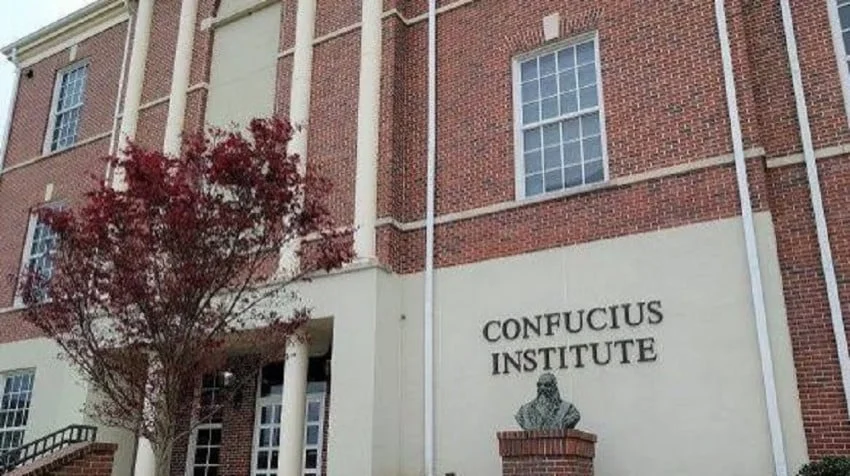
The United States Department of Defense has officially designated Chinese-funded cultural and educational centers operating within American universities, widely known as Confucius Institutes, as a substantial threat to the nation’s security interests. This strategic pivot, announced by Secretary of Defense Pete Hegseth, marks a significant escalation in the ongoing geopolitical and academic tension between Washington and Beijing. The classification serves as the latest move in a multi-year effort by the U.S. government to mitigate what it characterizes as foreign malign influence, intellectual property theft, and ideological subversion within its higher education infrastructure.
The decision follows an intensive review process by the Pentagon, which concluded that these entities, despite their outward appearance as centers for language and cultural exchange, function as conduits for Chinese state influence. According to Secretary Hegseth, the Department of Defense has identified roughly 80 new "propaganda cells" operating across 30 different U.S. universities. These entities, while occasionally operating under rebranded names or altered organizational charters, reportedly maintain the singular goal of advancing the strategic interests of the People’s Republic of China (PRC) at the expense of American academic freedom and technological security.
The Chronology of Academic Friction
The scrutiny of Confucius Institutes is not a recent development but rather the culmination of over a decade of mounting suspicion regarding the nature of academic partnerships between U.S. institutions and the Chinese government.
In 2004, the first Confucius Institute was established at the University of Maryland. By 2017, the presence of these institutes had ballooned, with over 100 branches operating across U.S. campuses. The initial appeal was largely financial and academic; universities were often provided with seed funding, teaching staff, and educational materials by the Office of Chinese Language Council International, known as Hanban—an agency under the Chinese Ministry of Education.
However, concerns began to crystallize around 2014 when the American Association of University Professors (AAUP) issued a report urging universities to review or terminate their partnerships, citing the institutes’ lack of academic freedom and their direct supervision by the Chinese government. The report highlighted that contracts often contained non-disclosure clauses and stipulated that the institutes would adhere to Chinese law, effectively prohibiting the discussion of sensitive topics such as the status of Taiwan, the events of Tiananmen Square, or the human rights situation in Xinjiang.
The pressure intensified in 2018 with the passage of the National Defense Authorization Act (NDAA). Section 1091 of the act prohibited the Department of Defense from funding Chinese language programs at universities that also hosted a Confucius Institute. This legislation triggered a massive wave of closures across the United States. By 2020, the U.S. Department of State formally designated the Confucius Institute U.S. Center as a foreign mission of the PRC, mandating that it register with the government as an agent of a foreign power.
The Pentagon’s Strategic Rationale
The Pentagon’s current stance is rooted in a comprehensive evaluation of intellectual property security. Secretary Hegseth noted that in the past two months, the Department of Defense has moved to systematically dismantle these organizational cells. The rationale is twofold: the protection of sensitive research and the preservation of intellectual independence among the student body.
The Department of Defense contends that the institutes serve as a platform for economic espionage. By embedding themselves within university ecosystems, these organizations can gain visibility into the research projects of American faculty and students, particularly in fields related to artificial intelligence, quantum computing, and biotechnology—all sectors that the PRC has identified as critical to its "Made in China 2025" industrial policy.
Furthermore, the "propaganda" component cited by Hegseth refers to the soft-power projection inherent in the institutes’ curriculum. By controlling the narrative surrounding Chinese history and governance, the institutes are accused of creating a sanitized version of Chinese policy, which the Pentagon argues is designed to influence the next generation of American scholars and policymakers, potentially shaping their perceptions in a manner favorable to the Chinese Communist Party.
Data and Dissemination of Influence
The rapid proliferation and subsequent contraction of these institutes provide a clear metric of the tension between academic autonomy and national security. At their peak, more than 100 institutes existed in the United States. Following the 2018 NDAA, this number began a steady decline as universities faced the prospect of losing critical Pentagon research grants.
Data from the National Association of Scholars (NAS) indicates that while the number of official "Confucius Institutes" has plummeted to a handful, the underlying networks have often simply rebranded. This phenomenon, which Hegseth described as "80 cells appearing under different names," suggests a "whack-a-mole" dynamic where the influence operations persist even after the specific branded entity is removed.
The financial incentive structure also played a role in their initial success. Many universities, facing budget constraints, accepted funding that covered not only language instruction but also cultural programming and student scholarships. However, critics argue that the "cost" of this funding was the institutional integrity of the university. The Pentagon’s recent action signals that it no longer views these financial benefits as worth the security risks associated with foreign oversight of campus programs.
Official Responses and Diplomatic Fallout
The response from Beijing has been swift and critical. The Chinese Ministry of Commerce has publicly urged the United States to "respect facts" and cease what it describes as discriminatory actions against academic and research cooperation. Beijing maintains that the Confucius Institutes are purely educational organizations intended to facilitate cross-cultural understanding and language acquisition.
In a statement issued following the Pentagon’s announcement, a spokesperson for the Chinese embassy in Washington argued that the U.S. government is politicizing educational exchanges. "The Confucius Institutes have always operated with transparency and have contributed positively to the mutual understanding between the peoples of China and the U.S.," the statement read. Beijing views the U.S. crackdown as a manifestation of a "Cold War mentality" and an attempt to stifle the academic freedom of its own institutions.
Within the United States, the academic community remains divided. While university administrators often emphasize the importance of international collaboration, the faculty and security communities have increasingly prioritized the risk of foreign interference. Some university boards have found themselves in a precarious position, balancing the desire for global engagement with the necessity of compliance with federal security mandates.
Implications for the Future of Academic Exchange
The designation of these institutes as a national security threat has profound implications for the future of U.S.-China academic relations. Firstly, it signals that the era of "unrestricted engagement" in research is likely over. Universities are now expected to conduct rigorous due diligence on all foreign funding sources, particularly those originating from countries designated as strategic competitors.
Secondly, the move forces a re-evaluation of how international students and visiting scholars are integrated into sensitive research environments. If the Department of Defense continues to broaden its oversight, universities may face stricter compliance requirements, which could lead to a decrease in collaborative research projects.
Thirdly, the focus on "propaganda cells" suggests that the U.S. government is increasingly concerned with the ideological environment on university campuses. This could lead to broader legislation affecting not just Confucius Institutes, but any foreign-funded entity that the government deems to be engaging in "malign influence" campaigns.
The long-term impact on the American university system will likely be a heightened emphasis on transparency. Institutions will be required to disclose all foreign gifts and contracts in greater detail, a practice that has already begun under updated reporting requirements from the Department of Education. While this may increase administrative burdens, proponents argue that it is a necessary step to ensure that American research and education remain independent of foreign state influence.
Ultimately, the Pentagon’s decision underscores a broader transformation in U.S. foreign policy. In an era of great power competition, the boundaries between military, economic, and cultural spheres have blurred. Education, once considered a neutral ground for international cooperation, is now a front line in the competition for global influence and intellectual superiority. As the United States moves to "systematically dismantle" these networks, the challenge will be to maintain a vibrant, open academic environment while simultaneously safeguarding the research and values that underpin national security.