Jakarta – In a milestone development for Indonesia’s petrochemical and industrial engineering sectors, PT Tripatra Engineers and Constructors (Tripatra) has officially announced its successful delivery of a major industrial infrastructure project in collaboration with PT Kaltim Parna Industri (KPI). The newly inaugurated facility, located in Bontang, East Kalimantan, is designed for carbon dioxide (CO2) liquefaction and stands as a pioneering achievement in the region. Built with a design capacity of 300 metric tons per day, the plant transforms industrial byproducts into high-value commercial commodities, bridging the gap between heavy industrial production and sustainable environmental stewardship.
The facility officially commenced operations following its inauguration, marking a significant step forward for KPI, a premier petrochemical business unit under the Parna Raya Group. Tripatra, a renowned Indonesian engineering-driven solutions provider, executed the complex undertaking through a comprehensive Engineering, Procurement, and Construction (EPC) contract. By converting carbon emissions from an industrial byproduct into a purified, commercially viable resource, the project underscores a growing corporate commitment in Indonesia to integrate circular economy principles into heavy manufacturing operations.
Project Overview and Technical Scope
The newly established plant in Bontang is engineered to capture gaseous carbon dioxide generated as a byproduct during KPI’s primary manufacturing operations, specifically from the production of ammonia. Rather than releasing these emissions into the atmosphere or leaving them unutilized, the facility deploys advanced purification and liquefaction technologies to transform the gas into liquid CO2 (LCO2).
The resulting product meets stringent quality thresholds, making it fully compliant with rigorous industrial and food-grade standards. This ensures that the output can be safely and effectively utilized across various commercial sectors, including the food and beverage industry—where liquid carbon dioxide is essential for carbonation, refrigeration, and food preservation—as well as other chemical and manufacturing applications.
With a daily production capacity of 300 metric tons, the facility represents a massive scale of operations. The engineering execution required sophisticated handling of cryogenic processes, rigorous safety protocols for high-purity gas processing, and seamless integration with KPI’s existing ammonia production infrastructure. Tripatra’s deployment of its core EPC competencies ensured that the facility was constructed to international standards of safety, quality, and environmental compliance.
Leadership Perspectives and Strategic Vision
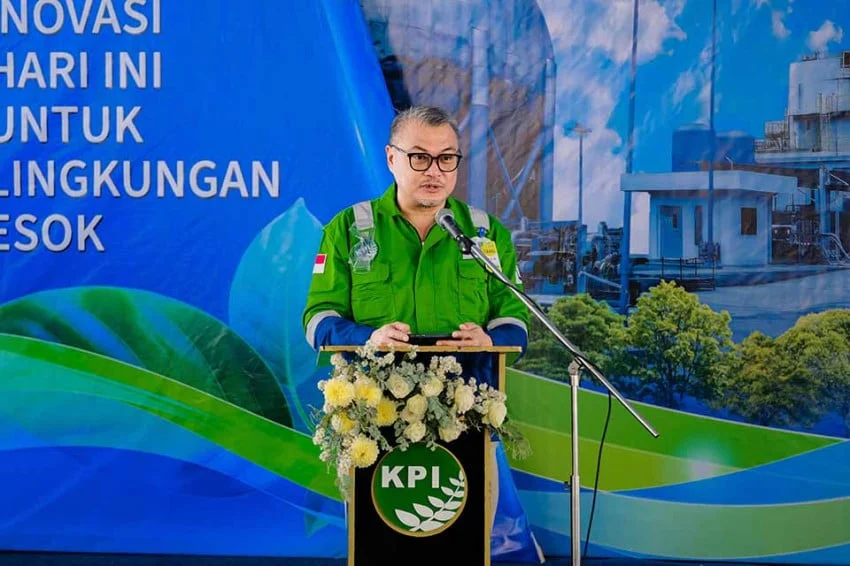
Speaking at the inauguration, Raymond Naldi Rasfuldi, President Director and CEO of Tripatra, expressed deep gratitude for the trust bestowed upon his company by KPI throughout the project lifecycle. He emphasized that the successful completion of the plant is not merely an engineering triumph, but a testament to collaborative dedication.
"This trust is both a significant responsibility and a profound source of pride for us to support the business development of KPI," stated Raymond Naldi Rasfuldi. "As an engineering-driven solutions provider, Tripatra is proud to support KPI in realizing the construction of the largest CO2 liquefaction plant in Indonesia, which is also the first of its kind in the island of Kalimantan and the eastern region of Indonesia."
Raymond further highlighted the collaborative nature of the achievement, noting that the complex undertaking was brought to fruition through the collective resilience, diligence, and unwavering commitment of the teams from KPI, Tripatra, and the various specialized project partners involved.
Leadership from the Parna Raya Group and KPI echoed these sentiments, pointing out that the facility aligns with the corporation’s long-term strategic vision to diversify its product portfolio while simultaneously mitigating its environmental footprint. By transitioning from traditional waste management to resource recovery, KPI has positioned itself as an forward-looking entity within Indonesia’s competitive petrochemical landscape.
Implementation of Carbon Capture and Utilization (CCU)
At the heart of the Bontang facility’s operational model is the application of Carbon Capture and Utilization (CCU). Unlike Carbon Capture and Storage (CCS)—which typically focuses on permanently injecting captured greenhouse gases into deep geological formations for long-term storage—CCU involves capturing carbon dioxide and repurposing it as a raw material to create marketable products.
The CCU approach utilized in this project transforms an environmental liability into an economic asset. In the context of global climate action, CCU is increasingly recognized by international energy agencies and industrial bodies as a vital transitional technology. While it does not permanently sequester carbon forever in the way underground storage might, it displaces the need for fossil-derived CO2 in industrial supply chains, thereby reducing lifecycle emissions and fostering a closed-loop industrial ecosystem.
By implementing CCU technology at a commercial scale, KPI and Tripatra are demonstrating how heavy industries in emerging economies can proactively address sustainability challenges. The process involves capturing the exhaust gases from ammonia production, removing impurities through a series of absorption, stripping, and distillation steps, and subsequently compressing and cooling the purified gas into a liquid state ready for transport and commercial distribution.
Chronology and Project Development Milestones
The realization of Indonesia’s largest CO2 liquefaction plant is the result of years of meticulous planning, engineering design, regulatory compliance, and construction execution. Although the official inauguration took place on October 22, 2026, the genesis of the project dates back much earlier, stemming from strategic dialogues between KPI and Tripatra regarding sustainability enhancement at the Bontang complex.
- Initial Feasibility and Conceptual Design (2023–2024): KPI and Tripatra conducted extensive feasibility studies to evaluate the volume and purity of the CO2 byproduct generated from ammonia production. Engineers analyzed various technological pathways for gas purification and determined the optimal capacity required to achieve economic viability and environmental impact.
- EPC Contract Award and Detailed Engineering (2024): Following successful commercial negotiations, Tripatra was awarded the Engineering, Procurement, and Construction contract. Detailed engineering phases commenced, focusing on plant layout optimization, safety integration, and material sourcing suited for corrosive and cryogenic operational environments.
- Procurement and Fabrication (2024–2025): The procurement phase involved sourcing specialized high-grade piping, compressors, heat exchangers, and cryogenic storage tanks from global and domestic suppliers, adhering strictly to international pressure-vessel and safety codes.
- Site Construction and Modular Assembly in Bontang (2025–2026): Physical construction on the ground in Bontang, East Kalimantan, involved rigorous workforce management, safety audits, and environmental oversight. Despite logistical challenges inherent to large-scale industrial construction in regional areas, the project maintained a strong safety record.
- Pre-Commissioning, Commissioning, and Inauguration (October 2026): Rigorous testing of the control systems, pressure testing, and trial runs of the gas-processing units were conducted successfully, culminating in the formal inauguration on October 22, 2026.
Broader Economic and Environmental Implications
The commissioning of the Bontang CO2 liquefaction facility carries wide-ranging implications for the Indonesian economy, regional industrial development, and national environmental goals.
From an economic perspective, the plant diversifies KPI’s revenue streams. By converting what was previously flared or vented exhaust into a high-purity commercial commodity, the company captures additional value from its existing feedstock. Furthermore, the availability of locally produced food-grade and industrial-grade liquid CO2 in Kalimantan and eastern Indonesia reduces reliance on long-distance maritime or overland transport of liquid gas from Java, potentially lowering logistical costs for regional manufacturing and beverage sectors.
From an environmental standpoint, the facility supports Indonesia’s broader nationally determined contributions (NDCs) under the Paris Agreement. Although heavy industries face intense pressure to decarbonize, technological solutions like CCU provide a practical bridge. By putting captured carbon to productive use, industries can demonstrate measurable progress in emission reduction strategies without compromising operational output.
Additionally, the project establishes a regional precedent. Being the first facility of its kind in Kalimantan and eastern Indonesia, it provides a technical and operational blueprint for other resource-based and petrochemical companies operating in the region. As environmental regulations tighten and carbon pricing mechanisms evolve in Indonesia, early movers like KPI and Tripatra are uniquely positioned to navigate future regulatory landscapes successfully.
Conclusion and Future Outlook
The successful completion and inauguration of the PT Kaltim Parna Industri CO2 liquefaction plant by Tripatra marks a notable achievement in Indonesia’s industrial engineering sector. By uniting advanced EPC capabilities with cutting-edge Carbon Capture and Utilization technology, the project proves that environmental sustainability and commercial profitability can advance in tandem.
As Indonesia continues to pursue industrial modernization alongside its carbon reduction targets, the Bontang facility serves as a benchmark for future engineering endeavors. Moving forward, industry observers anticipate that the success of this project will catalyze further investments in circular economy infrastructure, reinforcing the nation’s industrial resilience and commitment to sustainable growth.