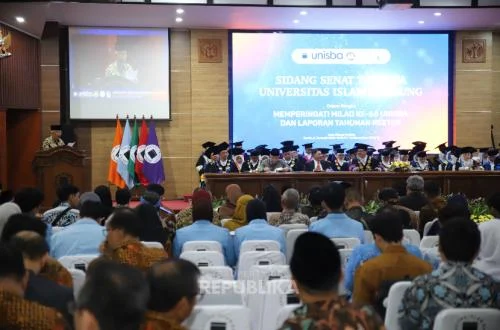
Universitas Islam Bandung (Unisba) has officially set its sights on the regional stage, announcing a comprehensive strategic vision to transform into a self-reliant, advanced, and prominent Islamic higher education institution in Asia by the year 2033. This long-term objective serves as the bedrock of the university’s newly inaugurated Rencana Strategis (Renstra) or Strategic Plan for the 2025–2029 period, which acts as the critical bridge toward the ultimate 2033 milestone.
The announcement was made during a momentous Sidang Senat Terbuka (Open Senate Session) held on Monday, November 16, 2026, at the Unisba Main Hall. The event, which commemorated the institution’s 68th anniversary, was attended by academic leaders, faculty, students, and representatives from government and industry partners. Under the theme "Moving with Faith, Making an Impact for Civilization," the university outlined its commitment to integrating spiritual values with academic rigor and global standards.
The IMAN Framework: A Blueprint for Development
To navigate the complexities of modern higher education, Unisba Rector Prof. Ir. A. Harits Nu’man, M.T., Ph.D., IPU., ASEAN Eng., introduced the "IMAN" framework. This strategic pillar serves as the philosophical and operational guide for the university’s growth over the next decade.
The framework consists of four foundational pillars:
- Islamic Spirit: Ensuring that the institution remains grounded in its religious identity, fostering an environment where faith informs scientific inquiry and ethical conduct.
- Maintenance and Sustainability: Prioritizing the long-term viability of the university’s infrastructure, financial systems, and environmental responsibilities.
- Adaptability: Enhancing the university’s ability to respond to the rapidly changing technological and societal landscapes, particularly regarding digital transformation and pedagogy.
- National and Global Excellence: Striving for competitiveness on the world stage, ensuring that research and graduates meet international benchmarks.
Institutional Growth and Academic Performance
As of late 2026, Unisba operates with a robust academic ecosystem, supporting 9,947 active students across 10 faculties and 37 distinct study programs. The effectiveness of these programs is reflected in the 2025 Tracer Study, which highlights that graduates now experience an average waiting period of only three months to secure their first professional employment. This statistic is a significant indicator of the university’s success in aligning its curriculum with industry needs.
Internationalization remains a key metric of success for the institution. The latest data indicates 317 instances of international student mobility and 727 certifications of professional competence among the student body. These figures suggest a concerted effort to move beyond domestic boundaries, preparing graduates for a globalized workforce.
Research, SDGs, and Environmental Leadership
Unisba’s commitment to the Sustainable Development Goals (SDGs) has yielded tangible results. The university has successfully met or exceeded performance indicators for six out of eight targeted SDG categories. This academic excellence has been recognized internationally; the university currently holds the 35th position in Indonesia according to the THE Impact Rankings 2025 and is ranked within the 1,001–1,500 group globally. Notably, it stands as the top-ranked Private Islamic University (PTIS) in West Java.
A primary example of this impact is the "HI-CARE Zero Waste Arcamanik" initiative. This large-scale collaborative project involved 500 students and 100 faculty members working across 54 administrative villages (RW). By implementing systematic waste management practices, the program successfully increased waste sorting efficiency by 87 percent and diverted 562.7 tons of organic waste from landfills. In recognition of this effort, the Governor of West Java presented the Rector of Unisba with the Appreciation Award for Contribution in Waste Management, specifically in the category of Action and Collaboration.
Socio-Economic Contribution and Community Engagement
Beyond environmental stewardship, Unisba has actively engaged in socio-economic development. The institution provided scholarships to 788 students in the past year, ensuring that academic quality is not limited by financial background. Furthermore, the university has provided formal mentorship to 235 Micro, Small, and Medium Enterprises (MSMEs), helping them navigate the challenges of the modern economy.
The "Lembur Hibar" (Lembur Bebas Rentenir or Village Free from Loan Sharks) program serves as a testament to the university’s community-centric approach. By providing financial literacy and alternative credit solutions, the program has become a model for community empowerment, earning Second Place in the 2025 Mandaya Awards.
Governance and Future Challenges
The university’s administrative integrity has been bolstered by its consistent financial management. For three consecutive years, Unisba has maintained an unqualified opinion (Wajar Tanpa Pengecualian/WTP) in its financial audits, signaling a high level of transparency and accountability in institutional governance.
Despite these achievements, leadership remains cognizant of the hurdles ahead. Prof. Harits Nu’man acknowledged that several critical areas require intensified focus during the 2025–2029 cycle. Specifically, the university intends to accelerate the digitalization of student services, modernize pedagogical processes, diversify its revenue streams, and—perhaps most importantly—improve the "hilirisasi" (downstreaming) of research results. The goal is to ensure that academic findings do not remain confined to journals but are actively applied to solve industrial and societal problems.
"The future of Unisba is a collective mandate," Prof. Harits stated during his address. "It belongs to the lecturers, the educational staff, the students, the alumni, and our partners. We must move forward in unison, sharing a single direction and purpose."
Reflections from Leadership
Prof. Dr. KH. Miftah Faridl, Chairman of the Unisba University Foundation, emphasized that the 68th anniversary is not merely a celebration of the past but a moment for serious introspection. He highlighted that the longevity of the institution serves as a foundation for strengthening its devotion to the community. As the university moves into its next phase, the foundation’s role will be to ensure that the "Islamic Spirit" remains the compass by which all administrative and academic decisions are measured.
Implications and Outlook
The roadmap toward 2033 represents a significant shift for Unisba. By aligning its strategic plan with global impact rankings and local socio-economic needs, the university is positioning itself as an essential node in the Indonesian educational landscape. The focus on "hilirisasi" suggests a transition toward an entrepreneurial university model, which is essential for long-term sustainability in the higher education sector.
If Unisba continues to maintain its current trajectory—balancing spiritual identity with rigorous research and community-driven projects—it is likely to exert a greater influence on policy and development within West Java and beyond. The challenge remains in the execution of the digital transformation and the ability to attract international partnerships that can sustain its goal of becoming a premier institution in Asia.
As the university embarks on its 2025–2029 Strategic Plan, the academic community and the public will be watching closely to see how effectively the IMAN pillars translate into tangible global standing. With a solid foundation in governance and a clear vision for the future, Unisba enters its 68th year with the confidence of an institution that has successfully bridged the gap between tradition and innovation.