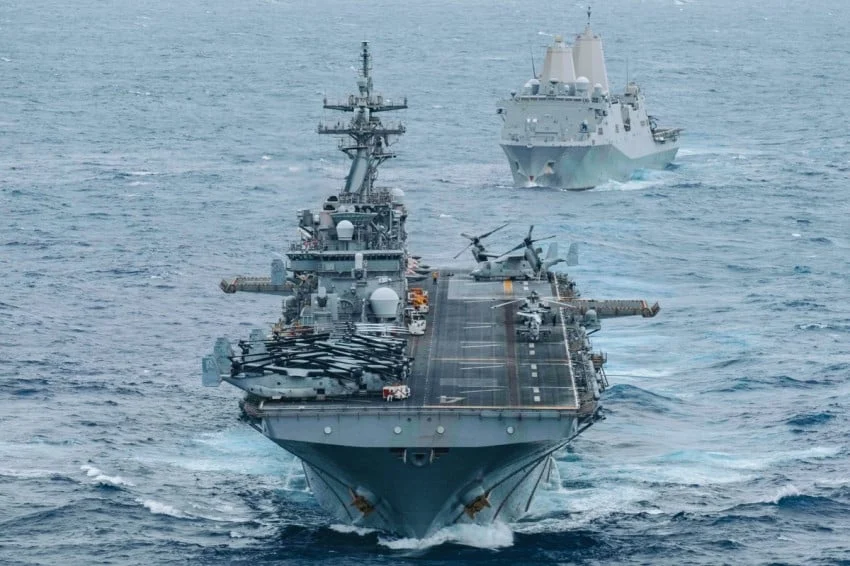
The United States has significantly escalated its naval presence in the Middle East with the arrival of the USS Theodore Roosevelt carrier strike group, marking a notable intensification of American military posturing in the region. According to reports from ABC News citing senior U.S. officials, the arrival of this third carrier group into the U.S. Central Command (CENTCOM) area of responsibility is designed to bolster an ongoing maritime blockade targeting Iranian ports. This strategic maneuver reflects a concerted effort by Washington to exert maximum pressure on Tehran, further straining already fragile geopolitical relations in the Persian Gulf and surrounding waters.
The USS Theodore Roosevelt, a Nimitz-class nuclear-powered aircraft carrier, entered the theater on Sunday, November 15, joining an already formidable armada. Its arrival complements the existing deployment of the USS George H.W. Bush and the USS George Washington, both of which have been actively patrolling the Arabian Sea. This concentration of three carrier strike groups represents a rare and aggressive display of naval power, underscoring the high stakes involved in the current standoff between the United States and the Islamic Republic of Iran.
A Massive Naval Mobilization
The current naval deployment is not limited to the three primary aircraft carriers. Military observers have noted that this mobilization includes a wider task force comprising more than 20 U.S. Navy vessels. Current estimates suggest that approximately 19 major warships are operating within the direct jurisdiction of CENTCOM, creating an unprecedented network of surveillance, interception, and strike capabilities.
The logistical complexity of maintaining such a fleet in a forward-deployed posture is immense. These strike groups typically consist of a flagship carrier, guided-missile cruisers, guided-missile destroyers, and at least one attack submarine. By integrating these assets, the U.S. military is effectively creating an "iron ring" around key maritime chokepoints, most notably the Strait of Hormuz—the world’s most critical artery for global oil transit.
Strategic Context and Historical Precedents
To understand the gravity of the current situation, it is necessary to look at the broader context of U.S.-Iran tensions. The relationship between Washington and Tehran has been characterized by cycles of escalation and de-escalation for decades, but the current period is defined by a more direct confrontation regarding maritime security and the enforcement of economic sanctions.
For years, Iran has utilized its naval capabilities, including its Revolutionary Guard Corps (IRGC) fast-attack craft and its domestic missile programs, to project power in the Persian Gulf. In response, the United States has sought to reassure its regional allies—including Saudi Arabia, the United Arab Emirates, and Israel—that it remains committed to regional stability. The presence of three carrier groups is a clear message to Tehran that the U.S. retains the ability to project overwhelming force into the region should the situation escalate into direct kinetic conflict.
Historically, the U.S. has maintained a presence in the Middle East to ensure the free flow of commerce. However, the move to enforce a "blockade" of Iranian ports represents a departure from traditional "freedom of navigation" operations. By explicitly targeting the logistics of Iranian trade, the U.S. is signaling that its naval assets are being used as a primary tool of economic warfare.
Chronology of Escalation
While the arrival of the USS Theodore Roosevelt is the most recent development, it is part of a deliberate sequence of military moves:
- Early 2026: Increased reports of interference with commercial shipping in the Persian Gulf lead to initial calls for a reinforced naval presence.
- Mid-2026: The USS George H.W. Bush and USS George Washington are deployed to the Arabian Sea to monitor Iranian naval exercises.
- October 2026: Diplomatic channels between Washington and Tehran reach a deadlock, with Iran announcing an expansion of its uranium enrichment programs.
- Early November 2026: U.S. intelligence suggests an increased risk of regional instability, prompting the Pentagon to order the deployment of the Theodore Roosevelt group.
- November 15, 2026: The USS Theodore Roosevelt enters the CENTCOM area of operations, officially completing the three-carrier formation.
Official Responses and International Reactions
While the Pentagon has remained measured in its public statements, describing the deployment as "routine presence operations aimed at ensuring maritime security," the underlying intent is clearly understood by regional actors.
Tehran has denounced the buildup, labeling it an act of "provocation" and "nautical terrorism." Iranian officials have frequently stated that the presence of foreign navies in the region only serves to increase the risk of miscalculation. "The Persian Gulf is our home," a spokesperson for the Iranian Ministry of Foreign Affairs noted in a recent briefing, "and the presence of outside powers is the primary cause of insecurity."
Regional allies of the U.S., conversely, have largely welcomed the move. Israel, in particular, has viewed the strengthening of the U.S. fleet as a necessary deterrent against Iranian proxy activity in the Levant and the Gulf. Analysts in the region argue that the deployment provides a "security umbrella" that allows for a more assertive stance against Iranian-backed groups.
Implications for Global Markets
The economic implications of this naval concentration are profound. The Strait of Hormuz carries roughly 20-30% of the world’s total oil consumption. Any increase in military activity in this area inevitably impacts global energy markets.
Oil prices have shown volatility in response to the news, with traders pricing in the "geopolitical risk premium." Should the current blockade move from a surveillance operation to a more restrictive interdiction of vessels, the global energy supply chain could face significant disruptions. Insurance premiums for commercial shipping operating in the region have already begun to climb, reflecting the heightened risk of confrontation.
Analytical Assessment: Is War Inevitable?
From a military analysis perspective, the presence of three carrier strike groups is intended as a deterrent, not necessarily a precursor to an immediate offensive. The U.S. military doctrine of "deterrence through strength" is based on the premise that if the adversary perceives the cost of conflict to be prohibitively high, they will refrain from provocative actions.
However, the risk of "accidental escalation" remains a primary concern for international security experts. When multiple military forces are operating in confined spaces like the Persian Gulf, the potential for a minor collision or a misidentified signal to spiral into a broader conflict is high. The "fog of war" is compounded by the fact that Iranian forces often employ "swarm" tactics, which are designed to challenge the traditional, high-value assets of the U.S. Navy.
Furthermore, the deployment of such a massive force requires significant sustainment. The U.S. Navy cannot maintain this level of presence indefinitely without exhausting its crews and equipment. This suggests that the current posture is intended to achieve a specific, short-to-medium-term diplomatic or strategic objective, rather than a permanent change in regional force structure.
Looking Ahead
The coming weeks will be critical. If the U.S. maintains this level of force, it will likely increase the pressure on Tehran to return to the negotiating table or, at the very least, reduce its support for regional militias. However, if Iran interprets this move as a prelude to a direct attack on its sovereign territory, it may respond with asymmetric measures, such as mine-laying or targeting critical energy infrastructure in neighboring states.
The international community, including the United Nations and the European Union, is watching closely. There have been quiet calls for de-escalation, but with both Washington and Tehran currently holding firm to their respective red lines, the diplomatic space for a peaceful resolution is narrowing.
As the USS Theodore Roosevelt settles into its new position, the world remains in a state of watchful waiting. The focus is now on how Iran will calibrate its response—whether it will choose to demonstrate restraint or respond with a counter-escalation that could test the resolve of the U.S. naval presence. For now, the Persian Gulf remains one of the most volatile and heavily militarized zones on the planet, serving as a reminder that the peace of the global economy is inextricably linked to the delicate balance of power in the Middle East.