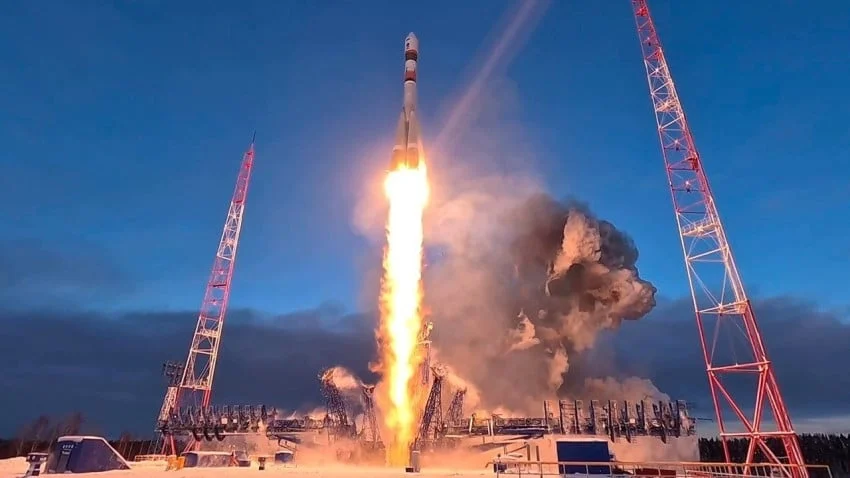
MOSCOW — In a significant development that underscores the accelerating militarization of Earth’s lower orbit, the Russian Federation successfully executed the launch of a Soyuz-2.1b carrier rocket on Saturday. Liftoff took place from the state-operated Plesetsk Cosmodrome, situated in the northern Arkhangelsk region. According to official briefings from the Russian Ministry of Defense, the payload—identified in military communiques as a strategic space-based platform often characterized in domestic reports as a military space base component—was successfully integrated into its designated target orbit.
The launch, which took place under strict security protocols, marks another milestone in Moscow’s long-term strategy to bolster its orbital defense and surveillance capabilities. While details regarding the precise operational payload remain classified, aerospace analysts and defense observers note that the deployment aligns with Russia’s broader doctrine of securing strategic dominance in the space domain. As geopolitical tensions between spacefaring nations reach new heights, the boundary between civilian space exploration and military orbital infrastructure continues to blur, placing renewed focus on the security of low Earth orbit (LEO).
Chronology of the Launch and Ascent Phase
Operations at the Plesetsk Cosmodrome commenced in the early morning hours, culminating in the ignition and liftoff of the medium-lift Soyuz-2.1b launch vehicle. The ascent phase proceeded strictly according to telemetry schedules.
Approximately nine minutes into the flight, the upper stage of the rocket separated from the payload, successfully placing the asset into the pre-calculated orbital insertion trajectory. The Russian Ministry of Defense confirmed that shortly after separation, ground-based tracking and control systems operated by the Russian Space Forces—a distinct branch of the Aerospace Forces—established stable telemetry links with the spacecraft.
According to the ministry’s official statement, telemetry data confirmed that all onboard systems, power grids, and attitude control mechanisms were functioning within normal parameters. The spacecraft is now fully under the operational command of military ground controllers stationed at Russia’s principal flight control facilities.
The "Space Jellyfish" Phenomenon Over the Komi Republic
Beyond its strategic and military implications, the launch triggered a striking atmospheric phenomenon that captivated residents across neighboring regions. As the Soyuz-2.1b ascended through the upper layers of the atmosphere, it left a luminous, expanding trail of exhaust gases that became widely visible across the night skies of the adjacent Komi Republic.
Numerous local residents and amateur astronomers documented the event, capturing footage of a glowing, cloud-like formation that gradually expanded into translucent, ribbon-like tendrils. This striking visual effect—frequently referred to by observers and media outlets as a "space jellyfish"—is a well-documented optical occurrence associated with high-altitude rocket launches.
The phenomenon occurs when the exhaust plume from a rocket’s upper-stage engine expands significantly in the near-vacuum of the upper atmosphere and stratosphere. At the time of the burn, while observers on the ground are shrouded in the darkness of night, the high-altitude exhaust gases remain illuminated by the direct rays of the sun, which has already set for terrestrial viewers. The sunlight scatters through the particulate matter and expanding combustion byproducts, creating the signature glowing, pulsating visual display that often generates widespread public fascination and transient reports of unidentified aerial phenomena.
Background Context: The Plesetsk Cosmodrome and the Soyuz-2.1b Workhorse
The Plesetsk Cosmodrome, officially designated the 1st State Test Cosmodrome, has served as a cornerstone of the Soviet and subsequently Russian space programs since the Cold War era. Situated approximately 800 kilometers north of Moscow and 200 kilometers south of the Arctic Circle, Plesetsk is historically favored for launching payloads into high-inclination, polar, and Molniya orbits. Because of its high-latitude geographical positioning, launches from Plesetsk are uniquely suited for surveillance, reconnaissance, early-warning, and communications satellites that require continuous coverage of the polar regions and the Northern Sea Route.
The launch vehicle utilized for Saturday’s mission, the Soyuz-2.1b, is a vital workhorse of the modern Russian space fleet. Representing an advanced iteration of the legendary R-7 Semyorka rocket family—which first launched Sputnik and Yuri Gagarin into space—the Soyuz-2.1b incorporates modern digital flight control systems, upgraded third-stage engines, and significantly increased payload capacity compared to its predecessors.
Capable of lifting up to 8.2 metric tons into low Earth orbit when launched from Plesetsk or the Vostochny Cosmodrome, the rocket features a RD-0124 engine on its third stage, providing enhanced specific impulse and precise orbital insertion capabilities required for complex military and state-sponsored payloads.
Strategic Implications and the Militarization of Low Earth Orbit
The deployment of advanced space-based assets by major global powers reflects a fundamental paradigm shift in modern warfare. Low Earth orbit has transitioned from a purely scientific and commercial domain into an intensely contested strategic high ground. Military planners across the United States, Russia, China, and other advanced space-faring nations increasingly view orbital infrastructure as critical to command, control, communications, computers, intelligence, surveillance, and reconnaissance (C4ISR) networks.
Space-based platforms enable real-time battlefield management, precision navigation, secure communications, and early detection of ballistic missile launches. Consequently, the protection of friendly orbital assets and the potential neutralization of adversary space capabilities have become central tenets of modern military doctrine.
The characterization of such missions as "military space bases" or strategic orbital outposts highlights the growing emphasis on persistent, maneuverable space assets. Unlike traditional satellites that follow predictable trajectories, modern military programs increasingly explore technologies capable of orbital maneuvering, proximity operations, and enhanced resilience against anti-satellite (ASAT) measures.
International Reactions and Regulatory Concerns
The ongoing expansion of military space programs has amplified concerns within the international community regarding the long-term sustainability and security of outer space. The 1967 Outer Space Treaty prohibits the placement of weapons of mass destruction in orbit, but it leaves a legal gray area concerning conventional military hardware, surveillance platforms, and dual-use technologies.
Diplomatic bodies and multilateral organizations have repeatedly called for enhanced transparency and confidence-building measures to prevent escalation in orbit. Critics argue that the deployment of secretive military payloads increases the risk of miscalculation, accidental collisions, and the accumulation of space debris—a growing hazard in an increasingly congested LEO environment.
Despite these international anxieties, national security imperatives continue to drive robust investment in orbital defense capabilities. For Moscow, maintaining independent, reliable access to space via launch sites like Plesetsk and workhorse vehicles like the Soyuz-2.1b is viewed as an absolute prerequisite for national sovereignty and strategic deterrence in the twenty-first century.
As the newly deployed space asset begins its operational lifecycle under the supervision of the Russian Space Forces, defense analysts will closely monitor telemetry data, orbital adjustments, and subsequent launch schedules to gauge the broader strategic trajectory of Russia’s military space architecture.