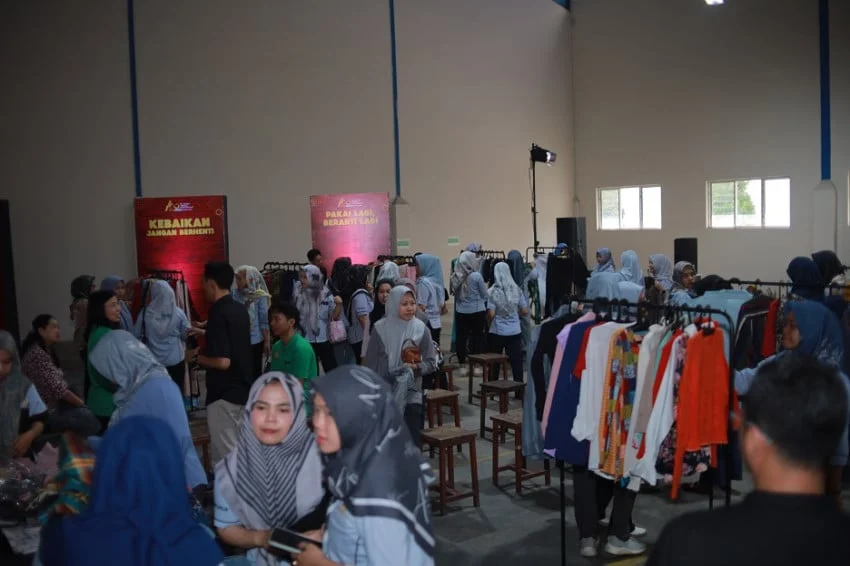
KUDUS — In an era defined by rapid consumerism and the mounting global crisis of textile waste, corporate sustainability initiatives are increasingly shifting from broad environmental pledges to actionable, grassroots practices. Addressing this challenge at the internal level, PT Aroma Tobacco International (ATI) launched a pioneering corporate sustainability campaign titled “Pasar Baik ATI,” held on October 20–21, 2026, in Jambean, Kudus, Central Java. The two-day event aimed to reshape consumption patterns among its workforce by promoting the principles of a circular economy through a tangible, community-driven clothing exchange program.
The initiative was strategically organized as a key component of PT ATI’s 20th-anniversary celebrations, marking two decades of corporate presence in the region. Rather than hosting traditional celebratory festivities that often generate high volumes of single-use waste, the company chose to redirect its anniversary focus toward environmental responsibility and resource optimization. By targeting its internal workforce as the primary catalyst for change, ATI sought to demonstrate that corporate sustainability must begin with individual behavioral shifts, encouraging employees to rethink how they manage personal commodities, reduce wardrobe clutter, and minimize textile waste.
The Mechanics of Circular Consumption: How Pasar Baik ATI Works
Modern lifestyles frequently contribute to the accumulation of unused household items, particularly clothing. Garments that no longer fit, fail to match current style preferences, or are simply worn on rare occasions often end up forgotten at the back of wardrobes or discarded entirely. To combat this linear "take-make-dispose" model, Pasar Baik ATI introduced a structured, gamified barter system designed
to give pre-loved clothing a second life.
Under the operational mechanism of the event, employees were invited to bring gently used, clean, and wearable apparel to designated collection points prior to and during the two-day program. Upon submission, these garments were evaluated and exchanged for a specialized token currency unique to the market. Employees could then use these tokens to browse the collection and acquire other donated items that better suited their needs or preferences, entirely free of monetary cost.
This token-based exchange system effectively removed the financial barriers typically associated with secondhand shopping while fostering a sense of shared community value. It transformed what would otherwise be perceived as discarded items into a localized, circular economy where value is retained within the employee ecosystem. Furthermore, the initiative ensured that usable textiles were diverted from local landfills, directly addressing the burgeoning issue of textile waste accumulation in regional communities.
Extending Product Lifecycles: The Inclusion of On-Site Tailoring Services
Recognizing that pre-loved clothing sometimes requires minor adjustments to achieve an ideal fit or style, PT ATI expanded the scope of Pasar Baik ATI beyond a simple swap meet. The company integrated an on-site tailoring and garment-alteration service directly into the event space.
Staffed by local tailoring professionals, this service allowed employees to have their newly acquired items adjusted, repaired, or customized on the spot. By providing immediate access to minor alterations, the company directly tackled one of the primary reasons individuals abandon garments: minor sizing discrepancies or slight damages such as missing buttons, loose hems, or split seams.
This value-added feature served a critical dual purpose. First, it enhanced the practical utility of the exchanged clothing, ensuring that employees walked away with garments they could comfortably wear in their daily lives. Second, and more importantly, it reinforced the core philosophy of product lifecycle extension. In a circular economy, repairing and altering existing goods is just as vital as reusing them, as it directly reduces the demand for newly manufactured apparel and curbs the environmental footprint associated with the global textile supply chain.
Broader Context: The Global Textile Waste Crisis and Corporate Responsibility
The timing of PT ATI’s initiative aligns with a growing global urgency regarding the environmental impact of the fashion and textile industries. According to data from international environmental agencies, the global fashion industry is responsible for roughly 10% of global carbon emissions and remains a massive consumer of water resources. Furthermore, the rise of "fast fashion" has accelerated the rate at which clothing is produced, worn, and discarded, leading to millions of tons of textile waste entering landfills annually.

In developing nations like Indonesia, the influx of both domestic and imported secondhand clothing—alongside domestic textile production waste—presents significant waste management challenges. While informal thrift markets ("thrifting" or loak) have long existed in urban centers, formalized corporate programs that actively promote circular habits among white-collar and industrial workforces remain relatively novel.
By implementing Pasar Baik ATI, the company has positioned itself as a forward-thinking corporate citizen in Central Java. Industrial hubs like Kudus, traditionally known for manufacturing and agricultural sectors, are increasingly recognizing the necessity of integrating environmental, social, and governance (ESG) principles into their operational frameworks. Initiatives like this prove that sustainability is not solely the domain of multinational environmental NGOs or high-end luxury brands; it can be effectively localized and scaled within standard manufacturing and corporate environments.
Internal Reactions and Workforce Engagement
The response from the PT ATI workforce during the October 20–21 event was overwhelmingly positive. Employees across various administrative and operational departments actively participated, bringing in bags of well-maintained garments and enthusiastically browsing the racks for items contributed by their colleagues.
Internal feedback gathered during the event highlighted a profound shift in employee perception regarding secondhand goods. Many participants noted that the token system and the festive atmosphere removed any social stigma traditionally attached to wearing pre-owned clothing. Instead, the event fostered a spirit of camaraderie and shared purpose among staff members, who bonded over finding unique pieces and discussing sustainable living habits.
Management representatives from PT ATI noted that the success of Pasar Baik ATI demonstrated a high level of environmental and social consciousness among the workforce. Company leadership emphasized that sustainability initiatives are most effective when they directly engage employees, transforming passive workers into active participants in the company’s broader corporate social responsibility (CSR) vision.
Implications for Future Corporate Sustainability Programs
As PT ATI marks its 20th anniversary, the success of the Pasar Baik ATI initiative establishes a robust precedent for the company’s future environmental endeavors. Industry observers and regional analysts suggest that internal behavioral change programs can serve as powerful testing grounds for larger, community-wide sustainability projects.
By proving that employees readily embrace circular consumption models when provided with accessible infrastructure, PT ATI has laid the groundwork for potential scaling of the initiative. Future iterations of the program could potentially expand beyond internal staff to include local communities, schools, or broader public networks in Kudus and surrounding regencies.
Moreover, the integration of practical solutions—such as on-site tailoring alongside the exchange market—offers a blueprint for other Indonesian corporations seeking to implement meaningful ESG programs. Rather than relying on symbolic gestures like tree-planting ceremonies or one-off donations, companies are increasingly challenged to implement structural interventions that alter daily consumption habits and promote resource efficiency.
Conclusion
The Pasar Baik ATI initiative stands as a notable example of how regional enterprises can successfully localize global sustainability concepts. By combining a clothing exchange market with practical garment alteration services, PT Aroma Tobacco International has successfully transformed its 20th-anniversary milestone into an educational and actionable platform for circular consumption.
As the global community continues to grapple with the realities of waste generation and resource depletion, grassroots corporate initiatives like those seen in Jambean, Kudus, offer a practical path forward. They demonstrate that meaningful environmental stewardship often begins right inside the workplace, one garment, one token, and one shared conversation at a time.