President Prabowo Subianto arrived in Manila, the Philippines, on Monday, November 16, 2026, to participate in the high-stakes 29th ASEAN-China Summit. The diplomatic gathering brought together leaders from across Southeast Asia alongside Chinese Premier Li Qiang to address regional cooperation, economic partnership, and geopolitical stability in the Indo-Pacific. Amid a backdrop of complex maritime dynamics and evolving global trade policies, Indonesian leadership under President Prabowo continues to project a firm commitment to multilateralism, regional centrality, and diplomatic engagement.
The summit serves as a crucial platform for dialogue between the ten member states of the Association of Southeast Asian Nations (ASEAN) and Beijing. President Prabowo’s presence in Manila underscores Jakarta’s active role in shaping regional frameworks and ensuring that the voice of Southeast Asia remains cohesive in its dealings with major global superpowers. As Indonesia navigates its domestic economic priorities while maintaining a steadfast foreign policy posture of "free and active" (bebas aktif), Prabowo’s diplomatic maneuvers in the Philippines have drawn significant international attention.
A Striking Diplomatic Display at the Official Photo Session
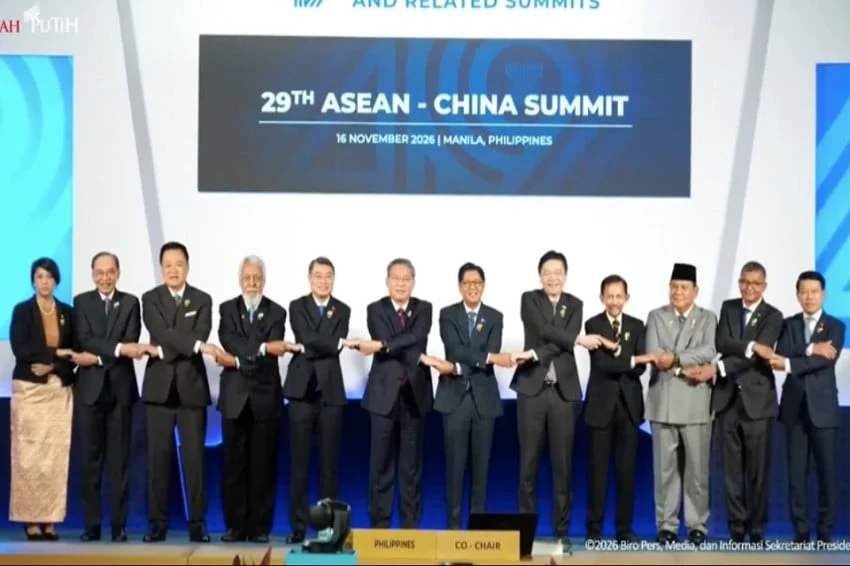
A defining moment of the summit’s opening phase was the traditional group photograph, which featured ASEAN leaders standing alongside Chinese Premier Li Qiang. Positioned prominently within the lineup, President Prabowo Subianto stood directly beside the Sultan of Brunei Darussalam, Sultan Hassanal Bolkiah. The juxtaposition of the two Southeast Asian leaders highlighted the enduring bilateral ties between Indonesia and Brunei, as well as the broader solidarity shared among Islamic-majority and Malay-world nations within the regional bloc.
President Prabowo cut a distinctive figure at the gathering, wearing his signature professional gray suit paired with a classic black kopiah—a traditional Indonesian cap. This sartorial choice, which Prabowo has consistently worn on both domestic and international stages, serves as a subtle yet powerful cultural statement, projecting national identity while engaging in high-level statecraft. Philippine President Ferdinand R. Marcos Jr., acting as the gracious host of the summit, warmly welcomed Premier Li Qiang and the various ASEAN heads of state and government to the venue, setting a collaborative tone for the day’s closed-door and plenary sessions.
Commemorating Milestones in ASEAN-China Relations
The 29th ASEAN-China Summit carries profound symbolic and strategic weight, as 2026 marks a major historical milestone for both entities. Addressing the assembled leaders, Philippine President Ferdinand R. Marcos Jr. emphasized that the current meeting serves as a crucial turning point for evaluating past achievements and charting future trajectories. Specifically, this year marks the 35th anniversary of the establishment of official dialogue relations between ASEAN and China, which began back in 1991. Furthermore, the diplomatic calendar highlights the fifth anniversary of the ASEAN-China Comprehensive Strategic Partnership, established in 2021 to elevate economic, security, and socio-cultural cooperation to unprecedented heights.
Over the past three and a half decades, the economic relationship between ASEAN and China has flourished into one of the most dynamic trade corridors in the world. China has remained ASEAN’s largest trading partner for consecutive years, while ASEAN collectively surpassed the European Union and the United States to become one of Beijing’s top trading partners. However, this deep economic interdependence is continuously balanced against strategic anxieties, particularly regarding territorial disputes in the South China Sea and supply chain resilience. During the summit, leaders discussed ways to expedite the ongoing negotiations for the Code of Conduct (COC) in the South China Sea, aiming to establish legally binding rules that prevent escalation and preserve freedom of navigation in international waters.
Indonesia’s Broader Diplomatic Agenda in Manila
President Prabowo’s itinerary in Manila extended well beyond the ASEAN-China framework. Just prior to the China-focused sessions, the Indonesian leader actively participated in the 49th ASEAN Summit, where he addressed critical transboundary issues affecting the region. Notably, President Prabowo used the platform to reiterate Indonesia’s unwavering commitment to tackling environmental degradation, specifically focusing on the prevention and mitigation of forest and land fires (karhutla).
Transboundary haze pollution has long remained a contentious ecological and diplomatic issue in Southeast Asia. In his address at the 49th ASEAN Summit, Prabowo outlined Indonesia’s strengthened national monitoring systems, stricter law enforcement against corporate entities engaged in illegal land-clearing practices, and enhanced cross-border cooperation with neighboring countries such as Malaysia and Singapore. By demonstrating proactive environmental stewardship, Indonesia sought to reassure its regional partners that Jakarta is fully capable of managing its domestic ecological responsibilities while contributing to regional climate resilience.
Furthermore, President Prabowo’s active participation in these multilateral forums aligns with his broader foreign policy vision, which emphasizes economic diplomacy, food security, energy transition, and regional peace. Since taking office, Prabowo has maintained a rigorous travel schedule, visiting key global capitals across Asia, the Middle East, Europe, and the Americas to secure trade agreements, attract foreign direct investment, and position Indonesia as a bridge-builder between the Global South and major industrial powers.
Chronology of Events and Diplomatic Engagements
The lead-up to the 29th ASEAN-China Summit involved months of preparatory ministerial meetings and senior officials’ gatherings designed to iron out differences and draft joint declarations.
- Early 2026: ASEAN and Chinese senior economic officials convene in Beijing and various Southeast Asian capitals to review the implementation of the ASEAN-China Free Trade Area (ACFTA) 3.0 upgrade, focusing on digital economy, green economy, and supply chain connectivity.
- November 14-15, 2026: Arrival of foreign ministers and senior delegates in Manila, the Philippines, for preparatory bilateral talks and the finalization of summit outcome documents.
- November 16, 2026 (Morning): President Prabowo Subianto attends the 49th ASEAN Summit, where he delivers a keynote intervention addressing climate change, regional security, and the prevention of forest and land fires.
- November 16, 2026 (Afternoon): The official opening of the 29th ASEAN-China Summit. Leaders gather for the ceremonial group photo, where President Prabowo stands beside Sultan Hassanal Bolkiah of Brunei Darussalam, followed by plenary discussions with Chinese Premier Li Qiang.
- November 17, 2026 (Projected): Concluding bilateral meetings on the sidelines of the broader ASEAN summits involving dialogue partners such as Japan, South Korea, the United States, and Australia.
Economic and Strategic Implications for Indonesia
The outcomes of the 29th ASEAN-China Summit carry direct implications for Indonesia’s national development trajectory. As Southeast Asia’s largest economy, Indonesia stands to gain significantly from deepening trade integration with China, provided that local industries are adequately protected from unfair competition and trade imbalances. The ongoing modernization of the ASEAN-China Free Trade Agreement aims to facilitate smoother cross-border e-commerce, reduce non-tariff barriers, and encourage sustainable investments in green technologies, electric vehicle supply chains, and renewable energy infrastructure—sectors that President Prabowo has heavily prioritized in his national economic strategy.
At the same time, Indonesia’s diplomatic posture in Manila reinforces its traditional adherence to ASEAN Centrality. In an era marked by intensifying strategic competition between the United States and China, Indonesia has consistently maintained that the region must not become a proxy battlefield for major power rivalries. By engaging constructively with Premier Li Qiang while simultaneously advocating for international law, regional sovereignty, and peaceful dispute resolution, President Prabowo projects Indonesia as an indispensable anchor of stability in the Indo-Pacific.
Political analysts and foreign policy experts have noted that Prabowo’s active personal diplomacy signals a continuation of Indonesia’s assertive international posture. Unlike passive diplomatic strategies, Prabowo’s approach combines personal rapport-building—evident in his amicable interactions with leaders like Sultan Hassanal Bolkiah and other regional counterparts—with clear articulation of national interests. This dual track allows Indonesia to foster deeper economic partnerships without compromising its strategic autonomy.
As the summit draws to a close, attention will shift toward the implementation phase of the various declarations signed in Manila. For Indonesia, the immediate task will be translating these high-level regional commitments into tangible domestic benefits, ensuring that enhanced cooperation with China and fellow ASEAN member states directly contributes to job creation, technological advancement, environmental preservation, and long-term security for the Indonesian people.