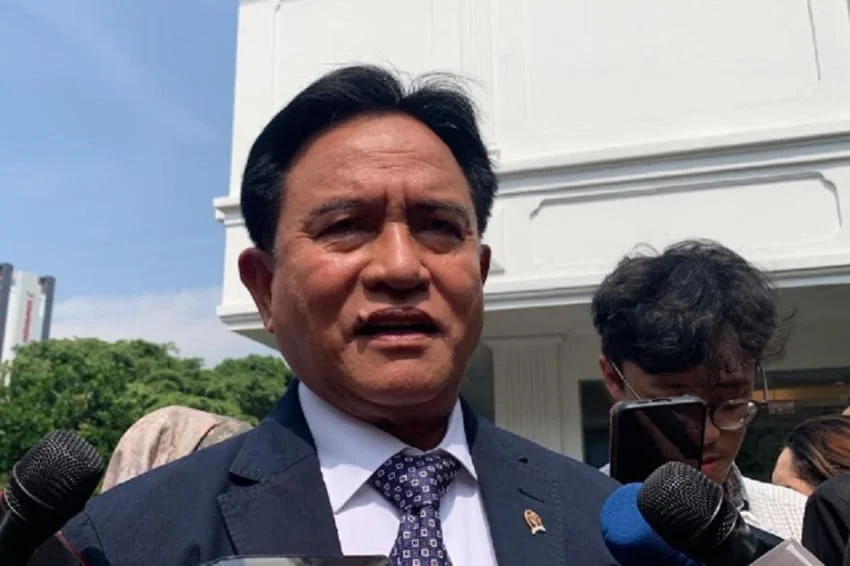
JAKARTA — Coordinating Minister for Law, Human Rights, Immigration, and Corrections Yusril Ihza Mahendra has formally addressed swirling public speculation regarding his inclusion on purported lists of potential candidates for the office of the Vice President of the Republic of Indonesia. The rumors have centered around hypothetical scenarios involving a successor to incumbent Vice President Gibran Rakabuming Raka. Speaking to members of the press corps at the Presidential Palace complex in Jakarta on Thursday, November 12, 2026, Yusril adopted a measured and neutral stance, emphasizing that public discourse regarding political leadership is an inherent aspect of a democratic society.
The statement from one of Indonesia’s most prominent legal scholars and senior politicians arrives amidst an increasingly dynamic political landscape under the administration of President Prabowo Subianto. As discussions surrounding governance, coalition stability, and constitutional continuity remain at the forefront of national attention, the remarks made by Yusril shed light on both the democratic freedom of public nomination and the stringent legal mechanisms governing executive succession in the world’s third-largest democracy.
Public Aspirations and Democratic Freedoms
Addressing journalists who inquired about his name being circulated among prospective vice-presidential contenders, Yusril underscored that the prerogative of the public to propose, discuss, and nominate figures for high public office is a foundational pillar of democratic expression. Rather than offering a definitive personal ambition or dismissing the claims outright, the Coordinating Minister chose to defer the overarching authority of candidate selection to the institutional processes and the ultimate decision of the head of state.
"And I think the names nominated to become potential candidates, well, that is up to the society, right? The public is welcome to do so, I cannot comment on anything," Yusril remarked to reporters at the Presidential Palace.
His response highlights a careful balancing act between acknowledging the political momentum generated by various civil and political factions and maintaining strict adherence to executive discipline. By framing the circulating lists as public aspirations rather than formal political maneuvers, Yusril sought to temper speculative fervor while respecting the constitutional boundaries that define executive appointments in Indonesia.
Constitutional and Legislative Frameworks Governing Executive Succession
Beyond addressing his personal inclusion in the succession discourse, Yusril previously elaborated on the rigorous legal and structural requirements that would
dictate the selection of a new vice president should a vacancy arise. Citing the provisions outlined within the Law on the People’s Consultative Assembly, House of Representatives, Regional Representative Council, and Regional Legislative Councils (commonly known as the UU MD3), Yusril stressed that any future appointment to the vice-presidency must strictly align with existing statutory frameworks and coalition agreements.
According to the legal parameters governing Indonesia’s presidential system, the mechanism for replacing a vice president involves nominations submitted by the president to the House of Representatives (DPR), followed by a confirmation vote. Yusril emphasized that political realism and legislative harmony dictate that a prospective vice president should ideally originate from within the ranks of the ruling coalition parties. This requirement ensures legislative stability, minimizes friction between the executive and the legislature, and preserves the foundational pact established during the presidential election cycle.
The emphasis on coalition alignment is not merely a procedural preference but a strategic necessity in Indonesian politics. With President Prabowo Subianto leading a broad-based "Red and White Cabinet" coalition that commands a substantial majority in the DPR, maintaining solidarity among coalition partners is vital for the passage of national strategic policies, budgetary approvals, and legislative reforms. Consequently, any discussion regarding executive succession inevitably intersects with the intricate balance of power among the coalition’s constituent political parties.
Background and Context of the Succession Discourse
The ongoing discussions surrounding executive succession and the vice-presidency stem from a complex confluence of political dynamics, legal evaluations, and the natural evolution of Indonesia’s governance structure following the 2024 general elections. President Prabowo Subianto and Vice President Gibran Rakabuming Raka assumed office in October 2024, initiating a grand coalition administration designed to foster national unity and legislative efficiency.
However, political observers note that speculation regarding cabinet reshuffles, strategic realignments, and future electoral trajectories frequently surfaces in the media and academic circles. Figures like Yusril Ihza Mahendra—who boasts a decades-long career encompassing roles as Minister of State Secretary, Minister of Justice and Human Rights, and a leading constitutional lawyer—are often focal points in such discussions due to their extensive institutional experience and high standing within the political establishment.
The creation of the Coordinating Ministry for Law, Human Rights, Immigration, and Corrections under the Prabowo administration further elevated Yusril’s profile, positioning him as a central figure in coordinating legal reform, human rights policy, and state security oversight. This institutional prominence naturally places him at the intersection of legal policymaking and high-level political strategy, rendering him a frequent subject of media inquiry regarding governance matters.
Implications for the Prabowo-Gibran Administration and Coalition Stability
The public commentary provided by Yusril carries several important implications for the stability and perception of the current administration. First, by redirecting the focus toward institutional processes and the authority of the president, Yusril reinforces the internal cohesion of the executive branch. Speculation regarding leadership changes, if left unaddressed or improperly managed, can introduce unnecessary political uncertainty, potentially unsettling financial markets and domestic investors who rely on policy continuity.
Second, Yusril’s reference to the UU MD3 and the necessity of coalition backing serves as a reminder to political actors of the structural rules that govern Indonesian governance. In a multiparty system characterized by shifting alliances, adherence to legal frameworks provides a predictable anchor that prevents executive succession from devolving into protracted partisan conflict.
From a broader analytical perspective, the ongoing public discourse underscores the vitality and continuous scrutiny of Indonesia’s democratic institutions. While the administration remains fully focused on executing its core development agenda—including food security, downstreaming of natural resources, free nutritional meals, and legal reform—the vigilance of the public, political analysts, and the media ensures that governance remains transparent and accountable.
Conclusion
As the political year progresses, statements from senior officials such as Coordinating Minister Yusril Ihza Mahendra provide valuable clarity amidst speculative reporting. By maintaining that the prerogative for executive appointments rests with President Prabowo Subianto and that any structural succession must strictly respect legislative statutes like the UU MD3, the government continues to signal institutional stability. Whether public aspirations regarding future leadership will translate into formal political developments remains to be seen, but the framework for addressing such possibilities remains firmly anchored in Indonesia’s constitutional and statutory law.