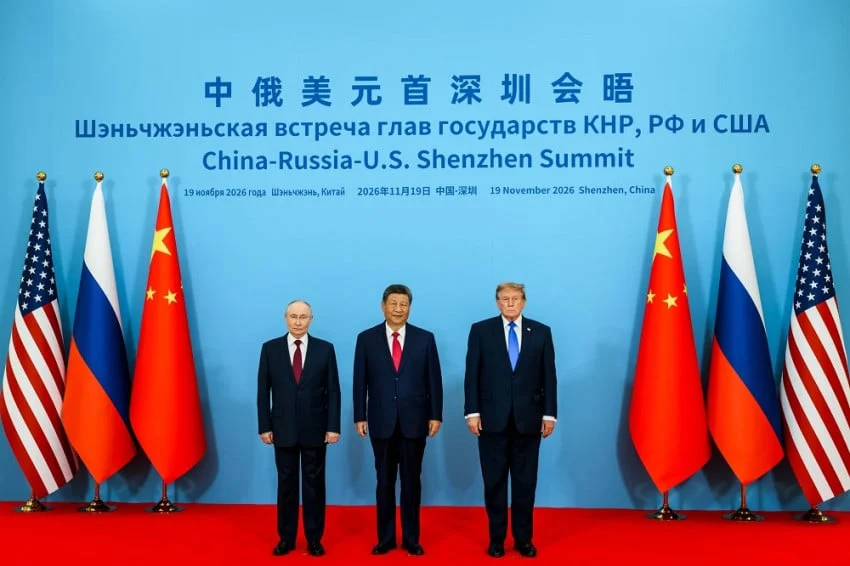
In a development that has sent ripples through the international geopolitical landscape, U.S. President Donald Trump has characterized his recent trilateral summit with Russian President Vladimir Putin and Chinese President Xi Jinping as a pivotal moment for global stability. Following the conclusion of the Asia-Pacific Economic Cooperation (APEC) summit in Shenzhen, Trump returned to Washington to brief the press on what he described as one of the most successful presidential tours in American history. The meeting, which brought together the leaders of the world’s three most formidable nuclear powers, has sparked widespread debate among policy experts regarding the potential de-escalation of long-standing tensions and the tangible risk of a third world war.
The Dynamics of a New Trilateralism
The APEC summit, traditionally a platform for fostering economic integration across the Pacific Rim, was fundamentally reshaped by the spotlight on the informal, yet highly significant, trilateral dialogue between Washington, Moscow, and Beijing. While the summit hosted representatives from over 20 nations, President Trump noted that the momentum was heavily concentrated on the interactions between the three superpowers.
"The other participants understood that the world is currently defined by the actions and relations of these three nations," Trump stated during his press briefing at the White House. "There was a clear sense that the eyes of the international community were fixed on our trilateral discussions, essentially transforming the broader summit into a strategic meeting of the three major global players."
This acknowledgment underscores a shifting reality in international relations: the transition from a post-Cold War era of multilateralism to a more concentrated framework where the "Great Powers" prioritize direct communication to manage global volatility. The "fantastic" rapport described by Trump is viewed by some analysts as a necessary pragmatic pivot, given the interconnected nature of modern global crises, from nuclear proliferation to the instability of energy markets.
Chronology of the Diplomatic Engagement
The events in Shenzhen were the culmination of weeks of intensive back-channel diplomacy.
- Pre-Summit Negotiations: Diplomatic envoys from the three nations met in neutral locations to establish a framework for the discussions, focusing on "rules of the road" for nuclear risk reduction.
- Arrival in Shenzhen: Upon his arrival, President Trump held a series of bilateral meetings before transitioning into the trilateral format.
- The Trilateral Session: The centerpiece of the summit saw the three leaders discussing shared responsibilities regarding global security.
- The Joint Declaration: The session concluded with a landmark trilateral declaration, which committed the three powers to a process of regularized dialogue and a reaffirmation of the responsibility to prevent nuclear conflict.
The Nuclear Imperative and Global Security
At the heart of the trilateral declaration lies a renewed commitment to nuclear non-proliferation and risk reduction. For decades, the strategic ambiguity between Washington, Moscow, and Beijing has been a source of profound instability. By formalizing a dialogue mechanism, the leaders aim to mitigate the risk of miscalculation.
The declaration specifically addresses the "responsibility of major nuclear powers" to maintain stable communication channels during times of regional crises. Experts suggest that this is a direct response to the heightened rhetoric seen over the past several years regarding the potential use of tactical nuclear weapons. By involving China—which has historically been more opaque regarding its nuclear expansion—in these discussions, the United States and Russia are attempting to create a more comprehensive global security architecture.
Addressing the Conflict in Ukraine
A significant portion of the bilateral engagement between Trump and Putin was dedicated to the ongoing conflict in Ukraine. The war, which has been a primary driver of friction between the West and Russia, was addressed with a stated emphasis on finding a diplomatic pathway forward.
President Putin reportedly signaled a willingness to explore a settlement, provided that certain security guarantees are met. While details of these discussions remain classified, the shift in tone from public confrontation to private dialogue marks a departure from the established policy of the previous several years. The implications for the Ukrainian front are immense, as any potential ceasefire or negotiated settlement would require the concurrence—or at least the tacit approval—of the broader international community, including Beijing, which has maintained a position of "strategic neutrality."
Economic Interdependence and Energy Security
Beyond the security dimensions, the APEC summit underscored the necessity of economic coordination. The three leaders touched upon energy security, acknowledging that the global transition to sustainable energy, coupled with the volatility of oil and gas markets, requires a cooperative approach.
The inclusion of Iran and the Semenanjung Korea (Korean Peninsula) in the discussions highlights the shift toward a "concert of powers" model. Trump’s administration has long argued that regional stability is impossible without the alignment of the world’s most influential nations. By bringing China into the fold on issues like the Korean Peninsula, the U.S. is attempting to leverage Beijing’s influence over Pyongyang to curtail nuclear testing and provocative military posturing.
Reactions and International Perspectives
The international reaction to the trilateral summit has been a mixture of cautious optimism and skepticism. European Union officials have expressed concerns about being sidelined in discussions that directly impact their security architecture, specifically regarding the future of the war in Ukraine. Meanwhile, smaller nations in the Asia-Pacific region have voiced apprehension, fearing that a "three-power" dominated world order might disregard the interests of smaller sovereign states.
"While a direct dialogue between Trump, Putin, and Xi is objectively beneficial for reducing the risk of a global conflict, it must not come at the expense of established international law or the voices of smaller nations," said a spokesperson for a leading international security think tank.
Fact-Based Analysis: Implications for the Future
The declaration of a "fantastic" relationship and the promise of a trilateral peace framework carry significant weight, yet analysts advise a measured interpretation. The history of great power politics is replete with instances where initial breakthroughs were undermined by domestic political pressures and competing national interests.
- Risk Reduction: The institutionalization of a "hotline" or regular communication channel between the three powers is the most concrete outcome. This directly lowers the probability of a "World War III" scenario arising from a technical error or an unintended escalation.
- Structural Power: The shift toward a trilateral focus confirms that the international system is moving away from the post-Cold War liberal order toward a more realist power-balancing system.
- Diplomatic Precedent: The success of this summit may serve as a model for future diplomatic efforts, moving away from large, unwieldy forums toward more focused, high-level strategic consultations.
However, challenges remain. The fundamental differences in governance, economic systems, and strategic objectives between the U.S., Russia, and China have not vanished. The ongoing conflict in Ukraine, the status of Taiwan, and the expansion of the NATO alliance remain deep-seated issues that cannot be resolved in a single summit.
Moving Forward: Is the Threat of Global War Diminished?
The central question—whether the risk of a third world war has decreased—remains complex. By acknowledging their shared responsibility, the three leaders have at least temporarily stepped back from the brink of total diplomatic collapse. The commitment to a trilateral declaration is a formal recognition that the cost of direct confrontation is too high for all involved parties.
As President Trump concludes his tour of Asia, the world watches to see if the "fantastic" relationship will translate into sustainable policy changes. If the trilateral framework holds, it could represent the most significant stabilization of global affairs since the end of the Cold War. Conversely, if these commitments prove to be purely performative, the international community may find itself returning to a state of heightened volatility once the summit’s momentum fades.
For now, the diplomatic community views this development as a necessary, if fragile, step toward normalcy. The coming months will be critical, as the mechanisms proposed in the trilateral declaration are tested in the crucible of real-world crises. The world remains in a state of transition, caught between the old paradigms of competition and a new, untested model of high-stakes cooperation. Whether this leads to a lasting peace or merely a temporary reprieve remains the defining question of the current era.