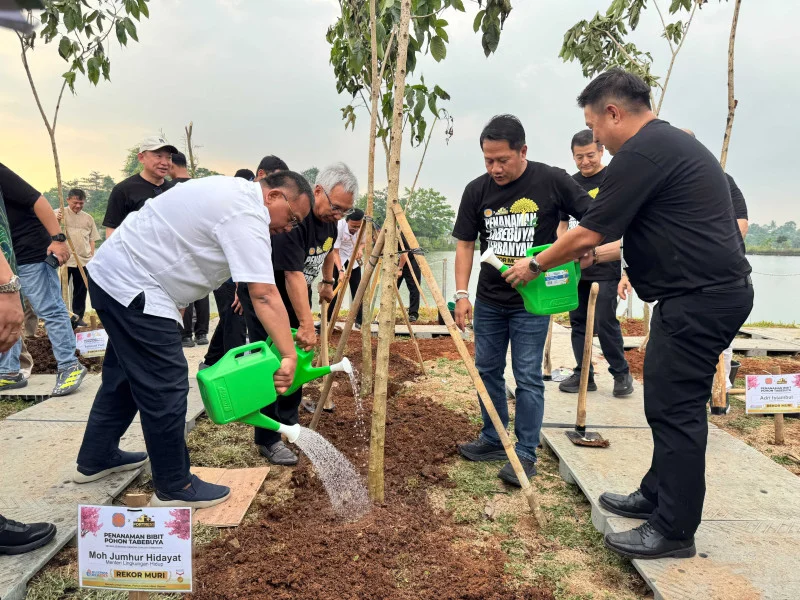
The Indonesian Real Estate Association, universally known as Realestat Indonesia (REI), has officially secured a prestigious accolade from the Indonesian World-Records Museum (MURI) following a massive, synchronized tree-planting initiative spanning 17 provinces across the archipelago. Held on Friday, November 20, the landmark environmental drive centered around the widespread cultivation of Tabebuia trees. This monumental undertaking was executed with the strategic backing of Pintu Baja Fortress, a leading industrial manufacturing brand under PT Jaya Bersama Saputra Perkasa (JBS Perkasa).
Designed as a core highlight of the upcoming REI National Working Meeting (Rakernas) for the year 2026, the campaign also serves as a proactive, high-impact prelude to World Tree Day, which is globally observed annually on November 21. By combining corporate social responsibility with urban ecological enhancement, REI aims to redefine how real estate developers interact with local ecosystems, steering the national property sector toward a more sustainable and climate-resilient future.
Strategic Centralization and Nationwide Execution
The main focal point of this decentralized yet synchronized environmental campaign was established at Citra Garden Serpong, situated in Cisauk within the Tangerang Regency of Banten province. The grand launch attracted high-profile figures from both the public and private sectors, most notably the Minister of Environment and Head of the Environmental Control Agency (KLH/BPLH), Mohammad Jumhur Hidayat. His presence underscored the federal government’s active endorsement of private-sector-led environmental restoration.
While the ceremonial launch took place in Banten, simultaneous planting operations unfolded across 17 distinct provinces. From the lush landscapes of Sumatra and various corners of Kalimantan all the way to the eastern frontiers of Papua, local chapters of REI and participating developers mobilized workforces, community volunteers, and local authorities. According to operational disclosures provided by event organizers, more than 9,350 mature Tabebuia saplings were successfully planted during this single-day synchronized event alone, contributing significantly to the association’s long-term green canopy targets.
The Million-Tree Roadmap: Progress and Milestones
The successful MURI record-breaking event did not occur in a vacuum; rather, it represents a crucial milestone in a broader environmental roadmap initiated earlier in the decade. Under the current leadership of DPP REI General Chairman Joko Suranto, the association launched an ambitious nationwide movement back in September 2024 to plant a staggering total of one million trees.
This ambitious initiative operates on a systematic and verifiable corporate mechanism: for every single residential housing unit transacted and sold by member developers across the country, exactly two trees are committed to the national planting pipeline. Through this consistent transaction-linked formula, REI’s cumulative environmental footprint has expanded exponentially.
Providing a detailed progress report during the MURI presentation ceremony, Joko Suranto revealed that total plantings achieved under the scheme had reached an impressive 720,000 trees as of November 20, 2026.
"Alhamdulillah, from a quantitative standpoint, we have successfully planted 720,000 trees to date. Our realistic target moving forward is to ensure that at least sixty percent of these saplings successfully survive and mature. Today, alongside Fortress, we have once again executed a synchronized planting of Tabebuia trees across 17 distinct points, bringing us one step closer to our ultimate goal of one million trees, God willing," stated Joko during his official address.
Beyond the per-transaction model, REI has institutionalized large-scale mass planting drives. To date, the association has orchestrated 19 major mass planting operations across geographically diverse and ecologically sensitive regions. Notable target locations have included the tourism hub of Labuanbajo in East Nusa Tenggara, the sprawling landscapes of the country’s future political capital, Nusantara Capital City (IKN) in East Kalimantan, and dozens of strategic locations across Sumatra, bringing the total number of localized planting points close to 50 nationwide.
Decoding the Rationale: Ecological and Moral Motivations
Joko Suranto emphasized that the association’s unwavering commitment to large-scale reforestation is driven by a triad of fundamental motivations. First and foremost, the campaign serves as a tangible expression of stewardship and affection for the planet. Second, it acts as an institutionalized pledge toward long-term ecological sustainability within an industry historically scrutinized for its land-conversion impacts. Third, and perhaps most importantly, it functions as an intergenerational gift of environmental health destined for future generations—specifically, the children and grandchildren of modern citizens.

From a scientific standpoint, the selection of these trees is closely tied to their measurable environmental yields. As Joko pointed out, every successfully matured tree functions as a natural hydrological regulator by retaining groundwater, acts as an active carbon sink while releasing vital oxygen into the atmosphere, and contributes to the microclimate cooling of densely populated urban areas.
The leadership also extended deep gratitude to regional heads, municipal governments, and national ministries that have eliminated bureaucratic bottlenecks and offered unreserved support on the ground. Notably, localized resistance to land-use adjustments for forestry initiatives has been virtually nonexistent, with many regional leaders actively rolling up their sleeves to participate in the cultivation efforts. As the CEO of Buana Kassiti Group, Joko expressed strong optimism that this million-tree initiative will continue to inspire positive behavioral shifts throughout Indonesia’s broader real estate ecosystem and civil society.
Industrial Transformation and the Significance of Tabebuia
Representing the primary corporate sponsor of the record-breaking event, PT Jaya Bersama Saputra Perkasa (JBS Perkasa)—widely recognized for its flagship Pintu Baja Fortress brand—highlighted the philosophical alignment between modern industrial manufacturing and ecological restoration. Founder and CEO Joni Effendi explained that the company’s corporate vision is deliberately anchored in driving productive industrial transformation, specifically by dismantling outdated, resource-depleting conventions that traditionally harmed natural ecosystems.
"Historically, for every single wooden house door manufactured, a tree had to be felled. Today, through our partnership with REI, we are actively returning to nature what we have historically altered and extracted," Joni asserted. By actively funding and supporting the large-scale distribution of Tabebuia saplings across Sumatra, Kalimantan, and Papua, Fortress hopes to set a new benchmark for corporate responsibility within the building materials sector.
The specific botanical choice—the Tabebuia tree, belonging to the Bignoniaceae family—carries deep linguistic and symbolic resonance. Etymologically, the name originates from the indigenous term tacyba bebyua, which translates to "ant wood," referencing the natural symbiotic relationship between the hollow twigs of certain species and local ant colonies. Symbolically, Tabebuia is celebrated globally for its striking resemblance to cherry blossoms when it blooms in vibrant shades of pink, yellow, and white, making it an ideal urban landscape tree. Beyond its aesthetic brilliance, the species is widely recognized for its robust resilience against harsh urban pollution, making it a powerful emblem of endurance, hope, and fresh beginnings for newly developed residential zones.
Government Endorsement and the Economics of Carbon Trade
The scale and execution of the REI-Fortress initiative drew high-level validation from the central government. Minister of Environment and Head of the Environmental Control Agency (KLH/BPLH), Mohammad Jumhur Hidayat, delivered a compelling endorsement of the nationwide green campaign. Despite recovering from an exhaustive official trip to Turkey and operating under suboptimal health conditions, the Minister made it a priority to attend the central event in Tangerang, signaling the critical importance the state places on public-private environmental partnerships.
Jumhur’s visit coincided strategically with the impending global observance of World Tree Day on November 21. In his formal remarks, the Minister stressed that ecological preservation can no longer be viewed as a peripheral corporate charity project. Instead, it must be embraced as an interconnected, collective responsibility—a concept he described as tanggung renteng (shared collective burden)—that transcends national borders and government agencies.
Furthermore, the Minister highlighted the immense macroeconomic potential embedded within structured environmental conservation, pointing directly to the lucrative global mechanisms of carbon trading. As Indonesia continues to develop its domestic carbon exchange infrastructure, private sector initiatives that systematically plant and preserve hundreds of thousands of trees position developers not only as environmental stewards, but as active participants in the emerging green economy.
"Because I recognize the absolute urgency of fostering a collective consciousness toward environmental protection, I made a point to attend this event today despite my travel fatigue," Jumhur remarked. He cautioned against treating environmental protection as a mere bureaucratic checklist, advocating instead for a paradigm shift that moves beyond compliance into deep-seated cultural norms.
Jumhur utilized a striking medical analogy to illustrate his point, comparing ecological restoration to community health initiatives: just as a society naturally unites to combat a widespread epidemic through collective medical intervention, so too must citizens and corporations unite voluntarily to heal a degraded planet. Through shared commitments and organically grown conservation cultures, the government hopes to foster an environment where ecological preservation is driven by innate civic pride rather than regulatory coercion.