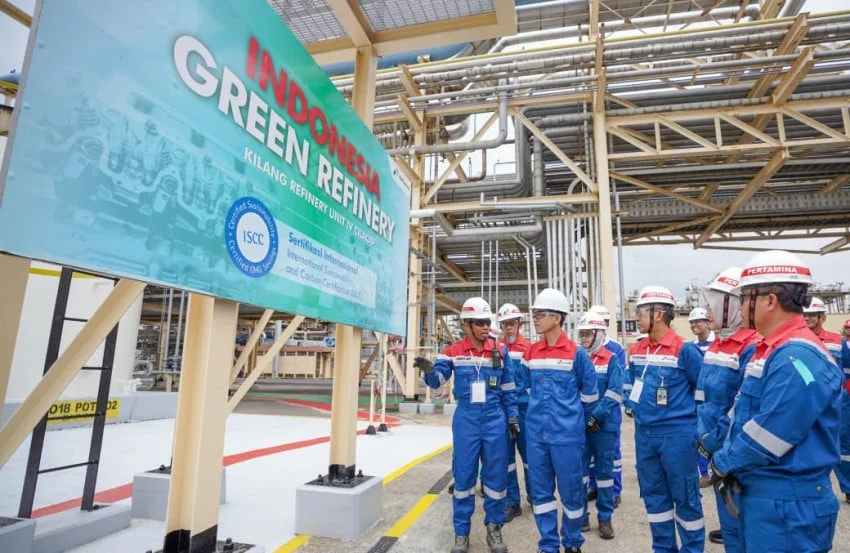
PT Pertamina Patra Niaga has reinforced Indonesia’s position in the global green energy transition by successfully producing 11 million liters of Sustainable Aviation Fuel (SAF) derived from used cooking oil, commonly known as "mijel" (minyak jelantah), at its state-of-the-art Green Refinery in Cilacap, Central Java. This commercial milestone underscores the nation’s growing capacity to transform domestic waste into high-value, environmentally friendly aviation fuel, aligning with international decarbonization goals within the aviation sector.
The achievement gained high-level national prominence when Vice President Gibran Rakabuming Raka conducted a direct field inspection of the processing facilities at the Cilacap Green Refinery. During his visit, the Vice President emphasized the critical nexus between large-scale industrial green energy production and grassroots economic empowerment.
"The development of SAF must go hand in hand with community empowerment. This ensures that the used cooking oil managed by housewives through local waste banks not only yields environmental benefits but also possesses tangible economic value, directly connecting local communities to the national industrial ecosystem," Vice President Gibran stated in a formal press release.
Technical Integration and Commercialization Milestone
The large-scale production of SAF at the Cilacap facility represents a major leap forward in Pertamina’s sustainable energy roadmap. According to Taufik Aditiyawarman, Vice President Director I of Pertamina Patra Niaga, the initiative leverages existing refining infrastructure through an innovative technical approach known as co-processing.
At the heart of this operation is the Thermal Distillate Hydro Treating (TDHT) facility. Through this unit, used cooking oil is blended and processed alongside conventional fossil components to create high-grade aviation biofuel that meets strict international aviation standards.
"In the implementation of SAF production at the Green Refinery in Cilacap, we have officially reached the commercialization stage. In October alone, we successfully produced approximately 11 million liters of co-processed SAF," Taufik explained during the briefing.
To ensure operational stability and product quality, the refinery utilizes used cooking oil at a maximum ratio of 5 percent of the total production capacity within the TDHT unit. This measured approach allows Pertamina to maximize the utility of its current infrastructure without compromising refinery yields or fuel safety parameters, paving the way for scalable future expansions as supply chains mature.
Background Context: The Global Push for Green Aviation
The aviation industry is one of the hardest sectors to decarbonize, accounting for approximately 2 to 3 percent of global carbon dioxide emissions. As international regulatory bodies, such as the International Civil Aviation Organization (ICAO), enforce increasingly stringent carbon offset and reduction schemes—such as the Carbon Offsetting and Reduction Scheme for International Aviation (CORSIA)—airlines worldwide are under immense pressure to adopt sustainable alternatives to conventional Jet A-1 fuel.

Sustainable Aviation Fuel has emerged as the most viable immediate solution for reducing aviation lifecycle emissions by up to 80 percent compared to conventional jet fuel. However, global SAF production has historically been bottlenecked by the availability and cost of sustainable feedstocks, primarily dedicated oil crops or animal fats, which often raise concerns regarding land-use change and food security.
By utilizing used cooking oil as the primary feedstock, Pertamina Patra Niaga successfully bypasses these ethical and environmental dilemmas. Sourcing waste lipids not only prevents the environmental degradation associated with the improper disposal of used cooking oil—such as water pollution and clogged municipal drainage systems—but also creates a circular economy model that transforms domestic waste into a high-value export commodity.
The Grassroots Supply Chain: Connecting Waste Banks to Refineries
A critical component of Pertamina’s SAF initiative is its inclusive supply chain model. Rather than relying solely on large industrial food-service aggregators, the procurement framework integrates local waste banks (bank sampah) and community-level networks.
Households and small culinary businesses collect used cooking oil and deposit it into local waste banks. These community institutions consolidate the volume and channel it upward into the industrial supply chain. This decentralized collection method provides a secondary stream of income for urban and rural households, turning a household nuisance into micro-economic capital.
Economic analysts note that this grassroots integration is vital for the long-term sustainability of green fuel projects in developing economies. By decentralizing the feedstock acquisition process, Pertamina secures a steady, diversified supply of raw material while simultaneously fostering public participation in the nation’s green transition.
Broader Implications for Indonesia’s Energy Independence
The successful commercialization of 11 million liters of SAF in a single production cycle carries profound strategic implications for Indonesia:
- Energy Diversification and Security: By reducing reliance on imported crude oil derivatives, Indonesia strengthens its energy independence while simultaneously diversifying its export portfolio toward high-value green products.
- Meeting Nationally Determined Contributions (NDC): The project directly supports Indonesia’s commitments under the Paris Agreement to reduce greenhouse gas emissions across the transportation and energy sectors.
- Positioning as a Regional Biofuel Hub: With vast domestic supplies of agricultural byproducts and waste oils, Indonesia possesses the raw material potential to become a leading regional producer and exporter of SAF in Southeast Asia, catering to international carriers seeking compliant green fuels.
Future Outlook and Next Steps
Following the successful inspection by Vice President Gibran Rakabuming Raka and the achievement of commercial-scale output in October, Pertamina Patra Niaga is expected to evaluate the potential for scaling up its TDHT processing ratios and expanding collection infrastructure nationwide.
As global aviation hubs increasingly mandate blending quotas for sustainable fuels—with markets in Europe and North America leading the regulatory push—Indonesian-produced SAF could soon power international flights originating from or transiting through the archipelago. The integration of local waste management with cutting-edge refinery technology demonstrates that Indonesia is not merely a participant in the global green energy transition, but an active innovator forging scalable paths toward sustainable industrial growth.