The landscape of Southeast Asian football enters a transformative era this week as the ASEAN Hyundai Cup 2026 officially begins, marking the latest chapter in the region’s most prestigious international tournament. With the rebranding under the title sponsorship of Hyundai, the competition formerly known as the AFF Championship returns to captivate millions of fans across the continent. The tournament, which features the premier national teams of the Association of Southeast Asian Nations (ASEAN), serves as a critical barometer for the progress of football in a region that has seen rapid development in infrastructure, coaching, and international competitiveness over the last decade. As the first whistle blows on July 24, 2026, the focus shifts to Group A, where traditional powerhouses and rising challengers prepare to battle for a spot in the knockout stages.
The 2026 edition of the tournament carries significant weight for the Indonesian national team, often referred to as the Garuda squad. Despite being one of the most consistent performers in the history of the competition, Indonesia has famously finished as runners-up on six occasions, a record that the current administration and coaching staff are desperate to rectify. Under the strategic framework established by the Football Association of Indonesia (PSSI), the national team enters this campaign with a blend of experienced veterans and a highly touted generation of younger players, many of whom have gained valuable experience in overseas leagues. The journey for Indonesia begins with a high-stakes encounter against Cambodia, a match that is widely viewed as a mandatory victory for any side harboring serious ambitions of reaching the semi-finals.
Tournament Structure and Opening Fixtures
The ASEAN Hyundai Cup 2026 follows a tested and competitive format designed to maximize regional engagement and maintain high sporting standards. The ten participating nations are divided into two groups of five. Group A consists of Indonesia, Vietnam, Singapore, Cambodia, and Timor-Leste. Group B, meanwhile, features the defending champions and other regional heavyweights. The group stage utilizes a round-robin format where each team plays four matches. The top two finishers from each group will advance to the semi-finals, which, along with the final, will be played over two legs on a home-and-away basis. This format is designed to test the tactical depth and physical endurance of the squads, as travel across the vast Southeast Asian archipelago becomes a secondary challenge to the action on the pitch.
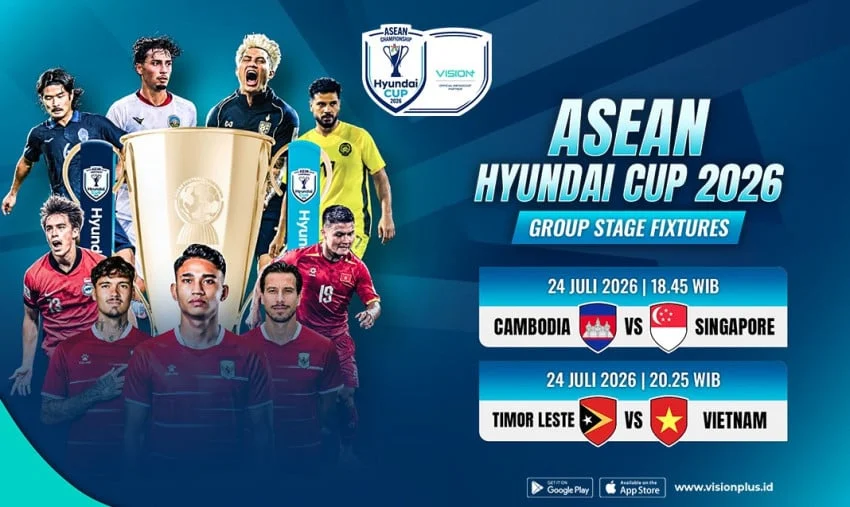
The opening day of the tournament, Friday, July 24, 2026, is set to feature a double-header that will establish the early hierarchy of Group A. The first match of the competition pits Cambodia against Singapore at 18:45 WIB. Singapore, a four-time champion, is looking to reclaim its former glory after several years of inconsistent performances in regional competitions. Cambodia, under a renewed technical program focused on youth development, enters the match as an underdog but possesses the potential to cause an upset if their disciplined defensive structure holds firm. Following this opening duel, Timor-Leste will face Vietnam at 20:25 WIB. Vietnam enters the tournament as one of the favorites, boasting a disciplined squad that has consistently performed well on the broader Asian stage. For Timor-Leste, the match represents an opportunity to demonstrate their growth as a footballing nation against one of the region’s elite teams.
Indonesia’s Strategic Objectives and Group A Dynamics
For the Indonesian national team, the 2026 campaign is about more than just participation; it is about validation. The PSSI has invested heavily in technical staff and international scouting, aiming to build a squad capable of dominating the ASEAN region. The opening match against Cambodia is viewed by analysts as a crucial "tone-setter." A convincing victory would not only secure three points but also provide a psychological boost ahead of the more grueling fixtures against Singapore and the regional rival, Vietnam.
The rivalry between Indonesia and Vietnam has become one of the most watched fixtures in Asian football. In recent years, matches between these two sides have been characterized by high intensity, tactical sophistication, and a deep-seated desire for regional supremacy. With both teams placed in Group A, their head-to-head encounter later in the group stage is expected to determine who finishes at the top of the table, potentially avoiding a difficult semi-final draw against the winners of Group B. Coaches from both camps have remained cautious in their public statements, emphasizing the importance of taking the tournament one match at a time, yet the underlying tension remains a focal point for fans and media alike.
Historical Context and the Evolution of the Championship
The ASEAN Hyundai Cup has undergone several transformations since its inception in 1996 as the Tiger Cup. Over the last three decades, it has evolved from a fledgling regional tournament into a major commercial and sporting event. The transition from the Mitsubishi Electric Cup to the Hyundai Cup in 2026 reflects the growing commercial value of Southeast Asian football. Global brands now recognize the region as a primary market, driven by a demographic that is among the most football-passionate in the world.
Historically, the tournament has been dominated by Thailand, who hold the record for the most titles won. However, the gap between the traditional "Big Three" (Thailand, Vietnam, and Singapore) and the rest of the field has narrowed significantly. The 2026 tournament is expected to showcase this parity. Nations like Malaysia, the Philippines, and even Cambodia have made strides in professionalizing their domestic leagues, which has directly translated to more competitive national teams. This evolution has made the group stages increasingly unpredictable, as the margin for error has become razor-thin.
Technical Analysis: Preparation and Personnel
Preparation for the 2026 tournament has been intensive across the board. Most participating nations conducted multi-week training camps and participated in FIFA-sanctioned friendlies in the months leading up to July. For Indonesia, the focus has been on tactical flexibility. The coaching staff has experimented with various formations, ranging from a traditional 4-3-3 to a more defensive 5-4-1, depending on the opposition. The integration of "diaspora players"—those with Indonesian heritage playing in European and North American leagues—has added a new dimension to the team’s physicality and tactical discipline.
In contrast, Vietnam has relied on a core group of players who have played together for several years. Their strength lies in their collective cohesion and a high-pressing style of play that often suffocates opponents in the midfield. Singapore, under a new technical direction, has emphasized a more pragmatic approach, focusing on set-pieces and counter-attacks. These differing philosophies will be on full display during the opening week, providing a fascinating study in regional footballing styles.
Economic and Social Impact of the 2026 Edition
Beyond the pitch, the ASEAN Hyundai Cup 2026 is a significant economic driver for the region. Hosting matches provides a boost to local tourism, hospitality, and retail sectors. The home-and-away format for the knockout stages ensures that multiple cities across Southeast Asia benefit from the influx of fans and international media. Furthermore, the broadcasting rights for the tournament have reached record valuations. In Indonesia, the digital streaming platform Vision+ has secured the rights to provide comprehensive coverage, allowing fans to access matches across various devices. This shift toward digital consumption reflects broader trends in the global sports media landscape, where accessibility and high-definition streaming have become the standard.
Socially, the tournament serves as a rare unifying force in a culturally diverse region. For many ASEAN nations, football is the primary sport, and the success of the national team is a source of immense national pride. The "Garuda mania" seen in Indonesia, where stadiums are routinely filled to capacity, is a testament to the deep emotional connection between the fans and the sport. Government officials and sports ministers across the region have often noted that the ASEAN Championship fosters regional cooperation and people-to-people ties, aligning with the broader goals of the ASEAN community.
Official Reactions and Future Implications
Leading up to the kickoff, officials from the ASEAN Football Federation (AFF) have expressed confidence that the 2026 edition will be the most successful to date. "The ASEAN Hyundai Cup represents the pinnacle of football in our region," an AFF spokesperson stated during a pre-tournament press conference. "We are seeing unprecedented levels of professionalism from our member associations, and the quality of play continues to rise. This tournament is not just about crowning a champion; it is about showcasing the talent and passion of Southeast Asia to the world."
The implications of the 2026 tournament extend beyond regional bragging rights. Success in the ASEAN Hyundai Cup can significantly impact a nation’s FIFA ranking, which in turn affects seeding for AFC Asian Cup qualifiers and FIFA World Cup qualifying rounds. For teams like Indonesia and Vietnam, who are striving to become mainstays in the latter stages of Asian continental competitions, a strong showing in the regional cup is a vital stepping stone. It provides the necessary high-pressure environment for younger players to develop the mental fortitude required for the highest levels of international football.
Conclusion: A Summer of Football Excellence
As the teams take to the field on July 24, the narrative of the ASEAN Hyundai Cup 2026 will begin to unfold. Will Indonesia finally break its "runner-up curse" and lift the trophy? Can Vietnam maintain its status as a regional powerhouse? Or will a dark horse like Cambodia or Singapore disrupt the established order? The answers will emerge over the coming weeks as the group stages conclude and the high-drama knockout rounds begin.
For the fans, the tournament offers a month of unparalleled excitement and national fervor. With every goal, tackle, and tactical masterclass, the 2026 edition of the ASEAN Hyundai Cup promises to solidify its place as a cornerstone of the regional sporting calendar. As the matches are broadcast to millions via platforms like Vision+, the world will once again witness why Southeast Asian football is one of the fastest-growing and most vibrant sectors in the global game. The journey to the final has begun, and for the ten nations involved, the stakes have never been higher.