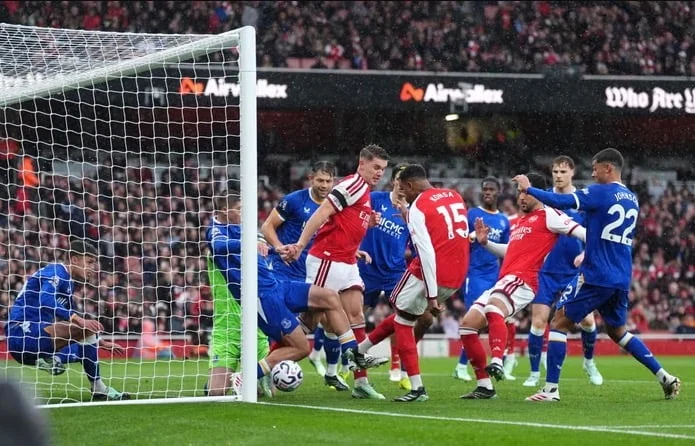
The Premier League title race intensified on a crisp afternoon in North London as Arsenal delivered a disciplined and professional performance, defeating Everton 2-0 at the Emirates Stadium. Mikel Arteta’s side showcased both defensive resilience and attacking opportunism to secure all three points, capitalizing on early defensive frailty before sealing the result with a trademark header from central defender Gabriel in the second half. The victory not only reinforces Arsenal’s status as genuine contenders for the English crown but also highlights the tactical maturity that has come to define the club under Arteta’s stewardship.
Playing in front of a capacity crowd of expectant supporters, the hosts established dominance from the opening whistle. Everton, managed with characteristic pragmatism, set up in a compact low block, inviting pressure and looking to exploit spaces on the counter-attack through direct vertical passes. However, the visitors’ defensive strategy unravelled remarkably early, undone by a combination of sustained Arsenal pressure and catastrophic miscommunication within their penalty area.
The Match Chronology and Tactical Breakdown
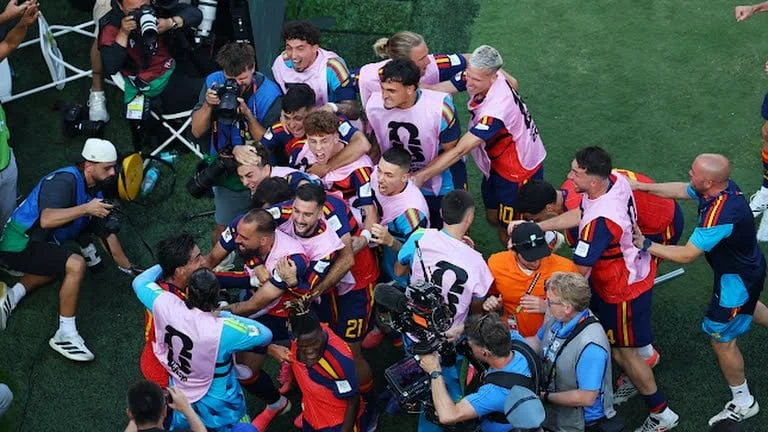
The tone of the encounter was set within the opening ten minutes. Arsenal immediately pinned Everton into their final third, utilizing the width of the pitch through their dynamic wide forwards and overlapping full-backs. The breakthrough arrived in the seventh minute, stemming from a sustained spell of pressure that resulted in a corner kick. As the delivery swung into a congested six-yard box, a critical failure of communication occurred between Everton goalkeeper Jordan Pickford and left-back Vitaliy Mykolenko. Neither player claimed the loose ball, allowing it to drop favourably to Konsa, who reacted quickest amidst the scramble to bundle the ball over the goal line. The early goal electrified the home supporters and forced Everton to marginally alter their passive tactical approach.
Despite holding the lead, Arsenal refused to rest on their laurels. The Gunners dominated possession, registering a staggering share of the ball in the first half while restricting Everton to speculative long-range efforts and isolated counter-attacks. Viktor Gyokeres proved to be a persistent thorn in the side of the visiting central defenders, utilizing his physical strength to pin back Everton’s backline. Midway through the first half, Gyokeres came agonizingly close to doubling the lead after latching onto a sublime defence-splitting pass from Eberechi Eze. However, a desperate, last-ditch sliding intervention by Jake O’Brien diverted the ball out for a corner, keeping the Toffees within striking distance.
As the half progressed, Everton’s backline absorbed wave after wave of attacks. Pickford made several crucial interventions to deny Arsenal’s secondary runners, while James Tarkowski marshalled his defensive partners with resolute authority. Despite Arsenal creating multiple half-chances through quick combinations in the half-spaces, the scoreline remained 1-0 in favour of the hosts as referee and players headed down the tunnel for the interval.
The second half commenced with a brief surge of ambition from Sean Dyche’s Everton side. Recognizing the need to shift momentum, the visitors pushed higher up the pitch, attempting to disrupt Arsenal’s build-up play. Merlín Röhl began to find pockets of space on the flank, producing a dangerous insweeding cross that flashed menacingly across David Raya’s six-yard box, though no visiting player was on hand to apply the finishing touch.
This brief resurgence, however, was quickly extinguished as Arsenal wrestled back tactical control of the fixture. Arteta introduced fresh legs and tactical adjustments to exploit fatigue in the Everton midfield. The pressure soon yielded a second goal in the 68th minute. Another well-executed set-piece—an area where Arsenal have excelled significantly over recent seasons—unlocked the resilient Everton defence. A pinpoint delivery found Gabriel towering above his marker inside the penalty area, and the Brazilian powerhouse directed a powerful header past a helpless Pickford, effectively ending the contest as a competitive spectacle.
With a two-goal cushion secured, Arsenal coasted through the remaining duration of the match. Noni Madueke squandered a gilt-edged opportunity to make it three, dragging his shot wide of the post after cutting inside from the right wing. Shortly after, Mikel Merino saw a goal-bound effort dramatically blocked by a recovering Everton defender. Everton offered little response in the closing stages, and when the final whistle blew, the scoreboard confirmed a thoroughly deserved clean-sheet victory for the North London club.
Supporting Data and Statistical Overview
A granular examination of the match statistics underscores Arsenal’s comprehensive dominance across the ninety minutes. The hosts controlled approximately 68% of the possession, completing over 600 passes with an accuracy rate exceeding 88%. This level of control stifled Everton’s ability to build any sustained rhythm, limiting the visitors to a mere two shots on target throughout the entire fixture—both of which were comfortably gathered by Spanish international goalkeeper David Raya.
Arsenal registered a total of 18 attempts on goal, with six hitting the target. Their expected goals (xG) metric hovered around 2.15, reflecting the quality of the chances generated, particularly from set-pieces and structured positional play in the final third. Defensively, Arsenal won over 60% of their aerial duels and successfully neutralized Everton’s primary aerial threat, preventing the visitors from capitalizing on set-pieces of their own.
For Everton, the defeat highlights ongoing struggles away from home against the league’s elite tier. While their defensive block proved difficult to break down for extended periods, their inability to retain possession under pressure placed an unsustainable burden on their backline. The statistical disparity in territory and final-third entries ultimately justified the two-goal margin.
Post-Match Reactions and Managerial Assessments
Speaking in his post-match press conference, Arsenal manager Mikel Arteta expressed satisfaction with his team’s professionalism and defensive solidity, while acknowledging the inherent difficulties of breaking down a defensively resolute opponent.
"I am very pleased with the maturity of the performance," Arteta told journalists. "In the Premier League, matches are rarely straightforward. When you play against an opponent that defends as deep and as well-organized as Everton, you need patience, discipline, and execution in the small details. Scoring early certainly helped, but the way we managed the game afterwards, restricting their transitions and maintaining our structure, was top-level. Gabriel scoring again shows our threat from set-pieces, which is a vital tool, but overall, it is the collective clean sheet that pleases me most."
On the opposing side, Everton manager Sean Dyche offered a realistic assessment of his team’s shortcomings, pointing specifically to the defensive lapse that gifted Arsenal their opening goal.
"You cannot come to a stadium like this, against a side of Arsenal’s quality, and make basic errors that gift them the lead inside ten minutes," Dyche remarked. "We had a clear tactical plan to frustrate them, and for large parts of the game, the defensive shape did its job. We absorbed a lot of pressure and restricted their open-play chances. But against elite teams, the margins are razor-thin. Conceding from a set-piece mix-up early on alters the entire complexion of your game plan. We showed glimpses of a reaction in the second phase of the game, but ultimately, the second goal killed the contest. We must dust ourselves down and prepare for the next challenge."
Broader Implications for the Premier League Season
The ramifications of this result extend deeply into the broader narrative of the current Premier League campaign. For Arsenal, collecting three points at home against a stubborn opponent validates their evolution into a side capable of grinding out results when not necessarily at their most fluent attacking peak. Maintaining defensive discipline and converting set-pieces into reliable scoring opportunities are hallmarks of championship-winning teams. As the fixture congestion intensifies over the winter period, the depth of Arsenal’s squad—evidenced by impactful contributions from across the roster—will serve them exceptionally well.
Conversely, Everton finds themselves embroiled in the familiar territory of fighting to pull away from the lower reaches of the table. While their defensive organization under Dyche remains largely intact against mid-to-lower-tier opposition, their lack of an incisive attacking outlet continues to limit their ability to spring surprises against the league’s traditional heavyweights. Securing their Premier League status will depend heavily on maximizing points against direct relegation rivals rather than fixtures of this magnitude, though defensive lapses against top sides remain an area of urgent remediation.
As the season approaches its halfway mark, performances like this one suggest Arsenal are well-equipped to sustain a rigorous, multi-front challenge. With tactical clarity, defensive resilience, and a growing psychological fortitude, the Gunners have once again signaled to their rivals that they are fully prepared to go the distance in pursuit of domestic glory.