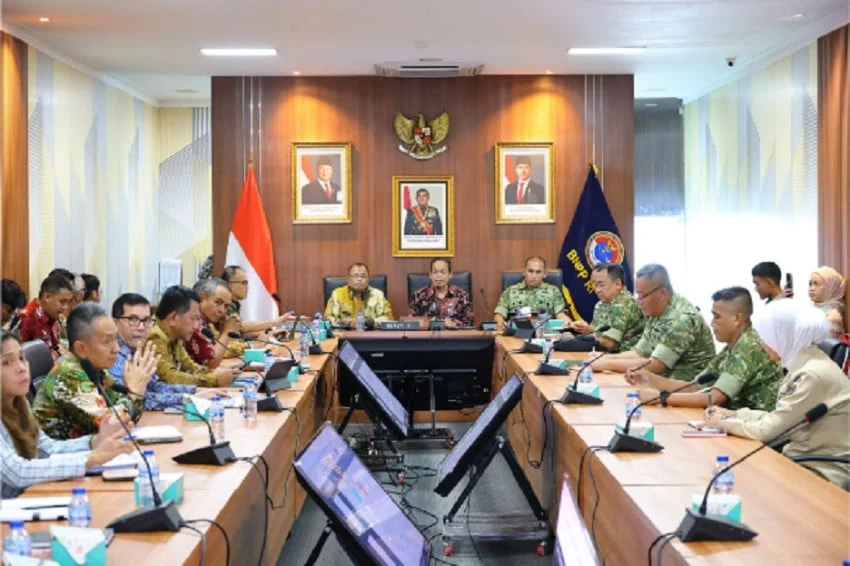
The Badan Nasional Pengelola Perbatasan dan Daerah Terpencil (BNPPDT) and the Indonesian Army (TNI AD) have formally convened in Jakarta to establish a comprehensive framework for the accelerated, integrated development of border regions across Kalimantan. Held at the Permanent Secretariat Office of the BNPPDT on Thursday, November 5, 2026, the high-level coordination meeting underscored the critical nexus between national security, territorial defense, and socio-economic prosperity in Indonesia’s outermost frontiers.
The strategic gathering brought together senior defense officials, civilian planners, and border management experts to deliberate on data collection, strategic evaluations, and policy alignment for the fourth quarter (TW IV) of the fiscal year. Discussions centered primarily on formulating actionable policies to fortify the defense architecture of Indonesia’s major islands and strategically vital archipelagic clusters, with a specific emphasis on the land and maritime borders shared with Malaysia on the island of Kalimantan.
Strategic Context and Defense Integration
The imperative for a synchronized approach to border management stems from the complex geopolitical realities facing Indonesia. Kalimantan, known internationally as Borneo, represents one of the most critical geopolitical frontiers for the Republic of Indonesia. Sharing a porous, heavily forested land boundary stretching nearly 2,000 kilometers with East Malaysia (Sabah and Sarawak), the region presents distinct challenges ranging from transnational smuggling and illegal migration to sovereignty oversight and environmental degradation.
During the coordination session, Plh Secretary of BNPPDT and Deputy for State Border Management, Nurdin, highlighted that the agency had compiled and finalized formal written responses to a series of strategic inquiries posed by the Staff Expert Team of the Chief of Staff of the Army (TNI AD). These responses serve as foundational data for the military’s ongoing strategic studies regarding border infrastructure and defense readiness.
Nurdin emphasized that the management of national borders cannot be executed in isolation by civilian authorities alone, nor can it be left entirely to military defense mechanisms. Instead, a dual-track paradigm focusing on concurrent defense readiness and civilian welfare is paramount.
"Looking ahead, we anticipate that the newly structured BNPPDT will achieve full operational capacity swiftly. We are committed to fostering robust synergies with all relevant stakeholders, prominently including the Indonesian Army, because national defense and community welfare are inextricably linked," Nurdin stated during the deliberations.
Chronology and Policy Evolution of Border Governance
The November 2026 meeting is part of a broader, sustained institutional effort by the Indonesian government to overhaul the governance of remote and border regions. Historically, border management in Indonesia suffered from sectoral egoism and fragmented policies, where various ministries and military branches operated under disjointed directives.
The evolution of border governance saw a major milestone with the establishment of the National Border Management Agency (BNPP), which has progressively transformed into expanded entities such as the BNPPDT to address the unique vulnerabilities of remote and isolated territories.
Over the preceding months, leadership at the BNPPDT has engaged in active reconnaissance and field evaluations across Indonesia’s outer islands. For instance, earlier operational assessments, such as leadership visits to strategic outposts like Miangas Island, laid bare the stark disparities in infrastructure, telecommunications, logistics, and healthcare access that plague remote regions. These field findings directly informed the strategic framework presented during the November meeting with the TNI AD, ensuring that military defense requirements are harmonized with civilian development goals.
The transition from a purely security-focused approach—dominant during the early decades of independence—to a human-centric developmental approach gained serious momentum under modern administrative reforms. Today’s policy framework recognizes that local populations living along the border act as the eyes and ears of the state; thus, their economic resilience and loyalty are the first line of national defense.
Multisectoral Collaboration and Operational Challenges
A core theme of the discussions at the BNPPDT Secretariat was the necessity of multi-agency coordination in managing Cross-Border Posts (Pos Lintas Batas Negara – PLBN). Mayjen TNI Edi Nurhabad, Deputy for Border Area Infrastructure at BNPPDT, elaborated on the intricate mechanics of PLBN administration.
Managing a modern PLBN is far from a simple administrative task. It requires the seamless integration of multiple state agencies, including immigration services, customs and excise (Bea Cukai), agricultural quarantine authorities, local law enforcement, and military security personnel.
"Managing a Cross-Border Post involves diverse elements and institutional mandates. Therefore, cross-sectoral coordination is non-negotiable to ensure that public services, trade facilitation, and security enforcement operate with maximum efficiency," Mayjen TNI Edi Nurhabad explained.
In Kalimantan, where several operational PLBNs—such as Entikong, Aruk, and Badau—serve as vital economic arteries connecting Indonesian regencies with Malaysian territories, efficient cross-agency coordination directly impacts the national economy. Streamlining bureaucratic bottlenecks at these checkpoints reduces logistics costs, deters illegal trafficking, and encourages formal cross-border trade, which in turn boosts the welfare of local border communities.
Implications for National Security and Regional Stability
The strategic partnership between the BNPPDT and the TNI AD carries profound implications for Indonesia’s overarching defense posture and regional diplomacy within Southeast Asia. By systematically aligning infrastructure development with strategic defense planning, Indonesia signals a proactive commitment to securing its sovereign territory while fostering constructive economic cooperation with its neighbors.
From a defense perspective, the integration of logistical routes, telecommunications networks, and transport infrastructure in Kalimantan significantly enhances the rapid deployment capabilities of the TNI AD. In the event of traditional or non-traditional security contingencies, well-maintained roads and operational hubs along the border ensure that military assets can be repositioned swiftly and efficiently.
Furthermore, civilian infrastructure projects—such as clean water facilities, electrical grids, health clinics, and educational institutions implemented under complementary initiatives like the "Bangun Beranda Negeri" program—help mitigate the socio-economic disparities that often make border populations vulnerable to external influences or illicit economic networks. When border communities enjoy a high quality of life and feel a strong connection to the Indonesian state, the security of the frontier is naturally reinforced from within.
Broader Economic and Infrastructural Goals
The ongoing collaboration also aligns with national economic development priorities. The relocation of Indonesia’s capital city, Nusantara (IKN), to the province of East Kalimantan has fundamentally shifted the geopolitical and economic center of gravity toward the island. Consequently, the security, stability, and infrastructural readiness of Kalimantan’s borderlands are no longer peripheral concerns; they are central to the stability of the national capital region.
The strategic studies conducted jointly by the BNPPDT and the TNI AD for the fourth quarter of 2026 aim to project infrastructural needs for the next decade. These projections include the expansion of all-weather road networks connecting remote border sub-districts, the establishment of digital connectivity hubs to integrate remote outposts into the national digital economy, and the upgrading of security outposts to modern standards.
As the BNPPDT transitions into its newly empowered operational framework, the institutionalized cooperation with the TNI AD serves as a vital model for civil-military relations in state administration. By bridging the gap between defense strategy and civilian welfare, Indonesia is laying a resilient foundation for the sustainable development and enduring security of its Kalimantan frontiers.