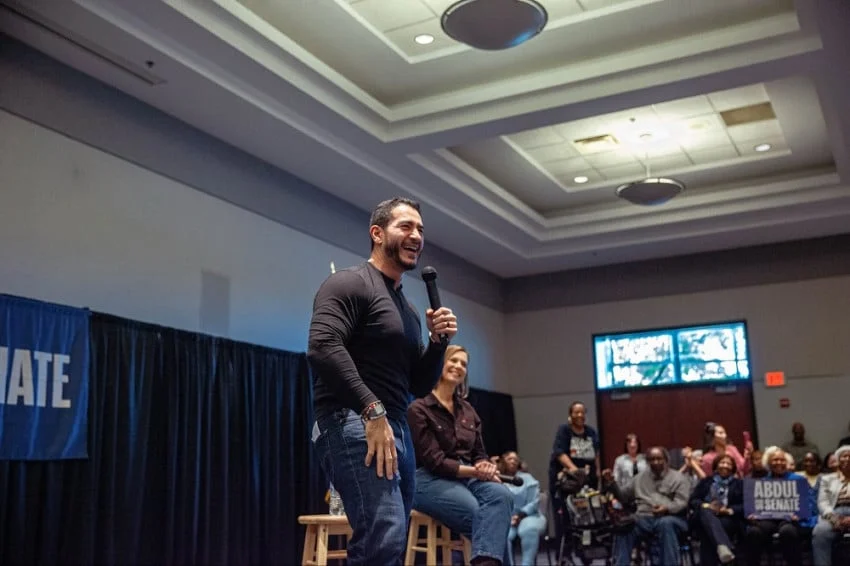
WASHINGTON — In a monumental achievement for political representation in the United States, Abdul El-Sayed, a prominent progressive Democrat and former public health official of Egyptian-American descent, has secured a historic victory in Michigan’s highly contested midterm Senate race. El-Sayed defeated his Republican opponent, Mike Rogers, in a high-stakes election that attracted national attention and drew massive voter turnout. By clinching this seat, El-Sayed officially becomes the first Muslim ever elected to the United States Senate, marking a transformative milestone for American governance, diversity, and civic participation.
The 42-year-old progressive leader successfully captured the Senate seat previously held by retiring Democratic Senator Gary Peters. Peters’ retirement opened up a fiercely contested vacancy that triggered one of the most expensive and closely watched legislative campaigns of the election cycle. El-Sayed’s victory not only maintains a crucial seat for the Democratic Party in the upper chamber of Congress but also signals a generational and demographic shift within American political leadership.
A Hard-Fought Campaign Amid Internal Party Divides
The road to the United States Senate was far from straightforward for El-Sayed, whose campaign unfolded against a backdrop of deep ideological friction within the Democratic Party. Throughout the primary and general election cycles, El-Sayed navigated complex intra-party debates concerning universal healthcare, economic inequality, federal spending priorities, and United States foreign policy—specifically regarding American diplomatic and military posture toward Israel.
Despite facing substantial headwinds and well-funded opposition both from within and outside his party, El-Sayed’s grassroots-focused mobilization strategy resonated deeply with Michigan’s diverse electorate. His platform centered heavily on progressive economic populism, affordable healthcare as a fundamental human right, robust environmental protections, and systemic reforms to protect working-class families. Analysts noted that his ability to unite a coalition of young voters, progressive activists, and traditional labor union members proved decisive in defeating Rogers, a seasoned political figure backed by powerful conservative donors.
Roots, Academic Excellence, and Public Health Leadership
Born in Rochester Hills, Michigan, to immigrant parents who moved to the United States from Egypt, El-Sayed’s life story embodies the classic American immigrant narrative paired with exceptional academic and professional achievement. Long before stepping onto the national political stage, El-Sayed built a formidable reputation as a physician, epidemiologist, and public health administrator dedicated to underserved communities.
El-Sayed’s academic journey reflects a track record of elite scholarship and public service. He graduated from the University of Michigan in 2007 with high honors, where he cultivated an early interest in biological sciences and social equity. His academic brilliance earned him a prestigious Rhodes Scholarship, enabling him to attend the University of Oxford. There, he pursued advanced graduate studies, ultimately earning his doctorate in public health in 2011. Following his time at Oxford, El-Sayed continued his rigorous educational path by attending Columbia University College of Physicians and Surgeons, where he earned his medical degree in 2014.
His transition from clinical medicine to systemic public administration occurred rapidly. In 2015, at the remarkably young age of 30, El-Sayed was appointed as the Executive Director of the Detroit Health Department by Mayor Mike Duggan. Stepping into the role during a period of intense institutional vulnerability following the city’s historic municipal bankruptcy, El-Sayed spearheaded sweeping reform initiatives. He led efforts to rebuild Detroit’s shattered public health infrastructure, combat chronic childhood lead poisoning, address high infant mortality rates, and restore public trust in municipal sanitation and health monitoring systems. His tenure in Detroit cemented his reputation as an operational crisis manager capable of delivering tangible results under extreme pressure.
Chronology of a Historic Rise
To understand the magnitude of El-Sayed’s ascent to the United States Senate, it is necessary to examine the trajectory of his career within Michigan politics over the past decade:
- 2015–2018: Serving as Detroit’s Health Director, El-Sayed gains statewide recognition for his aggressive advocacy against environmental racism and corporate polluters affecting urban neighborhoods.
- 2018: El-Sayed launches his first major statewide political campaign, running for Governor of Michigan. Running as an unvarnished progressive, he finishes second in a competitive Democratic primary won by Gretchen Whitmer, earning hundreds of thousands of votes and establishing a loyal statewide following.
- 2019–2024: Following his gubernatorial bid, El-Sayed expands his public platform. He works as a university professor, political commentator, author, and podcast host, maintaining active engagement in public health advocacy throughout the COVID-19 pandemic and championing "Medicare for All" legislation.
- Early 2024: With Senator Gary Peters announcing his decision not to seek re-election, El-Sayed evaluates a run for the open Senate seat, recognizing a rare opportunity to elevate progressive public health policies to the federal level.
- Mid-2024: El-Sayed secures key endorsements from progressive labor unions, environmental organizations, and prominent national figures, successfully navigating a crowded primary field.
- Late 2024 (General Election): In a fiercely contested showdown against Republican nominee Mike Rogers, El-Sayed leverages his deep roots in Michigan communities to build a winning electoral coalition, ultimately culminating in his historic victory.
Official Responses and Public Reactions
The historic nature of the election prompted an outpouring of reactions from political leaders, civil rights organizations, and community advocates across the nation. Supporters heralded the victory as a watershed moment for American democracy, demonstrating that voters are increasingly willing to look past prejudice and elect leaders based on their qualifications, vision, and dedication to public service.
Civil rights groups, including the Council on American-Islamic Relations (CAIR) and the Muslim Public Affairs Council (MPAC), issued statements celebrating the milestone. Representatives emphasized that El-Sayed’s election shatters long-standing glass ceilings for Muslim Americans in federal governance, proving that individuals from diverse religious and cultural backgrounds can reach the highest echelons of American political power.
Political analysts noted that El-Sayed’s victory reflects broader demographic shifts within the United States, where younger, more diverse electorates are demanding representation that mirrors the complex multicultural reality of modern America. At the same time, Republican strategists offered a more cautious assessment, pointing out that El-Sayed will face intense scrutiny in Washington as a freshman senator representing a crucial Midwestern swing state where conservative and moderate voters still hold significant sway.
Broader Implications and Future Outlook
Abdul El-Sayed’s entry into the United States Senate carries profound implications for the legislative agenda of the 119th Congress and the future direction of the Democratic Party. As a staunch progressive who has made healthcare access, climate action, and economic justice the cornerstones of his public life, El-Sayed is expected to be an energetic voice on key Senate committees.
From a policy perspective, El-Sayed’s background as an epidemiologist and physician positions him as a leading authority on public health legislation, pandemic preparedness, and healthcare reform. His presence in the Senate provides progressives with a formidable advocate who possesses both the academic credentials to craft sophisticated policy and the populist appeal to mobilize grassroots movements.
Furthermore, El-Sayed’s historic win serves as a powerful rebuttal to xenophobia and Islamophobia in American public life. By winning a statewide election in a vital swing state like Michigan—home to one of the largest and most politically active Arab-American and Muslim-American communities in the country—El-Sayed has demonstrated the unifying power of inclusive, issue-driven politics. As he prepares to take the oath of office in Washington, D.C., the eyes of the nation will be fixed on the freshman senator, watching to see how he translates his trailblazing historic milestone into effective, impactful federal leadership.