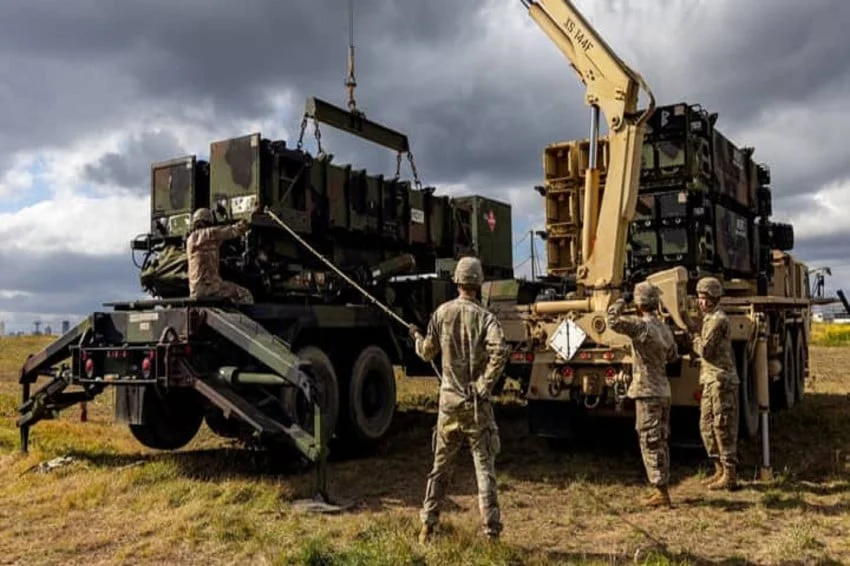
The Islamic Revolutionary Guard Corps (IRGC) of Iran announced a coordinated military operation late Saturday, targeting United States military installations in Bahrain. According to official statements released by the Iranian state news agency IRNA on Sunday, November 22, 2026, the strike involved a sophisticated combination of ballistic missiles and unmanned aerial vehicles (UAVs). The operation specifically targeted radar components of the American-operated Patriot missile defense systems stationed at the Al-Riffa and Awali bases. Tehran has characterized this offensive as a direct retaliation for what it describes as repeated violations of Iranian sovereign airspace by American military assets.
Chronology of the Escalation
The sequence of events leading to this kinetic engagement began in the early hours of Saturday. According to the IRGC’s official report, two American aircraft—an MQ-1 Predator and an MQ-9 Reaper drone—reportedly crossed into Iranian territorial airspace. The IRGC claimed these sorties were part of ongoing surveillance operations designed to map Iranian defense nodes.
Following these alleged incursions, the IRGC command structure authorized a retaliatory strike, labeling the event an "Operation for Airspace Sovereignty." By late Saturday evening, reports from the Persian Gulf indicated a series of explosions near the Al-Riffa and Awali military complexes. While the Pentagon has remained largely silent, local sources in Bahrain confirmed that sirens were activated across the island nation, and the resulting fires at a nearby industrial facility were the subject of immediate concern by the Bahraini Ministry of Interior.
Strategic Infrastructure and Military Impact
The targeting of Patriot missile defense radar systems represents a significant escalation in the ongoing shadow war between Washington and Tehran. The Patriot system is the cornerstone of the United States’ regional air and missile defense architecture, designed to intercept ballistic missiles, cruise missiles, and advanced aircraft. By focusing specifically on the radar arrays—the "eyes" of the defense system—the IRGC has demonstrated a tactical intent to neutralize the deterrent capabilities of the US Fifth Fleet, which maintains its headquarters in Bahrain.
Technical analysts suggest that the strike on radar nodes implies a high level of intelligence regarding US deployment patterns. The failure of the defensive umbrella to thwart the strike raises questions about the operational readiness of these systems under rapid-fire saturation attacks. IRGC officials boasted that the operation proved the "uselessness" of expensive US defense shields, asserting that the equipment intended to protect the region’s stability had instead suffered extensive damage.
Conflicting Narratives and Official Responses
The geopolitical narrative surrounding the incident remains deeply polarized. The Bahraini government, through its Ministry of Interior, issued a stern condemnation on Sunday morning, describing the strike as "a heinous act of aggression." Bahraini officials clarified that the strike impacted a civilian industrial facility, resulting in significant material damage but no immediate loss of life. This narrative creates a direct contradiction with the IRGC’s assertion that the attack was a precision strike against military targets.
As of the current reporting cycle, the United States Department of Defense has not issued a formal confirmation of the damage or a detailed casualty assessment. In the absence of a verified statement from Washington, regional observers are monitoring the movement of naval assets in the Persian Gulf. The silence from the Pentagon is often viewed in military circles as a period of "strategic assessment," where the US command structure determines the extent of the damage before formulating a public response or a retaliatory posture.
Historical Context and Regional Tensions
The relationship between Iran and the nations of the Gulf Cooperation Council (GCC), particularly Bahrain, has been fraught with tension for decades. The presence of the US Fifth Fleet in Bahrain has historically served as a stabilizing force for regional oil markets and a deterrent against Iranian expansionism. However, the recent shift in regional alliances, coupled with the ongoing instability in the broader Middle East, has strained these traditional security architectures.
Recent months have seen an increase in "grey zone" warfare—actions that fall below the threshold of full-scale war but serve to degrade the adversary’s strategic position. This includes the harassment of tankers, cyberattacks on critical infrastructure, and, as seen in this incident, direct confrontations involving UAVs. The Iranian assertion that its airspace is a "red line" is a long-standing doctrine, yet the decision to act upon it by striking US assets in a third country signals a shift toward a more aggressive, risk-tolerant posture by the IRGC.
Economic and Global Implications
The strike has sent ripples through global energy markets, as the stability of the Persian Gulf is intrinsically linked to the security of international maritime trade routes. Any escalation in the region inevitably triggers concerns regarding the flow of oil through the Strait of Hormuz, a critical maritime chokepoint.
Economic analysts suggest that the incident could lead to an immediate spike in insurance premiums for commercial shipping in the Gulf. If the conflict escalates further, the resulting uncertainty could have a compounding effect on energy prices. Furthermore, the incident serves as a stress test for the Biden administration’s—or its successor’s—regional policy, forcing a difficult choice between de-escalation and the maintenance of a credible military deterrent.
Strategic Analysis: The Future of Drone Warfare
The use of a hybrid drone and missile strike highlights the evolving nature of modern warfare. Asymmetric threats, such as those posed by the IRGC, are increasingly relying on cost-effective, high-volume drone strikes to overwhelm sophisticated, high-cost defensive platforms. The Patriot system, while highly capable, is designed primarily for high-altitude ballistic threats; the tactical use of loitering munitions or low-altitude drones presents a persistent challenge for such systems.
Military strategists note that the success of this attack, if confirmed, demonstrates the vulnerability of static military installations to modern intelligence-gathering and strike capabilities. The fact that the attack occurred in a sovereign country like Bahrain complicates the diplomatic fallout. It forces Bahrain to navigate its role as a host to the US military while managing its proximity to a hostile neighbor that views its territorial integrity with extreme sensitivity.
Looking Ahead
As the situation develops, the international community is looking for signs of de-escalation or further provocation. Diplomatic channels, including potential backchannel discussions between Washington and Tehran, are likely being tested. For now, the region remains in a state of high alert.
The IRGC’s statement that "every violation will be met with a harsh and decisive response" serves as a warning that this incident may not be an isolated event. Observers are now watching for a potential US response, whether it involves kinetic action, increased sanctions, or a diplomatic offensive through the United Nations Security Council.
The events of November 21 and 22 have undeniably altered the regional security calculus. With the damage to industrial infrastructure in Bahrain and the targeting of US military assets, the threshold for direct conflict between the United States and Iran has been tested. Whether this remains a contained dispute or escalates into a wider regional crisis will depend on the actions taken by both Tehran and Washington in the coming 48 to 72 hours. The world remains focused on the Persian Gulf, waiting to see if the rhetoric of "decisive response" will lead to a wider conflagration or if the parties involved will seek a diplomatic path to mitigate further loss.