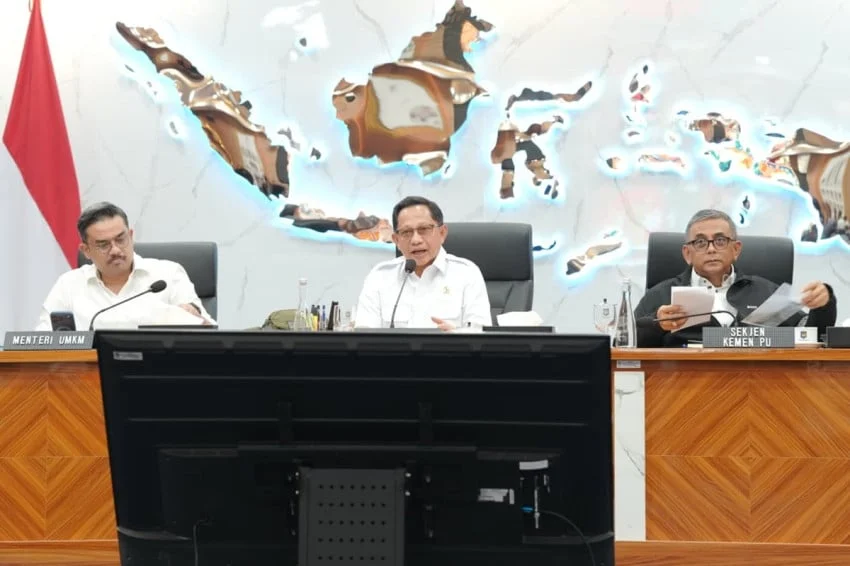
The Ministry of Home Affairs (Kemendagri) has reaffirmed its commitment to the systematic recovery of the Sumatra region following devastating natural disasters. On Wednesday, October 28, 2026, Minister of Home Affairs Muhammad Tito Karnavian, serving as the Head of the Task Force for the Acceleration of Rehabilitation and Reconstruction (PRR) for Sumatra, presided over a high-level meeting at the Ministry’s headquarters in Jakarta. The session focused on the strategic progress of restoring critical infrastructure and revitalizing Micro, Small, and Medium Enterprises (MSMEs), which form the backbone of the regional economy.
The meeting, which served as both a strategic review and a public briefing, was attended by key stakeholders, including the Minister of MSMEs, Maman Abdurrahman, and the Secretary-General of the Ministry of Public Works (PU), Apri Artoto. This collaborative effort underscores the inter-ministerial coordination required to address the multi-faceted challenges of post-disaster recovery in one of Indonesia’s most economically vital islands.
Strategic Roadmap: A Three-Year Recovery Horizon
The recovery effort in Sumatra is not a short-term intervention but a structured, multi-year program codified in a comprehensive master plan. According to the official documentation, the rehabilitation and reconstruction (rehab-rekon) phase is slated to span from 2026 through 2028. Minister Tito emphasized that while the scale of the damage is significant, the government’s approach is methodical to ensure that the rebuilt assets are not only restored to their original state but are also more resilient to future climate-related risks.
"The most critical point to emphasize is that the acceleration of the rehabilitation and reconstruction of Sumatra’s disaster-affected areas is proceeding on track, and these operations will continue through to 2028," stated Tito during the press release. By maintaining this timeline, the government aims to avoid the pitfalls of rushed construction, focusing instead on long-term sustainability and quality control.
The Heavy Lifting: Infrastructure and Public Works
A central pillar of the recovery mission lies with the Ministry of Public Works (PU), which has been tasked with the monumental job of rehabilitating essential physical infrastructure. Secretary-General Apri Artoto highlighted the complexity of the tasks ahead, which involve repairing and upgrading critical arterial roads, bridges, and educational facilities that were either destroyed or severely compromised during the disaster events.
One of the most pressing technical challenges identified by the Task Force is the issue of sedimentation in river basins. Minister Tito noted that many of Sumatra’s river systems have been heavily impacted by disaster-induced debris, which significantly reduces their water-carrying capacity. "Because of this sedimentation, if we do not manage it effectively, even minor heavy rainfall could trigger subsequent flooding. We are prioritizing desilting and river restoration as a primary flood mitigation strategy," Tito explained.
The implications of this are clear: infrastructure recovery is not merely about replacing asphalt or concrete; it is about hydrological management. Without clearing these sediment deposits, the region remains trapped in a cycle of vulnerability, where recovery efforts could be undone by the next rainy season.
Empowering the Economic Backbone: The MSME Sector
While infrastructure forms the physical foundation, the MSME sector represents the economic livelihood of the millions residing in the affected areas. Minister of MSMEs Maman Abdurrahman participated in the deliberations to ensure that the recovery plan provides the necessary support for small business owners who lost their inventories, facilities, and market access.
For many communities in Sumatra, MSMEs are the primary source of employment. A total shutdown of these businesses in the immediate aftermath of the disaster created a ripple effect of poverty and economic instability. The recovery program involves not just the physical repair of shops and kiosks, but also financial assistance, technical training, and supply chain restoration to help these businesses regain their footing. The involvement of the Ministry of MSMEs indicates a shift toward a more holistic recovery model—one that views economic resilience as being just as critical as the repair of bridges and roads.
Contextualizing the Disaster and Response Chronology
To understand the current stage of the PRR Task Force, it is necessary to look at the timeline of events. The disasters, which struck various provinces across Sumatra earlier in 2026, overwhelmed local administrative capacities, prompting the central government to take a proactive role through the formation of the Task Force.
- Early 2026: Initial disaster events occur, leading to widespread destruction of residential areas, public infrastructure, and economic zones.
- Mid-2026: The government conducts comprehensive damage and loss assessments (DaLA) to determine the budgetary requirements for reconstruction.
- Late 2026: Formalization of the Master Plan for Rehabilitation and Reconstruction. The October 28 meeting serves as the progress report for the first stage of this implementation.
- 2027-2028: The execution phase, involving large-scale construction, public service restoration, and economic stimulus programs for the local populace.
The government’s proactive stance in establishing a dedicated Task Force is a departure from previous ad-hoc responses. By centralizing the management under the Ministry of Home Affairs, the government is ensuring that local governments in the affected provinces are fully aligned with national standards and receive the necessary administrative support to expedite bureaucratic hurdles.
Challenges in the Path to Recovery
Despite the progress, the road ahead is fraught with technical and logistical challenges. The geography of Sumatra, characterized by complex topography and dense forests, makes the transportation of construction materials and heavy machinery difficult. Furthermore, the changing climate patterns have introduced uncertainty regarding the frequency and intensity of future disasters.
Analysts observe that the primary challenge for the PRR Task Force is maintaining the momentum of funding and political will over a three-year period. Often, in post-disaster scenarios, initial media attention fades, and budgetary allocations can be diverted or delayed. By making the progress of the rehabilitation a matter of public record and routine reporting, the Task Force is attempting to enforce accountability and transparency.
Furthermore, the integration of disaster risk reduction (DRR) into the reconstruction process is vital. Building back better is the official mantra, but its practical application requires rigorous enforcement of spatial planning and building codes. If the reconstruction fails to account for the heightened risk profiles of specific zones, the government risks wasting public funds on infrastructure that may not survive the next decade.
Implications for Regional Stability
The success of the Sumatra rehabilitation program carries significant implications for Indonesia’s national stability. Sumatra is a major contributor to the national GDP, particularly through agriculture, mining, and manufacturing. A prolonged period of economic paralysis in the region would have detrimental effects on the national economic outlook.
Moreover, the effectiveness of the disaster response serves as a barometer for the central government’s ability to protect its citizens and maintain essential services in times of crisis. The collaboration between the Ministry of Home Affairs, the Ministry of Public Works, and the Ministry of MSMEs signals a "whole-of-government" approach. This model of cooperation is expected to set a precedent for future disaster management efforts across the Indonesian archipelago, which remains one of the most disaster-prone regions in the world.
Looking Toward the Future
As the recovery enters its next phase, the focus will likely shift from emergency stabilization to long-term sustainable development. The progress reported on October 28 provides a glimpse into the complexities of rebuilding a region at scale. While the challenges of sediment management, infrastructure integrity, and economic revitalization remain, the structured timeline and inter-ministerial synergy provide a degree of confidence that the recovery is moving in the right direction.
The coming months will be critical, particularly as the Ministry of Public Works moves to implement larger-scale engineering solutions for river management and infrastructure hardening. For the people of Sumatra, the 2028 target is more than just a date; it represents a commitment to returning to normalcy and building a future that is resilient against the forces of nature. The government’s continued transparency and commitment to these targets will remain a focal point for both domestic observers and international stakeholders monitoring Indonesia’s capacity for resilience and recovery.