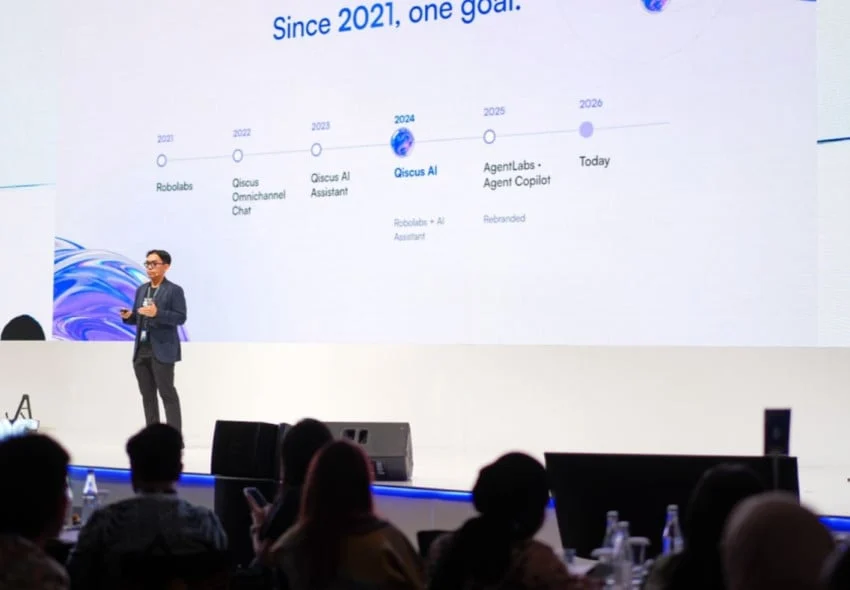
The Southeast Asian customer engagement landscape underwent a significant shift this week as Qiscus, a leading provider of agentic customer engagement platforms, officially launched two groundbreaking layers of artificial intelligence technology: Operator and Qiscus MCP. The announcement, made during the company’s signature annual forum, Conversa 6.0, held in Jakarta, signals a transition from passive AI interaction to proactive, operational decision-making. Attended by over 200 industry leaders, technology practitioners, and business strategists, the event underscored the urgent need for enterprises to move beyond simple chatbots toward a more cohesive, "agentic" architecture to achieve what the company defines as "Perfect CX"—a customer experience characterized by speed, hyper-personalization, and proactive problem-solving.
The Evolution of Customer Engagement: From Interaction to Operation
For the past decade, the integration of AI into customer service has primarily focused on the "interaction layer." Businesses have widely adopted Large Language Models (LLMs) to automate responses, deflect repetitive inquiries, and provide 24/7 support. However, as the digital footprint of modern consumers grows, these tools have often hit a ceiling. Businesses continue to struggle with fragmented data, siloed communication channels, and, most importantly, "decision latency"—the critical delay between identifying a customer issue and executing a meaningful, data-driven resolution.
Delta Purna Widyangga, CEO and Co-Founder of Qiscus, articulated this shift during his keynote address at Conversa 6.0. He argued that the current market saturation of conversational AI is insufficient for the demands of 2026. "For a long time, AI in customer service has largely functioned at the interaction layer, primarily focused on providing faster answers," Widyangga noted. "The logical next step is to elevate this to the operational layer, where actual business decisions are made. Today’s enterprises do not just require faster answers; they require faster, more precise, and automated decisions."
Decoding the New Architecture: Operator and Qiscus MCP
The two new pillars of the Qiscus ecosystem are designed to address the complexity of modern business operations. Qiscus MCP (Multi-Channel Platform) acts as the foundation, designed to unify disparate data streams and communication channels into a single, cohesive intelligence hub. By breaking down the silos that prevent real-time data visibility, MCP allows businesses to maintain a "single source of truth" for every customer interaction, regardless of whether that engagement occurs on WhatsApp, social media, email, or proprietary mobile applications.
Complementing this is "Operator," an agentic AI layer that moves beyond scripted responses. Unlike traditional bots that follow rigid decision trees, the Operator layer is capable of autonomous reasoning. It can ingest complex customer data, cross-reference it with internal business logic, and initiate actions—such as processing refunds, updating subscription statuses, or flagging high-risk accounts—without constant human intervention. This shift to agentic AI represents a move toward systems that can "think" and "act" rather than just "talk."
Chronology of Conversa: Building Toward the Agentic Shift
The launch of these technologies at Conversa 6.0 is the culmination of a multi-year roadmap for Qiscus. Since its inception, the company has tracked the maturity of digital customer service in Southeast Asia.
- 2021–2022: The focus was primarily on infrastructure and the adoption of multi-channel communication tools, as businesses rushed to digitize their service desks during the post-pandemic boom.
- 2023: Qiscus began integrating generative AI features into its dashboard, allowing for real-time sentiment analysis and agent assist tools.
- 2024: The focus shifted toward data integration, as the company recognized that communication tools were useless without access to backend CRM and ERP data.
- 2025: The development of the "Agentic" framework began in earnest, focusing on the ability of AI to trigger workflows based on intent recognition.
- 2026: With the launch of Operator and Qiscus MCP, the company has officially moved into the era of autonomous service orchestration.
Bridging the Decision Latency Gap
One of the most pressing challenges addressed by Qiscus is "decision latency." Research indicates that in large enterprises, the average time between receiving a customer signal (a complaint or a purchase inquiry) and executing an optimal response can be measured in hours, or even days, due to internal bureaucratic bottlenecks and technical fragmentation.
By using the Agentic Shift model, Qiscus aims to reduce this latency to seconds. The platform uses AI to orchestrate the flow of information across teams, ensuring that the right data reaches the right decision-maker—or the right autonomous agent—at the right time. This is particularly crucial for industries like fintech, e-commerce, and logistics, where a delay in communication can result in direct financial loss or significant brand erosion.
Industry Implications and Market Impact
The introduction of agentic AI into the mainstream market holds profound implications for the labor market and operational efficiency. Economists observing the sector suggest that the shift toward "orchestrated AI" will likely lead to a transformation in the role of human customer service agents. Rather than performing manual data entry or repetitive queries, human agents will transition into "AI supervisors" or "CX orchestrators," focusing their efforts on high-empathy scenarios and complex problem-solving that requires human intuition.
Furthermore, by democratizing access to these high-level AI tools, Qiscus is effectively closing the gap between large-scale enterprises and Small-to-Medium Enterprises (SMEs). Historically, "Perfect CX" was a privilege reserved for VIP customers or companies with massive IT budgets. Through a scalable platform approach, Qiscus aims to enable mid-market businesses to provide the same level of responsive, proactive service as their larger counterparts.
Looking Ahead: The Future of Orchestration
As the event concluded, the consensus among attendees was clear: the era of the standalone chatbot is effectively over. The future of customer engagement lies in "The Agentic Shift"—a concept that prioritizes the interconnectedness of systems over the performance of individual tools.
Qiscus’s strategic focus for the remainder of 2026 will be the widespread deployment of the Operator layer across its existing client base. The company plans to provide extensive training and migration support for businesses looking to integrate their legacy systems into the new MCP framework.
For many industry analysts, the success of this transition will depend on the ability of businesses to trust AI with decision-making power. While the technology is robust, the human element—governance, ethics, and the final oversight of automated decisions—remains a critical point of discussion. Qiscus has indicated that its roadmap includes further investments in "Human-in-the-Loop" (HITL) features, ensuring that while the AI acts autonomously, it remains firmly within the guardrails set by the business.
As the curtains closed on Conversa 6.0, the message from the Qiscus leadership was one of cautious optimism. The tools to build a more efficient, personalized, and proactive customer engagement future are no longer on the horizon; they are here. The challenge now lies in execution: for companies to successfully navigate the complexity of AI orchestration and turn the promise of agentic technology into a tangible competitive advantage. With the integration of Operator and Qiscus MCP, the company is positioning itself not just as a service provider, but as an essential architect of the future digital enterprise.