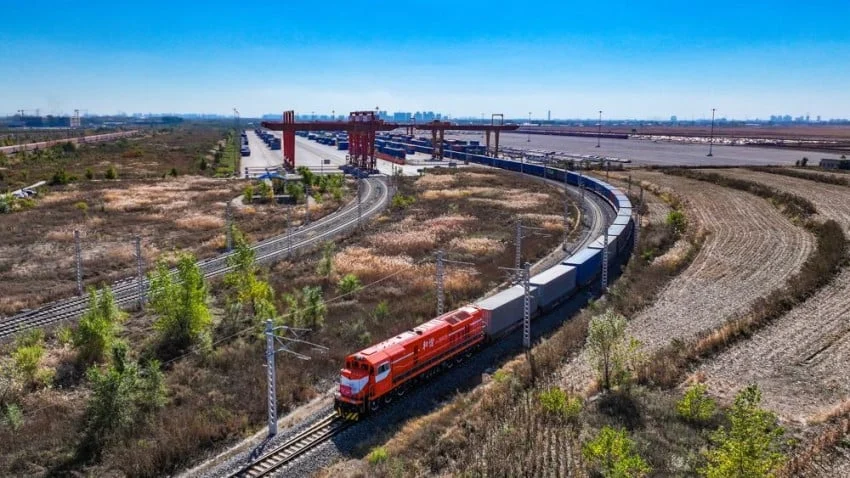
The global landscape of transportation infrastructure is currently defined by a stark divergence in capital allocation, with railway development serving as the primary benchmark for national industrial ambition. As nations grapple with the dual pressures of urbanization and the urgent need for decarbonized transit, the financial commitment to rail networks has become a geopolitical statement of intent. According to data synthesized by the International Transport Forum (ITF)—an intergovernmental organization operating under the auspices of the Organisation for Economic Co-operation and Development (OECD)—the disparity in investment levels between China and the rest of the world is not merely significant; it is transformative.
The Scale of Global Railway Investment
Infrastructure projects, particularly in the rail sector, represent some of the most capital-intensive undertakings a nation can pursue. The ITF, which regularly surveys its member states regarding gross investment—encompassing new construction, network expansion, large-scale reconstruction, and modernization—provides the most granular view of this trend. While historical comparisons are often complicated by varying accounting standards and fiscal definitions across borders, the data underscores a clear hierarchy in modern mobility development.
In 2021, the top five nations leading global railway investment were China, Japan, the United Kingdom, France, and Germany. China stands in a category of its own, having invested approximately €92.5 billion in that year alone. To put this figure into perspective, the combined expenditure of Japan (€17.0 billion), the United Kingdom (€13.3 billion), France (€11.5 billion), and Germany (€10.1 billion) totals roughly €51.9 billion—a sum that barely exceeds half of China’s individual commitment. While countries like India, Italy, and the United States maintain substantial rail budgets, their reporting methodologies often diverge from the ITF standard, placing them in a separate analytical tier, yet they remain far behind the Chinese trajectory.
China: The Engine of Global Rail Expansion
China’s dominance in the rail sector is not a recent phenomenon but the result of a multi-decade strategic pivot. As early as 2018, China accounted for 52% of the total railway infrastructure investment across the 42 nations surveyed by the ITF. This massive infusion of capital is deeply embedded in the nation’s long-term economic planning, serving as a pillar for domestic connectivity and industrial manufacturing capability.
The sheer velocity of growth is evidenced by recent reports from the China State Railway Group. In 2025, the state-owned operator reported a fixed-asset investment of 901.5 billion yuan (approximately USD 128.9 billion). This represented a 6% increase, setting a record high and signaling that the government views rail infrastructure as a recession-proof engine for economic stability. Within that same year, 3,109 kilometers of new track were inaugurated, of which 2,862 kilometers were dedicated to high-speed rail (HSR).
Over the five-year period from 2021 to 2025, China’s total operational rail network expanded from 146,300 kilometers to 165,000 kilometers. Even more striking is the evolution of the high-speed segment, which grew from 37,900 kilometers to 50,400 kilometers. This network is not merely the longest in the world; it is the backbone of the Chinese economy, facilitating the rapid movement of labor and goods across provinces that were once geographically isolated. While investment growth began to moderate in 2026, with 601.2 billion yuan (approximately USD 89 billion) spent in the first three quarters—an increase of 1.3%—the sustained level of spending underscores a transition from "rapid expansion" to "network consolidation and optimization."
Comparative Analysis: The Top Five Global Investors
While China occupies the apex, the other four nations in the top tier represent different approaches to rail management.
- Japan: Despite having a mature network, Japan continues to invest heavily in the maintenance and technological upgrading of its legendary Shinkansen (bullet train) network. Japan’s focus has shifted toward earthquake-resistant infrastructure and the deployment of magnetic levitation (Maglev) technology.
- United Kingdom: The UK’s investment profile is heavily influenced by large-scale projects like HS2, which have faced significant budget scrutiny and political debate. The focus here remains on increasing capacity on aging Victorian-era corridors.
- France: France’s rail investment is characterized by the expansion of the TGV network and a strategic emphasis on integrating regional lines with the European high-speed grid, balancing the needs of rural connectivity with high-speed trunk lines.
- Germany: Germany has prioritized the "Deutschlandtakt" initiative, aiming to optimize the entire national timetable to improve efficiency. Recent investments are heavily skewed toward electrification and digital signalization to reach climate neutrality goals.
The Strategic Rationale Behind Rail Investment
The rationale for such massive capital allocation is multifaceted. For China, rail infrastructure is a tool for "Internal Development Strategy." By connecting the less-developed western and inland regions with the affluent coastal hubs, the government has successfully mitigated internal wealth inequality. Furthermore, the reliance on high-speed rail has significantly reduced the carbon footprint of domestic travel compared to aviation, aligning with the country’s broader "Dual Carbon" goals—peaking carbon emissions by 2030 and achieving carbon neutrality by 2060.
From an economic standpoint, the "Multiplier Effect" of railway investment is substantial. Every yuan invested in rail infrastructure stimulates demand in the steel, cement, electronics, and construction sectors. Moreover, it creates a massive employment ecosystem that supports millions of jobs, ranging from high-tech signaling engineers to construction workers and administrative personnel.
Official Responses and Future Outlook
While specific ministerial responses vary, the consensus among global transport officials is that rail infrastructure is the most efficient method for moving large volumes of people over medium-to-long distances. The International Transport Forum has frequently noted in its policy briefings that nations with robust rail networks are significantly more resilient to fuel price volatility and are better positioned to meet the challenges of the green energy transition.
Critics of such high investment levels, particularly in the West, often point to the "Debt Sustainability" of such projects. The China State Railway Group has faced scrutiny regarding the profitability of individual lines. However, Chinese officials have consistently argued that the "Social Value" and "Long-term Economic Integration" outweigh short-term accounting losses. The state-led model allows for a long-horizon perspective that private sector-led projects in Europe or North America often lack, where quarterly returns on investment are prioritized.
Broader Implications for Global Connectivity
The success of China’s rail strategy has prompted a global debate on "Infrastructure Diplomacy." Through initiatives like the Belt and Road Initiative (BRI), China has exported its rail technology and construction expertise to countries in Southeast Asia, Africa, and Eastern Europe. This has created a global standard where Chinese rail engineering—from track gauges to rolling stock—is becoming the default in many emerging markets.
As we look toward 2030, the global rail sector is expected to undergo a transition from expansion to digitalization. The implementation of AI-driven traffic management, autonomous trains, and real-time predictive maintenance is the next frontier. China, with its vast network, is currently the largest "laboratory" for these technologies. The data gathered from its 50,000+ kilometers of high-speed track provides a unique dataset for researchers worldwide.
In summary, while the total investment figures vary by year and definition, the hierarchy of rail spending is clear. China’s unprecedented commitment has reshaped the physical geography of the nation and established a new paradigm for infrastructure development globally. For other nations, the challenge remains to balance the immense fiscal cost of such projects with the undeniable long-term benefits of enhanced mobility, reduced carbon emissions, and increased economic integration. As the global economy continues to prioritize sustainable development, the investments made today in rail will likely define the industrial competitiveness of nations for the next half-century.