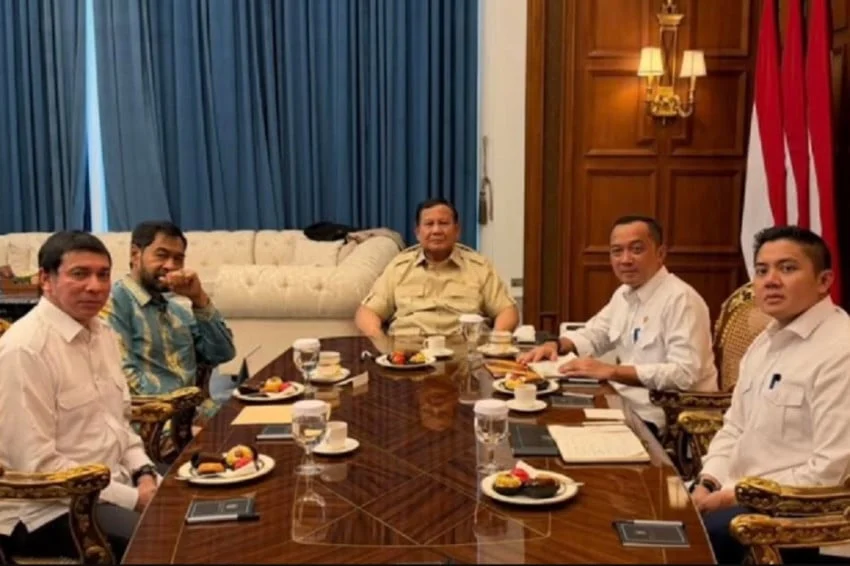
Governor of Aceh Muzakir Manaf, widely known as Mualem, held a high-level strategic meeting with President Prabowo Subianto at the Presidential Palace in Jakarta on Wednesday, November 4, 2026. The meeting marks a pivotal moment in the ongoing discourse between the central government and the provincial administration of Aceh, as both parties seek to address long-standing grievances and administrative hurdles that have characterized the post-conflict landscape of the region.
Accompanied by his Special Staffer, Teuku Irsyadi, Governor Mualem engaged in substantive discussions with the President, who was flanked by the Minister of State Secretary (Mensesneg) Prasetyo Hadi and the Cabinet Secretary (Seskab) Teddy Indra Wijaya. The dialogue reportedly focused on three critical pillars of Aceh’s governance: the continuity of the Special Autonomy (Otsus) funding, the legal formalization of the Aceh provincial flag, and the resolution of the land status regarding the iconic Blang Padang field.
Historical Context and the Evolution of Special Autonomy
The Special Autonomy status for Aceh was initially institutionalized through Law Number 11 of 2006 on the Governing of Aceh, a direct outcome of the 2005 Helsinki Memorandum of Understanding (MoU) between the Indonesian government and the Free Aceh Movement (GAM). This legal framework was designed to provide Aceh with a unique degree of self-governance and economic support, primarily funded through the Special Autonomy Fund.
However, as the sunset clause for these fiscal allocations approaches, the sustainability of the funding has become a point of contention. The fund, which constitutes a significant portion of the Aceh provincial budget (APBA), is essential for infrastructure development, poverty alleviation, and public service delivery. Governor Mualem’s visit to the Presidential Palace reflects an urgent need to secure a post-2027 fiscal roadmap, ensuring that the economic progress achieved during the peace era is not stalled by budgetary uncertainty.
Economic analysts observe that the reliance on the Special Autonomy Fund necessitates a transition toward sustainable regional investment. President Prabowo, who has consistently emphasized the importance of national food security and regional stability, is viewed as a pragmatic partner by the Aceh provincial government. Their previous cooperation—notably during disaster relief efforts where President Prabowo reportedly provided his personal helicopter for logistical support in Aceh—suggests a rapport that may facilitate smoother negotiations regarding fiscal allocations.
The Symbolic and Legal Complexity of the Aceh Flag
One of the most sensitive items on the agenda was the quest for legal certainty regarding the Aceh flag. The issue has been a persistent source of friction between the provincial administration and the central government for nearly two decades. While the Aceh government has long pushed for the adoption of the flag, which mirrors the design historically used by the GAM, the central government has historically raised concerns regarding potential separatist symbolism that could contravene national symbols.
In this meeting, the discussion pivoted toward finding a middle ground that respects the cultural and historical identity of the Acehnese people while ensuring full alignment with the sovereignty of the Republic of Indonesia. The legal status of the flag is governed by Qanun Aceh Number 3 of 2013, which has remained largely unimplemented due to federal government objections. By bringing this directly to President Prabowo, Mualem is signaling an intent to resolve the stalemate through high-level political diplomacy rather than protracted bureaucratic friction.
The Blang Padang Land Dispute
The third point of discussion concerned the Blang Padang field, a historic site in the heart of Banda Aceh. The land has been the subject of complex administrative claims involving military land usage, civilian administrative control, and historical preservation interests. Blang Padang holds significant sentimental value for the people of Aceh, serving as a hub for public activities and a symbol of civic space.
The resolution of this land status is not merely an administrative exercise; it is an effort to clear the path for urban development and public utility. By seeking the President’s intervention, the provincial government aims to cut through the institutional red tape that has stalled the transfer or reclassification of the land for decades, thereby unlocking potential for greater community-centered projects.

Chronology of Recent Federal-Aceh Relations
The meeting on November 4, 2026, is the latest in a series of engagements aimed at cementing the "Peace Dividend" in Aceh.
- Mid-2026: The Aceh administration intensified lobbying efforts for the revision of the Special Autonomy distribution mechanism.
- September 2026: Following a series of natural disasters in Aceh, President Prabowo intervened by providing logistical assets, fostering goodwill between the central government and the regional leadership.
- November 4, 2026: Formal consultation between Governor Mualem and President Prabowo takes place at the Presidential Palace, focusing on long-term legislative and fiscal solutions.
This timeline reflects a strategic shift from crisis management to long-term structural alignment. Observers note that the presence of the Mensesneg and Seskab in the meeting underscores the gravity of the requests, suggesting that the President is prepared to mobilize relevant ministries to draft the necessary executive or legislative actions.
Implications for Regional Stability
The outcomes of this meeting carry significant implications for the political stability of Indonesia’s westernmost province. If the central government agrees to a stable continuation of the Special Autonomy funds, it could drastically reduce the economic disparity that has historically fueled discontent. Furthermore, providing a dignified path for the recognition of regional symbols could act as a vital trust-building measure, reinforcing the commitment of the Acehnese people to the national framework under the auspices of a decentralized, yet unified, Indonesia.
However, the path forward is not without challenges. Any legislative change concerning Aceh requires careful navigation of national laws, including the potential revision of existing regulations governing regional symbols and fiscal transfers. The inclusion of the Cabinet Secretary in the meeting suggests that the administration is already looking toward the practical mechanics of implementation, potentially involving the Ministry of Home Affairs and the Ministry of Finance.
Official Responses and Future Outlook
While no official press release has been issued by the Presidential Palace regarding specific concessions, Mualem’s public statement via his official Instagram account indicates a positive reception. "In that meeting, we discussed several important agendas for Aceh, including the sustainability of the Special Autonomy Fund, the resolution and legal certainty of the Aceh flag, and the settlement of the Blang Padang waqf land status," Mualem stated.
For the people of Aceh, the results of this meeting are highly anticipated. The province has undergone a remarkable transformation since the 2004 tsunami and the subsequent peace agreement, and the current leadership is clearly focused on transitioning from the post-conflict phase to a phase of long-term economic and social consolidation.
As the administration of President Prabowo continues to solidify its domestic policy agenda, the engagement with Aceh serves as a litmus test for the central government’s ability to manage regional autonomy and cultural identity within the broader scope of national integration. Political analysts suggest that if these issues are resolved effectively, it would not only strengthen the President’s standing in the region but also provide a successful model for managing regional complexities in other parts of the Indonesian archipelago.
Looking ahead, all eyes are on the follow-up meetings between the Aceh provincial government and the relevant ministries in Jakarta. The coming months will likely see the formation of task forces or technical teams tasked with drafting the legal frameworks required to address the demands presented by Governor Mualem. Whether these discussions translate into concrete policy changes will determine the success of this high-level dialogue in fostering a more stable, prosperous, and integrated Aceh.
The meeting serves as a reminder that the relationship between the capital and the provinces remains a dynamic process, requiring constant maintenance, dialogue, and a shared commitment to the principles of justice and prosperity as enshrined in the national constitution. As Aceh looks to the future, the partnership between the provincial government and the central administration remains the most vital factor in the region’s continued trajectory toward sustainable development.