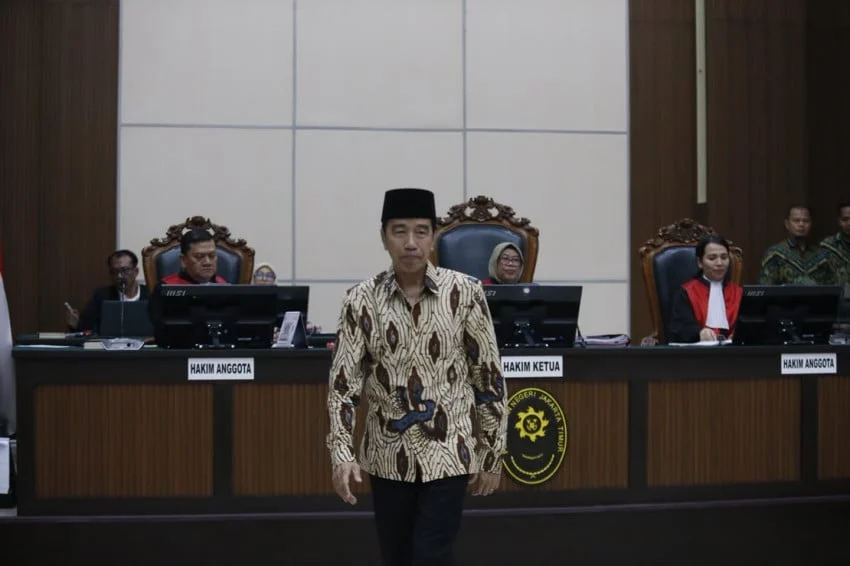
Jakarta – The atmosphere at the East Jakarta District Court reached a point of high tension on Thursday, November 5, 2026, as the seventh President of the Republic of Indonesia, Joko Widodo, appeared to provide testimony in a high-profile defamation and legal dispute involving his academic credentials. The proceedings, which have captivated the nation for months, took an emotionally charged turn when the former head of state publicly addressed the conduct of the defendant, Tifauzia Tyassuma, widely known as Doctor Tifa. During his testimony, Widodo expressed profound indignation, stating that his restraint had been pushed to its limits by the defendant’s decision to involve his deceased parents in a public controversy regarding his educational background.
The confrontation in court marked a significant escalation in the ongoing legal battle that has scrutinized the authenticity of Widodo’s academic history. For the former president, the core of the issue shifted from a matter of political critique to a deeply personal grievance when Tifa allegedly visited the gravesites of his parents as part of her self-styled investigation into his credentials.
Chronology of the Academic Credential Controversy
The saga surrounding Joko Widodo’s educational history began long before his second term ended. It surfaced as a persistent narrative in the digital space, often propagated by critics who questioned the validity of his university degree from Gadjah Mada University (UGM). Despite repeated clarifications from the university’s administration and the presentation of original documentation, the issue remained a focal point for certain activists and commentators.
In early 2024, the situation intensified when legal complaints were formally filed against several figures, including Tifauzia Tyassuma, accusing them of spreading disinformation regarding the president’s academic records. The case progressed through the preliminary stages of investigation, involving forensic experts, document verification, and the examination of digital footprints. By late 2025, the proceedings reached the East Jakarta District Court, where the judiciary began hearing testimonies from both the prosecution and the defense.
The specific incident that triggered Thursday’s courtroom outburst involved the defendant’s actions during the pre-trial phase. Observers noted that Tifa’s public engagement with the resting place of Widodo’s parents was perceived not as a legitimate investigative act, but as a symbolic gesture intended to provoke and intimidate.
The Personal Toll: A Breach of Cultural Norms
During the court session, Widodo delivered a candid account of his reaction to the defendant’s actions. "I am deeply offended and incredibly angry," Widodo stated before the panel of judges. "My parents, my biological mother and father, have been brought into this. They raised me from infancy and worked tirelessly to ensure I received an education. To see them insulted and their memory exploited in this manner is something I cannot accept."
In Indonesian culture, the sanctity of a person’s ancestors and the privacy of their final resting place carry immense social and moral weight. The act of targeting the parents of a public figure is widely viewed as a violation of social ethics, transcending the boundaries of political debate. Legal analysts suggest that by bringing this element to the forefront, the former president effectively shifted the public narrative from a technical dispute over paper documentation to a moral critique of his opponent’s tactics.
Legal Implications and Courtroom Dynamics
The trial of Tifauzia Tyassuma has been marked by a series of unconventional maneuvers that have challenged the decorum of the Indonesian judicial system. Earlier in the proceedings, the defendant’s legal counsel drew widespread criticism for adopting a confrontational and theatrical approach. This included a widely publicized "challenge" for the former president to grow a mustache within two weeks, an act that prompted immediate objections from the Public Prosecutor (JPU).
The prosecution argued that such tactics serve only to derail the judicial process and distract from the central charges: defamation and the dissemination of false information under the Electronic Information and Transactions (ITE) Law. Legal experts point out that while the defense may argue for freedom of expression, the court must weigh these rights against the laws prohibiting the spread of malicious hoaxes and the defamation of individuals.
If found guilty, the defendant could face significant prison time and substantial fines. More importantly, the outcome of this case is expected to set a legal precedent regarding the limits of political speech in the digital age. It poses a vital question for the Indonesian judiciary: at what point does investigative activism cross the threshold into criminal harassment?
Contextualizing the Academic Verification Process
To understand the weight of the former president’s frustration, one must consider the robust verification process that his academic credentials have already undergone. Gadjah Mada University, one of Indonesia’s most prestigious institutions, has repeatedly confirmed the legitimacy of the degree awarded to Joko Widodo in the early 1980s.
In a statement issued during the height of the controversy, the UGM Rector officially affirmed that the university’s records remain consistent with the credentials presented by Widodo. Furthermore, the Indonesian Ministry of Education and Culture has conducted independent audits of university registries to put such claims to rest. Despite these official validations, the "ijazah" (degree) controversy has persisted as a recurring theme among opposition groups, serving as a symbolic weapon rather than a substantive intellectual inquiry.
Broader Societal Impact and Polarization
The spectacle at the East Jakarta District Court reflects the deeper polarization that continues to affect Indonesian civil society. The rise of social media influencers and self-styled investigative journalists has created a landscape where unverified claims can gain significant traction before they can be addressed by legal or academic authorities.
Social commentators suggest that the involvement of families in political disputes is a symptom of a "post-truth" political environment. When facts are insufficient to sway public opinion, proponents of disinformation often resort to personal attacks and the desecration of private memories to elicit an emotional response from their target.
The public reaction to Widodo’s testimony has been mixed, mirroring the existing political divides. Supporters of the former president view his testimony as a dignified defense of his family’s honor. Conversely, some critics argue that the legal pursuit of activists—even those as polarizing as Tifa—risks chilling the environment for legitimate dissent. However, the prevailing legal consensus remains that the right to criticize a public figure does not extend to the harassment of their deceased family members.
The Path Forward: Judicial Finality
As the trial moves toward its conclusion, the focus of the public and the judiciary will shift to the final verdict. The case is being watched closely by civil society organizations, as it touches upon the delicate balance between the freedom to criticize public officials and the legal protections afforded to individuals against defamation and harassment.
The court is now tasked with synthesizing the emotional weight of the testimony provided by the former president with the cold facts of the evidence presented. The defendant’s legal team continues to insist that their actions were part of a pursuit of transparency, yet they have struggled to provide any evidence that contradicts the official records held by the university.
Ultimately, the courtroom drama in East Jakarta serves as a reminder of the fragility of reputations in the digital era. For Joko Widodo, the trial represents a necessary, albeit painful, process of asserting the truth and defending the dignity of his parents. For the Indonesian legal system, it remains a critical test of whether the rule of law can effectively curb the excesses of digital-age populism and restore a sense of decorum to the nation’s political discourse.
The trial is expected to resume next week, with the court scheduled to hear closing statements before deliberations for the final verdict begin. The judiciary’s decision will be a significant indicator of how the Indonesian state intends to handle the intersection of digital activism, personal privacy, and the legacy of its national leaders. As the nation watches, the proceedings serve as a somber reflection on the cost of political polarization and the enduring value of integrity in public life.