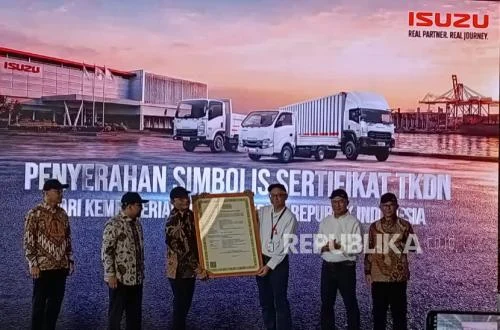
PT Isuzu Astra Motor Indonesia (IAMI) has reached a significant milestone, celebrating the production of its 300,000th vehicle at the Isuzu Karawang Plant in Karawang, West Java. This achievement, accomplished within a decade of the plant’s inception in 2015, underscores Indonesia’s growing importance as a global manufacturing hub for Isuzu’s commercial vehicle segment. The milestone not only marks a substantial production output but also signifies the deepening integration of Indonesian manufacturing capabilities into Isuzu’s worldwide production network, contributing to both the national automotive industry and the global supply chain.
A Decade of Growth and Global Integration
The Isuzu Karawang Plant, established in 2015, has rapidly evolved into a state-of-the-art manufacturing facility, adhering to international standards. Masayasu Hideshima, President Director of PT Isuzu Astra Motor Indonesia, expressed his pride in this accomplishment, highlighting the plant’s transformation. "The production of 300,000 units at the Isuzu Karawang Plant is a pivotal moment in the journey of PT Isuzu Astra Motor Indonesia," Hideshima stated during a ceremony in Karawang on Monday, July 20, 2026. "Since commencing operations in 2015, this plant has developed into a world-class manufacturing facility that is a source of pride for Indonesia and a crucial component of Isuzu’s global production network."
This success is attributed to the collective efforts of numerous stakeholders. Hideshima emphasized, "This achievement would not have been possible without the unwavering support of our customers, the government, our suppliers, our dealer network, and all our employees who have been integral to Isuzu’s journey in Indonesia." This collaborative spirit has been instrumental in navigating the complexities of automotive manufacturing and market demands.
Product Portfolio and Domestic Content Enhancement
The Isuzu Karawang Plant currently manufactures a diverse range of vehicles, catering to various commercial needs. Its production lines are responsible for the Isuzu Traga, Isuzu ELF, and Isuzu GIGA models. Additionally, the plant assembles UD Trucks, specifically the UD Quester and UD Kuzer, further broadening its manufacturing scope and market reach. Among these, the Isuzu Traga has emerged as the highest-volume production model at the facility, reflecting its popularity and demand in the market.
In alignment with the Indonesian government’s push to strengthen the national automotive industry, IAMI has made significant strides in increasing the utilization of locally sourced components. The company has consistently worked to elevate its Local Content Level (TKDN). Currently, the Isuzu Traga boasts a TKDN of 46.45%, followed by the Isuzu GIGA at 38.07%, and the Isuzu ELF at 33.04%. These figures represent a tangible commitment to developing the domestic supply chain.
The rise in TKDN is expected to generate substantial positive impacts for the Indonesian economy. Beyond the direct benefits of job creation within the manufacturing sector and its supporting industries, the increased reliance on local suppliers fosters crucial technology transfer. This process empowers local vendors to enhance their production capabilities and quality control, enabling them to meet the stringent global standards required by Isuzu. This, in turn, contributes to the overall competitiveness of Indonesia’s industrial base.
Export Prowess and Global Market Reach
The Isuzu Karawang Plant is not only a cornerstone for the domestic market but also serves as a vital export hub for Isuzu’s commercial vehicles. Since commencing export activities in 2019, vehicles manufactured in Karawang have been shipped to an impressive network of 25 countries. This global reach includes key markets such as Japan, South Africa, the Philippines, and Panama, demonstrating the quality and competitiveness of Indonesian-made Isuzu vehicles on the international stage.
The successful penetration of these diverse markets is a testament to the plant’s adherence to international quality benchmarks and its ability to meet varied regulatory requirements. The strategic importance of the Karawang facility in Isuzu’s global export strategy is evident in the consistent demand for its products across different continents.
Future Outlook and Commitment to Excellence
Looking ahead, Masayasu Hideshima reiterated Isuzu’s commitment to continuous improvement and expansion. The company aims to further enhance production quality, bolster the competitiveness of Indonesian manufacturing, and expand its export contributions. This will be achieved by developing vehicles that precisely meet market demands and comply with evolving international emission regulations.
"We will continue to improve production quality to meet the needs of both the domestic and export markets, delivering vehicles that our Isuzu Partners require, and complying with the various regulations applicable in each country," Hideshima affirmed. This forward-looking statement signals a proactive approach to innovation and market adaptation, ensuring Isuzu’s continued relevance and leadership in the global commercial vehicle sector.
The Significance of the Milestone
The 300,000-unit production milestone is more than just a numerical achievement; it represents a culmination of strategic investment, technological advancement, and dedicated human capital development. The Isuzu Karawang Plant’s journey from its inception to becoming a key global manufacturing node highlights the potential of Indonesia as a manufacturing powerhouse.
The plant’s establishment in 2015 was part of Isuzu’s broader global strategy to optimize its production footprint and enhance its supply chain efficiency. Indonesia, with its growing economy, a skilled workforce, and supportive government policies for the automotive sector, presented an attractive location for this expansion. The subsequent decade has seen the plant evolve, incorporating advanced manufacturing techniques and contributing significantly to Isuzu’s global output.
The focus on increasing Local Content (TKDN) is a critical element of this success story. It signifies a move towards greater self-sufficiency and a more robust domestic industrial ecosystem. For Indonesia, this translates into not only job creation but also the development of specialized skills and the nurturing of local enterprises capable of meeting international standards. The ripple effect of this local content strategy extends to ancillary industries, fostering a more integrated and resilient automotive value chain.
Economic and Industrial Implications
The sustained growth and production capacity of the Isuzu Karawang Plant have significant economic implications for Indonesia. As a major automotive manufacturing facility, it contributes directly to the country’s Gross Domestic Product (GDP) through its production output and export earnings. Indirectly, it stimulates economic activity through its demand for raw materials, components, and services from local suppliers.
Furthermore, the plant’s success in exporting to 25 countries positions Indonesia as a credible player in the global automotive export market. This not only generates foreign exchange but also enhances the country’s reputation as a reliable source of high-quality manufactured goods. The ability to compete on an international scale is crucial for long-term economic development and diversification.
The continuous efforts to enhance TKDN also play a vital role in reducing the country’s reliance on imported components, thereby improving the trade balance. The transfer of technology and know-how to local suppliers is an invaluable long-term benefit, fostering innovation and raising the overall technological capacity of the Indonesian manufacturing sector. This is crucial for moving up the value chain and ensuring sustainable industrial growth.
Looking Forward: Sustainability and Innovation
As the automotive industry globally shifts towards greater sustainability and embraces new technologies, Isuzu’s commitment to meeting evolving regulations, particularly concerning emissions, is paramount. The company’s proactive approach to adapting its production and product development to comply with international standards, such as Euro 6 or equivalent, will be critical for its continued success in export markets.
The emphasis on "delivering vehicles that our Isuzu Partners require" suggests a customer-centric approach, where product development is driven by market needs and specific operational requirements of businesses that rely on Isuzu’s commercial vehicles. This includes considerations for fuel efficiency, durability, safety, and the integration of digital technologies for fleet management and operational optimization.
The milestone of 300,000 units is a strong foundation upon which Isuzu Astra Motor Indonesia can build. The continued investment in the Karawang Plant, coupled with a strategic focus on local content, export expansion, and technological advancement, is poised to further solidify Indonesia’s position as a key manufacturing hub for Isuzu and a significant contributor to the global automotive landscape. The journey ahead will undoubtedly involve navigating new challenges, but the achievements of the past decade provide a robust testament to the potential and resilience of Indonesian manufacturing.