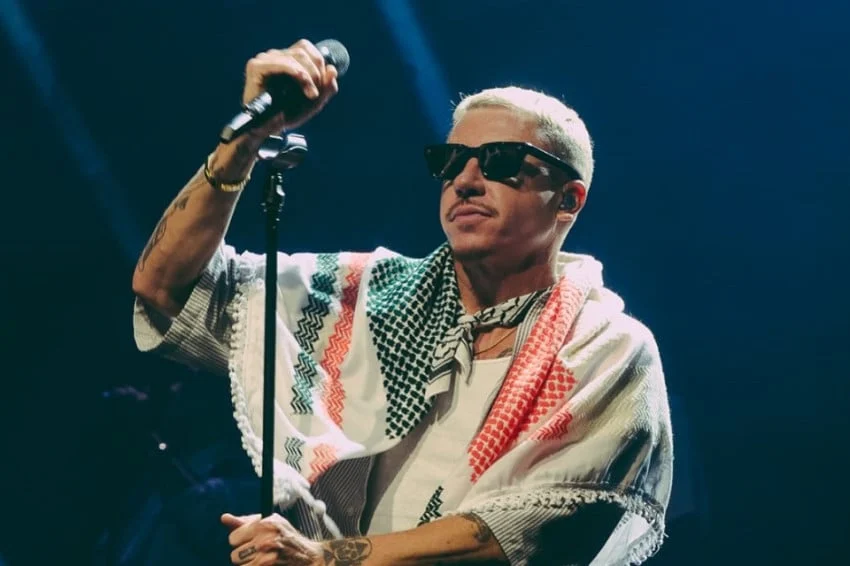
On October 26, 2026, American rapper Macklemore took to the stage at the 3Arena in Dublin, Ireland, for a landmark concert dedicated to the cause of Palestinian liberation. The event, which drew a capacity crowd of 13,000, served as a focal point for international advocacy, blending musical performance with urgent political discourse. The Dublin performance was not merely a concert but a statement of defiance and humanitarian commitment, occurring against a backdrop of increasing scrutiny regarding the intersection of celebrity activism and geopolitical advocacy.
The Context of the Dublin Performance
The Dublin show arrived at a pivotal juncture in the rapper’s career and the broader global discourse surrounding the ongoing conflict in Gaza. Roughly six weeks prior to the Dublin event, Macklemore faced significant professional repercussions for his vocal stance on the Middle East. Reports confirmed that the rapper was removed from a segment of Ed Sheeran’s North American tour, a decision widely attributed to his public expressions of solidarity with the Palestinian cause.
Despite the professional fallout, Macklemore doubled down on his advocacy. The Dublin event was curated to be more than a typical tour stop; it was organized as a mobilization for awareness. The inclusion of high-profile guest appearances—most notably Irish singer-songwriter Hozier and the politically outspoken hip-hop group Kneecap—underscored the event’s significance within the Irish cultural landscape, which has historically maintained a strong affinity for Palestinian human rights movements.
Chronology of Events and Escalation
The trajectory leading to the October 26 concert began months earlier as the humanitarian crisis in Gaza intensified.
- Mid-2026: Macklemore’s public rhetoric regarding the conflict became a central theme of his artistic output, leading to internal tensions regarding his scheduled concert appearances.
- September 2026: Following a series of statements and performances where he explicitly addressed the plight of civilians in Gaza, the rapper was officially dropped from the remaining dates of Ed Sheeran’s tour.
- October 2026: Preparations for the Dublin concert were finalized. The event was marketed as a benefit, with proceeds directed toward humanitarian efforts.
- October 26, 2026: The concert at Dublin’s 3Arena successfully filled all 13,000 seats, demonstrating the sustained public appetite for such advocacy.
Artistry as a Tool for Human Rights
During his set, Macklemore took deliberate steps to clarify the nature of his activism. He addressed the audience with a nuanced appeal, emphasizing that the "Free Palestine" movement, as he advocates for it, is rooted in universal human rights rather than sectarian animosity.
"This is not about hatred," Macklemore told the audience. "This is about the fundamental right to exist, to live without fear, and to raise children in safety. When we talk about liberation, we are talking about dignity for every human being."
His remarks were a direct response to critics who often categorize pro-Palestinian advocacy as being inherently anti-Semitic or exclusionary. By framing the conflict through the lens of human rights—specifically the rights of children and families in conflict zones—the rapper sought to bridge the gap between abstract political discourse and tangible human suffering.
Notable Contributions and Cultural Solidarity
The presence of Hozier and Kneecap on the Dublin stage provided the event with a unique cultural legitimacy. Hozier, an artist who has frequently utilized his platform to address social justice issues, delivered a performance that resonated deeply with the local Irish audience. Similarly, Kneecap, known for their sharp, politically charged lyrics, reinforced the evening’s themes of resistance and social change.
Perhaps the most poignant moment of the evening occurred when actor Mark Ruffalo appeared via a pre-recorded video message. Ruffalo, who has been an outspoken proponent of a ceasefire and humanitarian aid for Gaza, addressed the crowd with a message centered on empathy. The integration of film, music, and spoken word transformed the 3Arena into a space for communal reflection, highlighting the power of celebrity influence in shaping public opinion during periods of global crisis.
Supporting Data and Global Perspectives
The decision to host the event in Dublin is statistically significant. Ireland has consistently polled as one of the most pro-Palestinian nations in the European Union. According to recent Eurobarometer surveys, public sentiment in Ireland regarding the conflict in Gaza reflects a strong majority in favor of diplomatic intervention and humanitarian aid. By choosing Dublin, Macklemore ensured a receptive environment for his message, maximizing the impact of his advocacy.
The economic and logistical success of the concert—selling out a 13,000-capacity venue—suggests that there is a significant demographic of fans who do not perceive an artist’s political stance as a detraction from their entertainment value. On the contrary, for many, the alignment of an artist’s personal values with their own has become a prerequisite for patronage in the modern music industry.
Analysis of Implications
The removal of Macklemore from the Ed Sheeran tour and his subsequent success as a solo activist-performer raises complex questions regarding the professional consequences of political speech.
The "Cancel Culture" Debate
Critics of the move to remove Macklemore from the tour argue that it represents a form of institutional censorship, where corporate interests prioritize neutrality over the personal convictions of their artists. Supporters of the move, however, might argue that tour organizers are entitled to curate their lineups to avoid controversy that could alienate portions of their audience or corporate sponsors.
The Evolution of the "Activist-Artist"
Macklemore’s actions represent a shift in how modern musicians engage with the world. Unlike the protest music of the 1960s and 70s, which often remained abstract or metaphorical, the current generation of artist-activists is utilizing social media and global touring circuits to engage in real-time, specific geopolitical commentary. This approach carries both high rewards—such as the creation of a deeply loyal, mission-driven fanbase—and significant risks, including the loss of lucrative commercial opportunities.
Impact on the Music Industry
The Dublin concert serves as a case study for the industry at large. It proves that there is a viable, high-volume market for artists who take firm stances on humanitarian issues. As labels and concert promoters navigate an increasingly polarized world, the success of the 3Arena event may encourage other artists to be more transparent about their political stances, potentially signaling a move away from the carefully curated "neutrality" that has long dominated the pop music landscape.
Future Outlook
As the conflict in the Middle East continues to evolve, it is likely that the music industry will see more instances of artists using their platforms to express solidarity with one side or another. The success of the Dublin concert demonstrates that such events can act as a catalyst for public engagement, pushing humanitarian concerns to the forefront of the news cycle.
Macklemore’s commitment to his cause, despite the professional cost, indicates that his advocacy is not a temporary trend but a core component of his current artistic identity. For the 13,000 fans who gathered in Dublin, the concert was more than just a musical performance; it was a manifestation of the belief that music can serve as a bridge, a vessel for collective empathy, and a tool for social change in an era defined by deep division.
Whether this trend will result in sustained policy change or remain within the sphere of cultural discourse is yet to be determined. However, the events of October 26, 2026, stand as a testament to the fact that, regardless of the political fallout, artists are increasingly unwilling to remain silent on matters they deem to be of fundamental moral importance. The ripple effects of this concert will likely be felt in future tour bookings, public debates, and the ongoing dialogue between the global music community and the geopolitical realities of the 21st century.