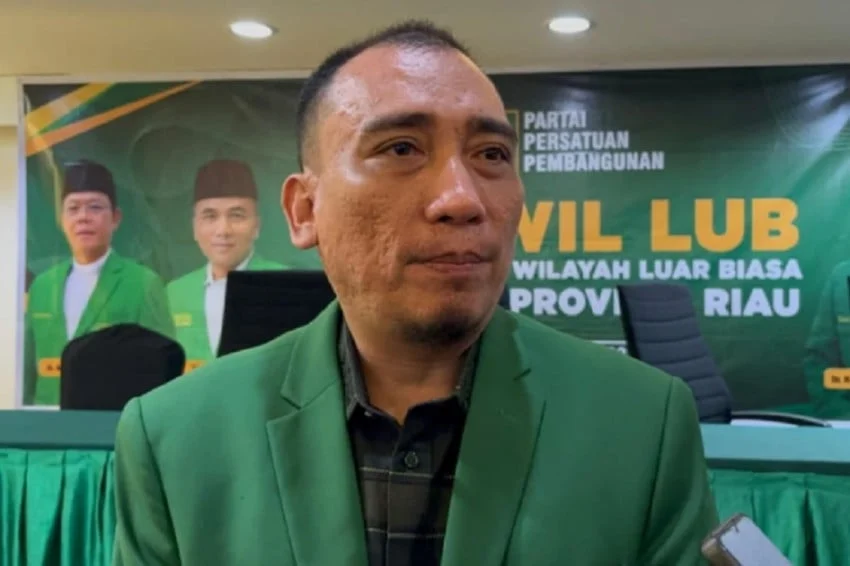
The central leadership of Gerakan Pemuda Kaabah (GPK), a prominent youth wing affiliated with the United Development Party (PPP), has reiterated its unwavering allegiance to the legally recognized central board of the party. This definitive stance was formally articulated by Ikbal Sayuti, Chairman of the Riau Provincial Chapter of GPK, during a press briefing addressing recent internal dynamics within the political organization. The declaration comes at a crucial juncture for the Islamic-based party, as it navigates structural consolidation following a series of legal verifications and administrative transitions recognized by the state.
According to the leadership in Riau, any statements, political maneuvers, or commentary disseminated by individual cadres that deviate from the officially sanctioned institutional position cannot and should not be misconstrued as the official policy of the PP GPK (Central Board of Gerakan Pemuda Kaabah). By drawing a distinct line between personal opinions and institutional mandates, the leadership aims to preserve structural discipline, prevent factional confusion among grassroots supporters, and maintain absolute synchronization with the broader strategic objectives of the parent political party.
Contextualizing the Leadership Alignment and Legal Foundation
The foundational rationale behind the strict adherence of GPK to the central PPP leadership is rooted in formal state administrative recognition. The organizational stance specifically references the outcomes of the Tenth National Congress (Muktamar X) of the PPP, which serves as the supreme decision-making forum of the party. More importantly, this internal consensus is legally reinforced by the Ministry of Law and Human Rights (Kemenkumham) Decree Number M.HH-15.AH.11.02, issued on October 6, 2025. This decree formally validated the structural leadership and administrative legality of the PPP executive board under the stewardship of Muhammad Mardiono as General Chairperson.
In the complex landscape of Indonesian party politics, youth organizations and autonomous wings function as critical mobilization machinery and ideological incubators. Consequently, maintaining clear lines of authority between the parent party and its youth extensions is vital for electoral preparedness and internal harmony. Ikbal Sayuti underscored that the legitimacy granted by the state through the Ministry of Law and Human Rights supersedes any localized or isolated dissent. For GPK, recognizing the official leadership is not merely a matter of political preference, but a strict adherence to the rule of law governing organizational legality in Indonesia.
Chronology of Legal Clarity and Judicial Affirmation
The reaffirmation of GPK’s stance arrives on the heels of a definitive judicial process that resolved months of internal leadership contestation within the PPP. The legal journey to cement the current leadership structure involved significant administrative hurdles and courtroom battles.
Throughout 2024 and 2025, the internal governance of the PPP faced challenges regarding the exact adherence to party statutes and procedural requirements during leadership transitions. These disputes eventually entered the state administrative court system. The primary legal milestone in this trajectory was achieved when the State Administrative Court (PTUN) delivered a verdict upholding the validity of the government decrees recognizing the Mardiono-led leadership.
The legal certainty was further fortified shortly before the current administrative statements were emphasized, when the Jakarta High State Administrative Court (PTTUN Jakarta) issued a decisive ruling. The appellate court officially strengthened the previous PTUN decision, formally declaring the legal validity of the Ministry of Law and Human Rights Decree concerning Muhammad Mardiono’s legitimate status as the General Chairperson of the PPP. This judicial closure effectively neutralized competing claims to the party leadership, providing a robust legal bedrock upon which affiliated organizations like GPK could anchor their operational and structural loyalty.
Addressing Unauthorized Statements and Personal Agendas
A core concern driving the recent public statements by the Riau GPK leadership is the potential distortion of organizational messaging by rogue or disaffected members. In political ecosystems, individual actors frequently utilize organizational titles to lend unwarranted weight to personal political ambitions, factional disagreements, or opportunistic bargaining chips.
Ikbal Sayuti was explicit in warning all members against exploiting the revered name of the organization for individual or private gains. He emphasized that in an era characterized by rapid information dissemination through digital media and social platforms, unverified statements made by unauthorized individuals can inflict disproportionate reputational damage on the collective body. When a cadre speaks to the media without institutional authorization, the public and media stakeholders may mistakenly attribute those views to the entire organization.
To mitigate this risk, the central and regional leaderships have stepped up internal communication protocols. Members are reminded that institutional discipline is paramount. Freedom of expression within political parties must be balanced against the collective responsibility to protect the organization’s integrity, especially during periods when unity is required to face upcoming electoral cycles and policy advocacy challenges.
Broader Implications for PPP and Allied Youth Wings
The firm stance exhibited by GPK Riau carries significant strategic implications for the broader United Development Party ecosystem. As one of Indonesia’s historical political entities rooted in Islamic values, the PPP has historically relied on a cohesive network of autonomous wings—ranging from youth organizations like GPK to women’s associations and religious scholar networks—to maintain its grassroots connection.
- Organizational Solidification: By publicly aligning with the legally recognized central board, regional youth chapters create a unified front that discourages splinter factions. This solidarity is essential for internal peace, allowing the party apparatus to redirect its energy from internal squabbles toward external constituency building.
- Electoral Readiness: With national and regional political calendars requiring continuous mobilization, organizational stability is a non-negotiable prerequisite. Coordinated messaging ensures that potential voters, coalition partners, and constituents perceive the party as disciplined and reliable.
- Precedent for Other Wings: The decisive approach taken by GPK sets a benchmark for other autonomous and semi-autonomous bodies within the PPP sphere. It signals that deviations from the central executive line, especially those lacking legal or procedural backing, will be swiftly identified, isolated, and publicly disowned by responsible organizational leaders.
Analytical Overview of Internal Party Dynamics
Political analysts observing the trajectory of religious-nationalist and Islamic-based parties in Indonesia frequently note that internal fractionalization remains one of the most significant vulnerabilities facing political longevity. When legal disputes arise over party leadership, the friction invariably cascades downward into youth wings, student associations, and regional branches.
The proactive stance demonstrated by Ikbal Sayuti and the broader leadership of GPK illustrates a modern approach to organizational risk management. By tying their internal compliance directly to state-issued administrative decrees—specifically the Ministry of Law and Human Rights framework—they establish an objective, verifiable standard of legitimacy. This strategy minimizes the space for subjective ideological disputes or personality-driven splits, as adherence to the law provides a clear, indisputable boundary between official institutional policy and unauthorized personal opinion.
Furthermore, this episode highlights the evolving maturity of political youth wings in Indonesia. Rather than rushing into emotional or reactionary positions during leadership transitions, contemporary youth leaders increasingly rely on legal certainty, statutory alignment, and institutional hierarchy to navigate complex political terrain.
Conclusion and Future Outlook
As Gerakan Pemuda Kaabah continues to consolidate its structures across various provincial chapters, the emphasis on discipline, legal compliance, and unified messaging remains central to its operational philosophy. The clear demarcation drawn by the Riau leadership between official organizational policy and individual commentary serves as a cautionary tale for those attempting to bypass institutional channels for personal or factional advantage.
Moving forward, the primary focus for GPK and the wider PPP apparatus is expected to shift entirely toward constructive political engagement, consolidation of grassroots support bases, and preparation for future democratic contests. By resolving internal uncertainties through adherence to judicial verdicts and administrative decrees, the organization has positioned itself to move forward with renewed focus, administrative clarity, and collective solidarity.