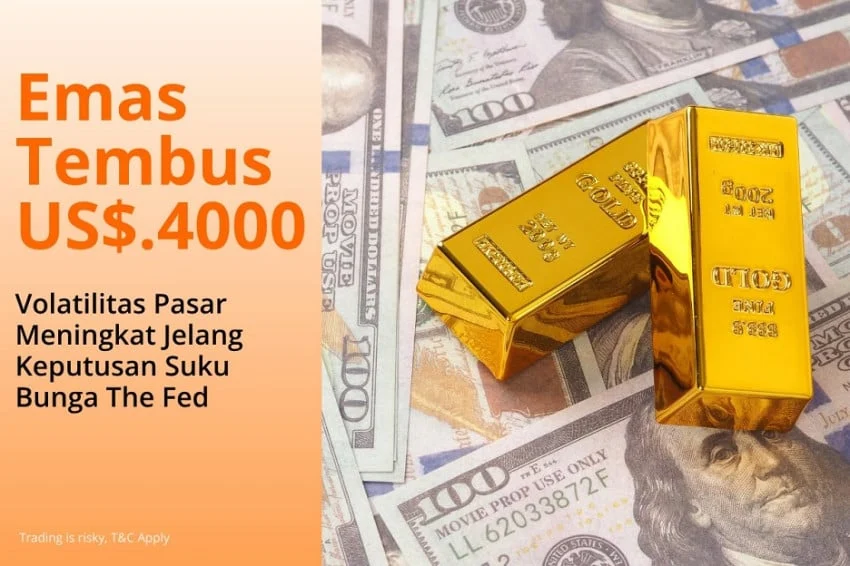
Global gold prices have once again captured the intense focus of international markets after experiencing a notable retreat that briefly pushed the precious metal below the critical psychological threshold of USD4,000 per troy ounce. This sudden price correction unfolded against a backdrop of escalating financial uncertainty and cautious trading behavior across major exchanges worldwide, as investors anxiously position themselves ahead of the crucial monetary policy meeting hosted by the United States Federal Reserve (The Fed) scheduled for October 27–28, 2026.
The recent movement in the commodities market highlights the delicate equilibrium currently governing global asset valuations. Precious metals, long utilized as a traditional safe-haven asset during periods of economic turbulence, are facing renewed selling pressure and heightened intraday swings. Market participants are closely monitoring macroeconomic data releases, shifting currency valuations, and evolving central bank rhetoric to gauge the trajectory of borrowing costs and inflation over the medium term.
Market Volatility and Broader Financial Indicator Shifts
Beyond the immediate price action observed in the physical and futures gold markets, broader financial indicators are signaling a pronounced shift in risk sentiment. Notably, the Chicago Board Options Exchange (CBOE) Volatility Index—commonly referred to as the VIX or the market’s "fear gauge"—surged past the key threshold of 20 during the trading session on Friday, October 23, 2026.
This technical breach above the 20-point mark serves as a strong market signal. It indicates a substantial elevation in expected stock market volatility within the United States over the near term. Historically, a VIX reading above 20 reflects heightened anxiety among equity investors, often triggering cross-asset portfolio rebalancing. In such environments, institutional investors frequently liquidate profitable positions—including holdings in gold and other commodities—to cover margin calls or reallocate capital into high-yield, short-term sovereign debt instruments. Consequently, the spike in the VIX played a contributing role in the sudden downward pressure experienced by gold prices as liquidity demands temporarily overshadowed long-term hedging strategies.
Chronology and Context of the Pre-Meeting Market Dynamics
The weeks leading up to the late-October 2026 Federal Reserve meeting have been characterized by persistent speculation regarding the central bank’s next policy moves. Throughout the third quarter of 2026, gold had maintained a robust upward trajectory, driven by persistent geopolitical tensions, robust central bank accumulation, and lingering concerns over global fiscal deficits.
However, as the calendar turned to October, incoming macroeconomic data from the United States painted a mixed picture of the world’s largest economy. Labor market reports showed unexpected resilience, while consumer price inflation figures proved stickier than anticipated by consensus forecasts. These economic indicators prompted a reassessment of the interest rate outlook among Wall Street analysts and institutional traders.

By mid-October, market consensus began shifting away from aggressive monetary easing toward a more cautious, data-dependent stance by the U.S. central bank. This shift directly impacted bond yields, with the benchmark U.S. 10-year Treasury yield moving higher. As sovereign bond yields crept upward, the opportunity cost of holding non-yielding assets such as gold increased significantly, creating an immediate headwind for the precious metal and culminating in the brief dip below the USD4,000 per troy ounce milestone just days before the Federal Open Market Committee (FOMC) convened.
The Mechanics of Central Bank Policy and Gold Valuations
To fully comprehend the forces driving the recent gold market correction, it is essential to examine the fundamental relationship between monetary policy, macroeconomic variables, and precious metal valuations. The Federal Reserve’s benchmark interest rate serves as the foundational anchor for global borrowing costs.
When market expectations lean toward higher-for-longer interest rates, fixed-income instruments like U.S. Treasury bonds and certificates of deposit offer attractive, risk-free returns. This dynamic typically reduces the relative appeal of gold, which generates no interest or dividends and incurs storage costs. Conversely, an environment characterized by anticipated interest rate cuts diminishes the appeal of fiat-denominated yield-bearing assets, thereby redirecting capital flows toward bullion as a preservation of purchasing power.
Beyond interest rate expectations, the valuation of gold is inextricably linked to the strength of the United States dollar (USD) and global geopolitical stability. A strengthening greenback makes dollar-denominated commodities more expensive for holders of other currencies, dampening physical demand in major consumer markets such as India and China. Furthermore, fluctuating sovereign debt dynamics and ongoing structural shifts in central bank reserve management—including the repatriation of gold reserves by various nations from foreign depositories—continue to introduce complex structural currents beneath the daily price movements.
Implications for Global Investors and Future Market Outlook
The recent volatility in gold prices and the concurrent rise in equity market uncertainty present both challenges and strategic opportunities for institutional and retail investors alike. Financial analysts emphasize that while short-term price dips below psychological barriers can induce panic selling among leveraged retail traders, institutional portfolio managers often view such corrections through a broader strategic lens.
As the Federal Reserve concludes its deliberations and issues its official policy statement alongside economic projections, market participants will parse every word from central bank leadership for clues regarding the terminal rate and the timing of future policy adjustments. Any indication of an unexpectedly hawkish stance could prolong the consolidation phase for gold, testing lower support levels. Conversely, a dovish pivot or acknowledgment of economic softening could quickly reignite safe-haven demand, propelling gold back above the USD4,000 threshold and re-establishing its upward momentum.
Ultimately, the events of late October 2026 underscore the intricate interconnectedness of global financial architecture. As macroeconomic data continues to evolve in real-time, risk management, asset diversification, and a nuanced understanding of central bank signaling remain paramount for navigating an increasingly volatile global marketplace.