The Indonesian National Police (Polri) has officially concluded a high-stakes ethical trial against Inspector General (Irjen Pol) Ahrie Sonta, resulting in his dishonorable discharge from the force. The decision, delivered by the Police Code of Ethics Commission (KKEP), marks a significant disciplinary action within the upper echelons of the institution, centered on allegations of illegal wiretapping targeting President Prabowo Subianto. The verdict of Pemberhentian Tidak Dengan Hormat (PTDH)—or dishonorable discharge—reflects the severity with which the state security apparatus treats unauthorized surveillance of the nation’s highest official.
The KKEP Verdict and Disciplinary Proceedings
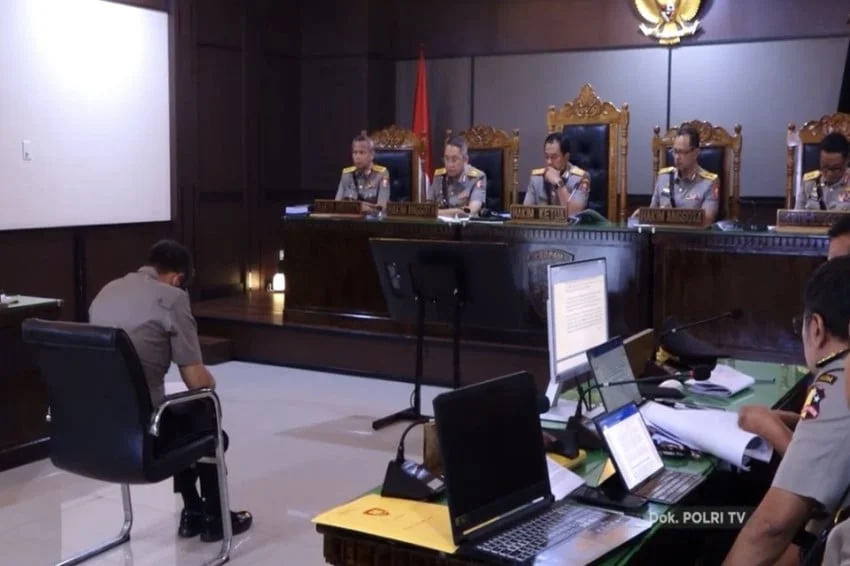
The KKEP trial, which took place on Tuesday, November 10, 2026, was an exhaustive legal marathon that began at 09:00 WIB and concluded at 20:10 WIB. During the proceedings, observers noted a visibly somber Ahrie Sonta, who remained head-bowed as the evidence of his professional misconduct was presented.
The commission was chaired by a high-ranking officer, Commissioner General (Komjen Pol) Rudy Darmoko, signaling the gravity of the case. He was supported by Deputy Chairman Irjen Pol Roma Hutajulu and a panel of three additional senior officers: Irjen Pol M. Zulkarnain, Irjen Pol Jayadi, and Irjen Pol Rahmat Setyadi.
In a press briefing following the conclusion of the session, the Head of the Public Relations Division of the National Police, Irjen Pol Johnny Eddizon Isir, confirmed the outcome. He stated that the investigation unequivocally established that Ahrie Sonta, while serving as the Acting Head of the Monitoring Center at the Bareskrim Polri (Criminal Investigation Agency), utilized his authority to conduct illegal wiretapping. This breach of protocol constitutes a severe violation of the Police Code of Ethics, as it undermined the security of the presidency and bypassed established legal oversight protocols.
Chronology of the Scandal
The investigation into Ahrie Sonta’s conduct did not emerge in a vacuum. The timeline leading up to the PTDH decision suggests a long-term internal inquiry conducted by the Police’s Internal Affairs Division (Propam).
- Early 2026: Initial reports began circulating regarding anomalies in the communications security protocols surrounding the President. Internal intelligence units identified unauthorized data intercepts originating from the Monitoring Center at Bareskrim.
- Mid-2026: Following a preliminary review, Ahrie Sonta was reassigned from his post to allow for an unhindered investigation into his digital activities.
- Late 2026: Forensic evidence was consolidated, linking the technical infrastructure under Sonta’s command to the illegal surveillance of the President’s private communication lines.
- November 10, 2026: The formal KKEP trial was held, resulting in the immediate dishonorable discharge of Sonta from the Indonesian National Police.
The case gained significant public attention due to Sonta’s reputation as one of the youngest and most promising two-star generals in the force. His swift rise through the ranks had made him a prominent figure in police operations, making his sudden downfall a matter of intense public discourse and institutional concern.
Analysis of the Illegal Wiretapping Operation
The charges against Sonta center on the misuse of the "Monitoring Center" under the Robinopsnal (Operational Development Bureau) of Bareskrim. This unit is tasked with tracking high-level criminal networks, including transnational organized crime, money laundering, and digital terrorism. By repurposing these high-tech capabilities to target the President, Sonta compromised the integrity of the state’s most sensitive investigative division.
Legal analysts point out that wiretapping in Indonesia is governed by strict regulations, most notably the Electronic Information and Transactions (ITE) Law and specific internal police regulations. Any interception must be backed by a court warrant and a legitimate criminal investigation, with oversight from the Prosecutor’s Office. The investigation concluded that Sonta operated outside these parameters, effectively turning the agency’s sophisticated surveillance tools into an instrument of personal or rogue intelligence gathering.
The Role of Institutional Oversight
The participation of a three-star general as the head of the ethics committee highlights the urgency for the National Police to restore public confidence. In the wake of the scandal, the Police leadership has faced mounting pressure to explain how such a breach was possible within a highly centralized security agency.
Official responses from the National Police Headquarters indicate a commitment to a "clean-up" operation. Irjen Pol Johnny Eddizon Isir emphasized that the force maintains a zero-tolerance policy for actions that jeopardize national stability. "The KKEP process is a reflection of the institution’s commitment to internal accountability," Isir noted. "Regardless of rank or position, any officer found violating the fundamental oath of service to the state must face the consequences dictated by our code of ethics."
Broader Implications for the Indonesian National Police
The dismissal of an officer of Sonta’s stature carries several implications for the future of the Indonesian National Police:
- Systemic Security Audit: The incident has prompted an immediate audit of the monitoring systems used by the Bareskrim and other divisions. The police are likely to implement stricter multi-factor authorization and real-time auditing of all surveillance activities to ensure that no single officer can bypass oversight mechanisms.
- Political Stability and Executive Trust: The fact that the President was the target of illegal surveillance has created a ripple effect in political circles. This has necessitated a review of how the police interact with the executive branch, with calls from legislative oversight committees for increased parliamentary monitoring of police intelligence operations.
- Institutional Morale: For the rank-and-file officers, the incident serves as a stark warning regarding the boundaries of operational authority. The trial has been used by the current police leadership as a case study to reinforce the importance of the professional code of ethics during training sessions for high-ranking officers.
- Legal Follow-up: While the KKEP trial concludes the administrative aspect of the case, it does not necessarily preclude criminal proceedings. Depending on the findings regarding potential treason or subversion, Sonta could face further prosecution in a civilian court, which could lead to imprisonment, further stripping him of his pension and social status.
Public and Expert Reaction
The public, through various media platforms and civil society organizations, has expressed mixed reactions. While many applaud the swift justice as a sign of transparency, others have questioned how a high-level official was able to operate under the radar for an extended period.
Security experts suggest that this case represents a "necessary surgery" for the National Police. By excising an officer who utilized state-sanctioned technology for illicit purposes, the institution is attempting to signal to the public that it is capable of self-correction. However, experts also warn that unless the systemic flaws that allowed for this level of unauthorized access are addressed, the risk of similar incidents remains high.
Moving Forward
The case of Irjen Pol Ahrie Sonta will undoubtedly be recorded as a landmark disciplinary event in the history of the Indonesian National Police. As the institution navigates the fallout, the focus will shift toward the administrative overhaul of its digital surveillance bureaus.
The decision to dishonorably discharge an officer of such high rank underscores the reality that in the modern era of statecraft, the protection of the presidency is not only a matter of physical security but also of digital integrity. As the legal proceedings transition from internal ethics hearings to potential criminal investigations, the National Police remains under the scrutiny of both the public and the state. The ultimate resolution of this case will serve as a bellwether for the independence and the integrity of Indonesia’s security apparatus in the years to come.